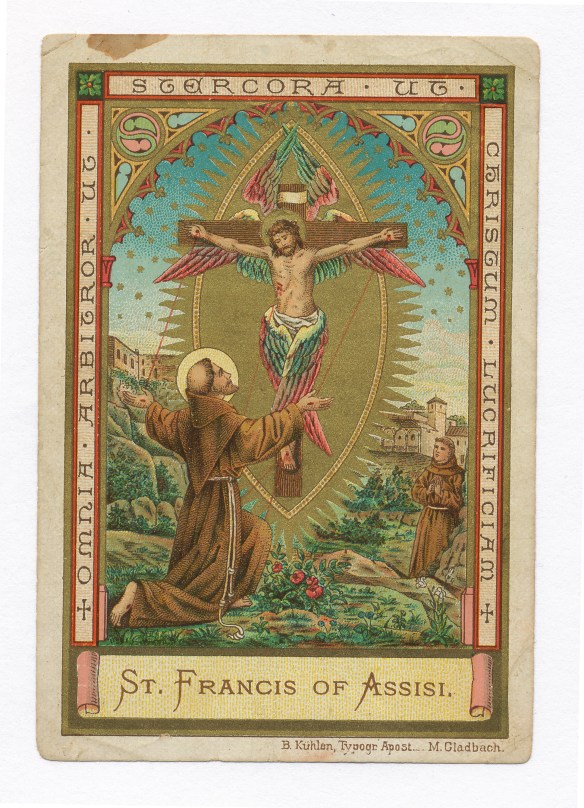
Feast of Saint Francis of Assisi

St. Francis of AssisiReviled, ridiculed, and considered a raving madman by his contemporaries, Francis of Assisi turned his back on the comfortable world of his birth to revitalize the message of Christ. By the time of his death, his holiness was universally recognized and he had shaken the staid convictions of church and political officials to their core. Today, his simple message of love for God, the earth, and all its creatures makes him revered by Catholics and non-Catholics alike. 

Born Giovanni Bernadone in the prosperous hill town of Assisi, he was a spoiled and indulged young man given to dressing well, playing pranks, and carousing with friends. The son of a wealthy cloth merchant, he was nicknamed Francesco (“The Frenchman”) because of his French mother. On a boastful lark at the age of twenty, he fought in a minor war against the neighboring town of Perugia. Everything changed when the enemy captured him and he spent a year in prison. When his father finally ransomed him home, Francis was ill with malaria and debilitated. Forced to endure months of quiet bed rest in order to recover, he found it hard to resume his old ways. Neither his friends nor his father’s business held much interest for him. 

In an effort to regain his former life, Francis made an attempt to fight for the Papal States under Walter de Brienne. Equipped with the finest armor, he met a shabbily clad knight along the way and on a whim exchanged clothes with him. That night in a dream, a voice told him to turn back and serve “the Master rather than the man.” After his father and friends ridiculed him for his desertion, he roamed the countryside alone in a state of spiritual crisis. One day, as he was wandering, Francis came upon a leper and was initially revolted by his sores. However, instead of turning away, Francis leapt from his horse, gave the leper all his money, and then kissed his hand. Thus began what Francis later called his conversion. It also began his daily ritual of visiting hospitals and leper colonies and meditating in the crumbling church of San Damiano.

Just beyond the walls of Assisi, San Damiano had been deserted by the town’s faithful and was tended by a single elderly priest. In 1205, while Francis was praying in front of the crucifix, he heard a voice, “Go, Francis, and repair my house which as you see, is falling into ruin.” Looking around at the decaying structure, Francis interpreted this request literally. He hurried to his father’s shop, bundled up as much fabric and drapery as he could carry, and sold it in the marketplace in order to buy building supplies. His father was furious and dragged him to the city consuls, not only to recover the money for the fabric but to force Francis to denounce his inheritance as well. At this meeting, Francis insisted that he was a servant of God and should not be judged by a civil court. He relinquished the gold and stripped himself of all his belongings. Handing them to his father he said, “From now onwards, I can turn to God and call him my father in heaven!” He left Assisi dressed in the garments of a hermit. 

Although he was now penniless, Francis was still intent on keeping his promise to rebuild San Damiano. He begged for stones and alms in the street, and the townfolk considered him a madman. He did eventually complete his task and Francis went on to repair other churches, including Santa Maria degli Angeli, known as the Porziuncola. Considered by Francis to be “one of the holiest places on earth,” this little chapel was originally erected in 353 by hermits from the Valley of Josaphat. It housed relics of the Virgin Mary and became known as Our Lady of the Angels because people reported hearing the sound of singing angels coming from inside at night. Francis, who had a deep connection to the Virgin Mary, built himself a hut near her church and would pray for her intercession in giving him earthly direction. On February 24, 1209, while at mass, he heard the Gospel of Matthew 10:9, where Jesus told his followers, “And going, preach, saying The Kingdom of Heaven is at hand . . . Freely have you received. Freely give. Take neither gold nor silver nor brass in your purses . . .nor two coats, nor shoes nor a staff . . . Behold I send you forth as sheep in the midst of wolves . . .” 

Stricken to the core, Francis immediately cast off what few possessions he had until he was dressed only in the coarse woolen tunic of the poor. He set out to Assisi to preach penance, brotherly love, and peace. His manner was so warm and sincere that, instead of scoffing at him, people listened with fascination to what he had to say. Here before them was the most Christlike man they had ever seen. The Porziuncola filled with his followers. By the end of that year, a small community of eleven men was following Francis and the simple Rule he wrote adapting the precepts of the gospel. 

In the summer of 1210, Francis and his companions traveled to Rome to seek the blessing of the pope for this new order of Friars Minor. Papal ecclesiastical advisers declared that the Rule of the Order, though taken solely from Christ’s command, was impractical and unsafe, and Francis’s request was rejected. That night Pope Innocent III had a dream in which Francis was holding up the Lateran Church with his shoulder. The next morning the pope immediately requested an audience with Francis and approved his mission. Upon the Friars’ return to Umbria, the Benedictine Order attempted to give them the Porziuncola for their monastery. Francis only accepted the use of the property. He strongly felt that their Order must always live in holy poverty, never owning anything. Even their name, Friars Minor (Little Brothers) reminded the men to never exalt themselves above anyone. 

The first Friars Minor traveled throughout Italy, joyfully preaching by day and sleeping in haylofts at night. Forbidden to take money, they supported their mission by working with laborers in the fields or begging for their meals. Having proved themselves adept at local peacemaking and sowing contentment, many of the Italian city-states invited them to preach and set up small communities within their borders. Missions were sent to Spain, Germany, Hungary, and France. Without trying to be revolutionaries, Francis and his followers completely changed the way the Church reached people. Because he truly believed that all of nature was wondrous and all creatures sacred to God, Francis introduced a new way of looking at the world, one accessible to rich and poor alike. His order attracted a socially diverse group of men and spawned an affiliated women’s order with Saint Clare of Assisi. He later drew up a rule for laity who desired to associate themselves with the Friars Minor. This order of Franciscan Tertiaries, or the Third Order of Saint Francis, exists today with worldwide membership from the Catholic, Episcopal, and Anglican Churches. Just as they did under Francis, members continue to follow the rules of humility, charity, and voluntary poverty. 

Francis was a true mystic. It was said that birds would quiet down and listen when he preached, and there are many tales of his ability to communicate with animals. When the citizens of Gubbio were being terrorized by a man-eating wolf, for example, Francis went up in the hills to find it. Upon seeing the vicious animal, he made the sign of the cross and invited the wolf to come to him. The wolf docilely lay at his feet, and Francis drafted a pact between the wolf, and citizens of Gubbio; in exchange for being regularly fed by the town, the wolf would leave its residents in peace. Both sides agreed, and Gubbio was freed from this menace. 

Francis’s life of sacrifice and self-deprivation put an incredible strain on his body. When he prayed, the light he saw in his raptures was so intense that it caused him to continuously weep. His followers feared for his eyesight, but he said he could not resist being in the presence of such a brilliant light. His devotions became more and more extreme and in August of 1224 Francis retired to the secluded mountain of La Verna for a forty-day retreat before the Feast of Saint Michael. He devoted most of his meditations to the wounds and suffering of Christ. At dawn on September 14, after a night of prayer, he had a vision of a Seraphim angel, nailed to a cross, flying at him. When the vision vanished, his body bore the stigmata of the crucified Christ. He bore these markings in secrecy for the last two years of his life. They were visible upon his death in October 1226.  

The contributions of Francis of Assisi were not limited to religion. A great writer and poet, he wrote “Canticle of the Sun,” his masterpiece inspired by Saint Clare, in his native Italian. Writing in a language other than Latin was uncommon at the time, and it set the groundwork for the poetry of Dante Aligheri, a great admirer of Francis. Publicly acclaimed as a saint in his own lifetime, Francis of Assisi led one of the most documented lives of the Middle Ages. Within decades of his death, there were numerous biographies written by his followers. Perhaps the greatest memorial to this saint is the Basilica of Saint Francis, commissioned by the city of Assisi two years after his death. Considered one of the most important monuments of Europe, Giotto, Cimabue, and Simone Martini, the greatest artists of their day, decorated the interior with scenes from the saint’s life. Assisi itself exudes such an air of peace and love from having the presence of such a graceful being in its midst that it remains an important site for pilgrims devoted to the memory and teachings of Il Poverello (“The Little Poor Man”) known as Saint Francis.

Blessing of Saint Francis of Assisi

May the Lord bless you

and keep you;

may the Lord show his face to you

and have compassion on you!

May he turn his face to you 

and give you peace!

Amen.

St. Francis of Assisi 1182 – 1226

Saint Francis of Assisi
“Lord make me an instrument of they peace, where there is hatred
let me sow love.”
Patron of: Ecologists

Love for God and everything in creation so consumed St. Francis of Assisi, that he was able to commune with the natural world on a divine level. Taming wolves, quieting flocks of birds and infusing peace and contentment to the humanity he interacted with, we call on Francis of Assisi to bring us into the harmonious rhythms of the universe, where all of nature and mankind are at one with the divine force of creation. An unlikely mystic, Francis was born Giovanni Bernadone in the town of Assisi. His father, a proud member of the upper classes was a wealthy cloth merchant married to a woman from Provence. Because he frequently conversed in French with his mother, Giovanni was soon known as “Francesco” or “the Frenchman” by his friends and neighbors. Confident that his son would follow in his footsteps, the elder Bernadone indulged and catered to Francesco’s every whim and the youth enjoyed a pleasure filled existence in the company of others in his social caste. On a lark he set off with friends to take part in a war with Perugia. Much to his shock, he was taken prisoner and it took his family a year to ransom him back. Upon his return, he was bedridden and seriously ill. But in recovering his health, Francesco seems to have lost his identity. He suffered a great spiritual crisis as all interest in his old life and his father’s business waned and disappeared. While wandering the countryside he stopped into the deserted church of San Damiano and heard the crucifix say to him, “Francis, go and repair my house, which you see is falling down.” Happy to have some direction in his life, he took the request literally and began rebuilding the structure with his bare hands. Ultimately, his father disowned him and when Francis, renouncing his inheritance threw his clothing in the street, he donned the simple brown garment given him by the Bishop of Assisi.

Begging for supplies, Francis continued his work on San Damiano. Eventually he was joined by other disenchanted young men looking for a higher meaning in life. By simply following the exact tenets of Christ, this little band of friars, never owning anything, bartering labor for food and shelter began a movement of religious seekers that revolutionized the Church by the simple and loving way they spread the gospel. Instead of writing in church Latin he used colloquial Italian and in an effort to explain the story of Christ’s birth, he created a living tableau of animals and people – the first Christmas crèche.

A great poet and mystic, Francis was the first saint to receive the stigmata while in a meditative rapture. Filled with humility and though he founded one of the world’s greatest religious orders, Francis of Assisi was never ordained a priest. Upon his death he requested to be buried in the cemetery for criminals, but the people of Assisi so loved him that they took his body and interred it under the altar of their great cathedral.

Just as popular with nonCatholics as Catholics, Francis has inspired great artists, composers and writers. Assisi, Italy remains a great pilgrimage site for those wishing to pay him tribute.

Prayer

O Beloved Saint Francis, gentle and poor, your obedience to God, and your simple, deep love for all God’s creatures led you to the heights of heavenly perfection and turned many hearts to follow God’s will. Now in our day, in our ministry to the many who come here searching for peace and intercede for us we come before the Lord with our special requests…

Mention your special intentions here.

O Blessed Saint of God, from your throne among the hosts of heaven, present our petitions before our faithful Lord. May your prayers on our behalf be heard and may God grant us the grace to lead good and faithful lives.
Amen
Saint Francis of Assisi, pray for us.

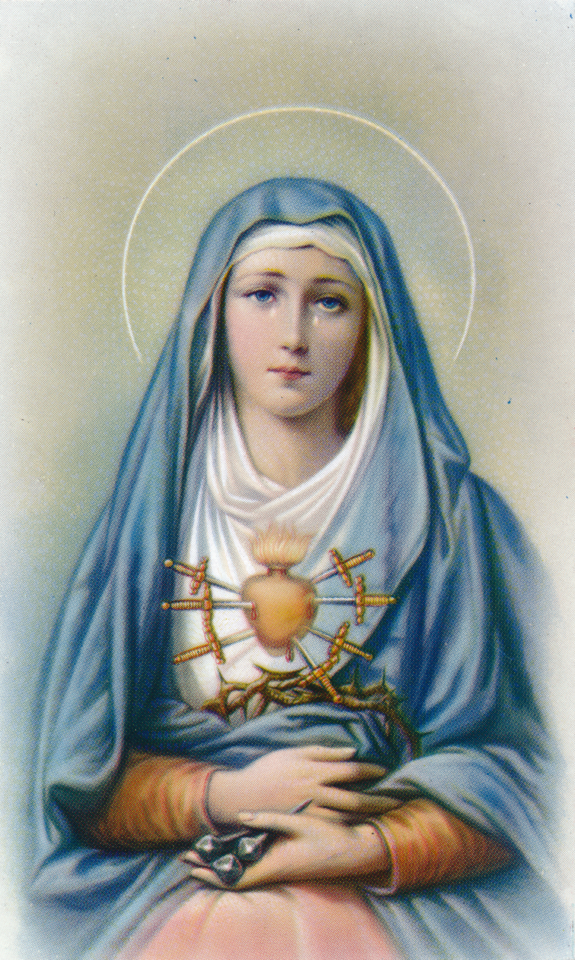
Mother of Sorrows

FullSizeCard_1@2x
Feast Day; September 15
“And you yourself shall be pierced with a sword – so that the thoughts of many hearts may be laid bare.”
Luke 2:34-35

When we are overwhelmed with grief, we turn to Mary, Mother of Jesus for help in our suffering. Throughout her life she endured much pain and sorrow and is fully able to empathize with anyone’s personal anguish. She endured the shame of being pregnant and unmarried, being poor, homelessness and having her only son unjustly imprisoned and executed. Most astonishing, Mary knew what was to befall her son yet had to see these events from God’s point of view and have faith that this was all for the good of mankind.

By meditating on the Seven Sorrows of Mary, a devotion from the Middle Ages, which uses scenes from the life of the Virgin Mother as a meditation on accepting the sorrowful part of life with grace.

The Seven Sorrows of Mary are:
1) The Prophecy of Simeon. As a young child, when his parents presented him in the temple, Jesus was met by the holy man Simeon who predicted everything that would happen to him in his address to Mary: “Behold, this child is destined for the fall and rise of many in Israel, and to be a sign that will be contradicted – and you yourself a sword will pierce so that thoughts of many hearts will be revealed.” (Luke 2:34-35).
2) The Flight into Egypt. In Bethlehem, after the birth of Christ, Joseph had a vision of an angel warning him of the impending slaughter of any male child under the age of two by King Herod in order to prevent the coming Messiah. The Holy Family had to travel a secretive route to Egypt and remain in that country until Herod died. Mary not only worried for the welfare of her own son but mourn for the murdered children left behind.
3) The Loss of the Child Jesus in the Temple. While on a pilgrimage to Jerusalem, the 12 year old Jesus vanished from his family. His heartsick parents finally found him three days later, arguing with elders in the temple.
4) The Meeting of Jesus with His Cross. Mary watched helplessly as her son was ridiculed and mocked as he stumbled, carrying the cross he was to be executed on.
5) The Crucifixion. As he was nailed to the cross, most of his disciples ran away. Mary never wavered as she stood at the foot of the cross, witnessing her son’s agony and death.
6) Jesus Taken Down from the Cross. Mary held her dead son’s wound covered body. This, her greatest sorrow is known as the “Pieta”.
7) The Burial of Jesus. As the stone was rolled, closing up his tomb, Mary had to say her final goodbye to her earthly son. Her faith had to be sincerely tested as there was no hint of the resurrection to come.

Novena
Most holy and afflicted Virgin, Queen of Martyrs, you stood beneath the cross, witnessing the agony of your dying son. Look with a mother’s tenderness and pity on me, who kneel before you. I venerate your sorrows and I place my requests with filial confidence in the sanctuary of your wounded heart.

Present them, I beseech you, on my behalf to Jesus Christ, through the merits of his own most sacred passion and death, together with your sufferings at the foot of the cross. Through the united efficacy of both, obtain the granting of my petition. To whom shall I have recourse in my wants and miseries if not to you, Mother of Mercy? You have drunk so deeply of the chalice of your son, you can compassionate our sorrows.

Holy Mary, your soul was pierced by a sword of sorrow at the sight of the passion of your divine son. Intercede for me and obtain from Jesus
(mention your request)
if it be for his honor and glory and for my good. Amen.


Women in Monastic life

6a21f0cfc30f69e020fcd0de044fe169The Poor Clares nuns in choir. The order was founded by Saint Clare
Early Christian monasticism in the East and the West sprang from the vitality of the local Churches. In the course of time, individuals responded to God’s call in particular distinctive ways, diverse ecclesial situations arose and, as a consequence, monasticism developed a rich and varied character :

The cenobitic life (from the Greek : koinos-bios, life in common) centered on the search for God in solitude. The eremitic life (from the Greek : erèmos, desert) in which the accent falls more on communal life. Two essential and complementary dimensions of Christian life, two forms of life closely linked which existed either in parallel or successively at different times.

Personal prayer
Personal prayer lies at the heart of monastic life : “a conversation with a friend, alone with the loved one by whom you know you are loved” Sr Teresa of Avila. “When you pray, go into your room and shut the door and pray to your Father who is in secret” Mt 6,6.

Depending on the traditions of the different religious orders, one prays in the cell (cellula, small room) or in church, in the solitude of a hermitage (the desert) or before the Blessed Sacrament exposed. Prayer can be brief or prolonged depending on the different orders.

But prayer always remains “a surge of the heart, it is a simple look toward heaven, it is a cry of thanksgiving and love from the depths of suffering or joy” St Therese of Lisieux ; a participation in the prayer of Jesus to his Father ; a single breath which opens out to infinite spaces.

This “long labour” of prayer shows the way, one must advance : “Confident, cheerful with joy on the way of happiness… Blessed are you, o Lord, for having created me !” St Clare.

Silence and solitude
“Listen… to the master’s instructions, and attend to them with the ear of your heart”
Rule of St Benedict.

The person who enters monastic life is drawn in a profound way to silence and solitude as the natural milieu where friendship with God is woven. Solitude and silence prepare the heart for the vigil of prayer; they are the weapons for spiritual combat, they link the community together.

A silence to listen

“The Word of God is Christ. It is He whom we hear in the Holy Scriptures… He whom we hear in the voice of the Church… He whom we hear when the world and our brothers call upon our charity” Dominican constitutions.

In this way all human sufferings and contemporary reality knock upon the door.

“An inhabited solitude. O beata solitudo, o sola beatitudo !” St Bernard.

“He who has God as a companion is never less alone than when he is alone”William of St Thierry.

Alone but not isolated.

What is the purpose of this retreat, this fertile setting oneself apart from the world ? It is to plunge into the heart of the Church so as to live out a more authentic apostolic zeal, St Dominic cried : “My God, my redeemer, what shall become of sinners ?”, and St Francis of Assisi : “Love itself is not loved”, St Teresa of Avila : “I am a daughter of the Church”, while St Paul of the Cross aspired to : “such a fire of love that it burns those who come near us… but also those who are far off, all peoples, all nations…”And St Therese of Lisieux would have wanted “to proclaim the Gospel to the four corners of the world… from the creation of the world to the consummation of time… In the heart of the Church… I will be Love”.

“Yes, truly, an apostolate as effective as it is hidden…” Perfectae caritatis.

Paradoxically, a nun responds to the call of the Church and the contemporary world in welcoming all those who want to take some time to return to their heart and to nourish themselves upon the riches of different spiritual traditions. “All guests are to be welcomed as Christ” Benedictine rule, 53.

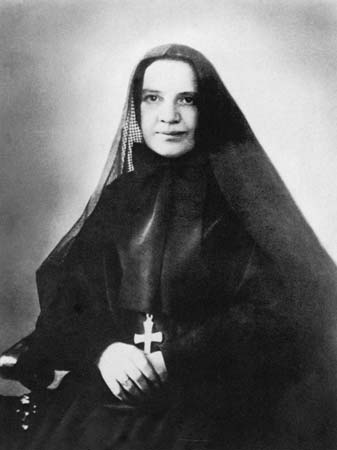
St. Frances Xavier Cabrini 1850-1917

21674-004-E9AE92F1
“We must pray without tiring, for the salvation of mankind does not depend on material success; nor on sciences that cloud the intellect. Neither does it depend on arms and human industries, but on Jesus alone.”

Invoked For: Immigrants

The first American citizen to be named a saint, St. Frances Xavier Cabrini never desired to travel to, much less spend her life in her adopted country of the United States of America. Born Maria Francesca Cabrini in northern Italy, she intended to use her schoolteacher’s degree to work as a missionary in China. Suffering through a smallpox epidemic which killed her parents, she was turned down by two convents she attempted to join. When she was finally accepted by one, she was sent to a small town to run an orphanage which was eventually closed. Enthralled by the works of Saint Francis Xavier, the Jesuit Missionary, she took his name and founded an order of nuns, the Missionary Sisters of the Sacred Heart. Many were shocked to see how quickly her new order was approved by the Pope. Instead of granting her wish to continue her namesake’s work in China, Pope Leo XIII told her, “Your China will be the United States.”

At that time 50,000 Italian immigrants lived crammed in a filthy ghetto in New York City. There was no one there to help or intercede for them. Arriving with six other nuns, Mother Cabrini was told to go home by the archbishop of New York. Instead, she moved her nuns into the Italian slums and immediately opened an orphanage. Through her personal tenacity as well as her willingness to live among the poor, Mother Cabrini set an impressive example for those trying to enact social reforms. Gifted with an innate business sense, and due to the great success her order had in caring for the destitute and displaced, Mother Cabrini was able to raise money from all levels of society. Within a few short years the Missionary Sisters of the Sacred Heart had opened orphanages, schools, hospitals and nurse’s homes throughout the United States, Central America, Argentina, Brazil, France, Spain, England and Italy. She became a United States citizen in 1909.

Though she was a tireless worker and an excellent administrator, Mother Cabrini felt the most important part of her day was the time she spent in mediation. Devoted to the Sacred Heart of Jesus, she felt great strength was to be found in humility, obedience and a quiet atmosphere. In her own case, by following the Pope’s orders at the expense of her personal dreams, she found more success in her mission than she could ever imagine was possible. At the time of her death, she had sixty seven foundations and over thirteen hundred missionaries carrying out her work.

Prayer

O loving Savior, infinitely generous, seeking only our interest, from your Sacred Heart, came these words of pleading love: “Come to me all you that labor and are burdened and I will refresh you.” Relying on this promise of your infinite charity, we come to you and in the lowliness of our hearts earnestly beg you to grant us the favor we ask in this novena, (mention your request here) through the intercession of your faithful servant, Saint Frances Xavier Cabrini. Amen.

Mother and Child

maryeu1
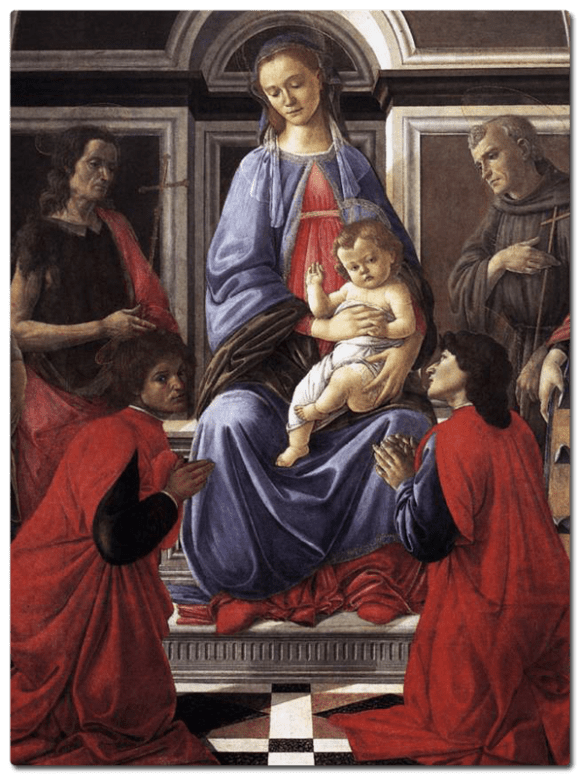
Madonna and Child with Six Saints (Sant’Ambrogio Altarpiece) – Sandro Botticelli – 1470

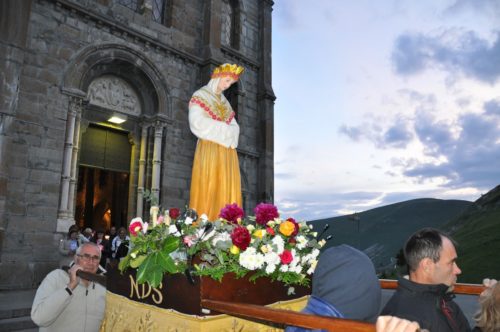
Visions of Mary: Our Lady of La Salette

procesion-de-la-salette-500x332

Our Lady of La Salette is the patroness of France.

The Feast of Our Lady of La Salette is September 19.

One of the most controversial of the Church-approved apparitions of Mary is her visit to La Salette in the French Alps. The seers who saw her were two poor shepherd children, half wild, unwanted by their parents and unschooled. They had little credibility with the people in their region and even less with the local clergy. Yet because of the complete conversion or change of heart of the little town, this apparition was approved within four years.

On September 19, 1846, two shepherds, fourteen-year-old Melanie Calvat and eleven-year-old Maximin Giraud were tending their cows in the Alpine hamlet of La Salette, France, approximately 6,000 feet above sea level. Both children had only recently met, the younger of the two, Maximin, was outgoing and friendly. He had insisted on their working together in order to stave off the boredom and loneliness of their tedious job. Melanie Calvat begrudgingly accepted his company. She was known to have a difficult and taciturn nature. She had worked as a shepherd from the time of her tenth birthday, and her master considered her disobedient and lazy. She was the fourth of tenth children, and many people in the village remember her mother as abusive and violent. On this Saturday afternoon in September the children had only been working together for a few days. They had taken a nap after lunch and upon awakening realized that their cows had wandered off. As they scrambled up into the pasture to retrieve them, they saw what seemed to them to be a globe of fire near a little hollow, which looked “as though the sun had fallen on that spot.” Upon closer inspection, the light took on a form and the figure of a beautiful woman weeping could be made out. The woman was sitting on a rock with her face buried in her hands. She saw the children and got up, saying, “Come near, my children, do not be afraid. I am here to tell you great news.”

Reassured and extremely curious, Maximin and Melanie ran over to the woman. They later reported that she was tall and everything about her radiated light. She wore clothing typical of the women of that area; a long dress with an apron, and a shawl crossed over her breast and tied around her back. Her dress, however was studded in pearls, and her bonnet was a strange crown-shaped hat that exuded bright rays. Hanging from her neck she wore a large crucifix with a figure of Christ on it. Beneath the arms of the cross there were, to the left a hammer, and to the right, pincers. An even brighter radiance emanated from this crucifix.  There were garlands of roses around her head, the edge of her shawl and around her feet. Throughout her conversation with the children the woman continually wept.

“If my people will not obey, I shall be compelled to loose my Son’s arm. It is so heavy, so pressing that I can no longer restrain it. How long I have suffered for you! If my Son is not to cast you off, I am obliged to entreat Him without ceasing. But you take no least notice of that. No matter how well you pray in the future, no matter how well you act, you will never be able to make up to me what I have endured for your sake.”

Then the woman pointed out how no one in the village took Sunday off from work. She added, “The cart drivers cannot swear without bringing in my Son’s name. These are the two things which make my Son’s arms so burdensome.”

She went on to say that if the village continued to act impiously there would be a great famine coming and it would be the people’s own fault. She added that if the people would change their ways, the rocks would become piles of wheat and the potatoes would sow themselves. Melanie later reported that since the lady was speaking French and she was not familiar with the French word for “potato,” the lady stopped what she was saying and added, “Ah, but you do not speak French!” and she continued her dialogue to them in the local patois. She then gave each child a secret that the other could not hear. She questioned them on whether they said their prayers. When they answered “no,” she said, “Ah, my children, it is very important to say them, at night and in the morning. When you don’t have time at least say an ‘Our Father’ and a ‘Hail Mary.’ When you can, say more.” She continued in a tearful voice: “Only a few old women go to mass in the summer. All the rest work every Sunday throughout the summer. And in winter, when they don’t know what to do with themselves, they go to mass only to poke fun at religion. During Lent they flock to the butcher shop like dogs.”

The lady went on to ask if either of them had ever seen spoiled grain before. Maximin quickly answered, “No.”

The lady reminded him that this was not so, “But my child, you must have seen it once near Coin, with your papa. The owner of a field said to your papa, ‘Come and see my spoiled grain.’ The two of you went. You took two or three ears of grain in your fingers. You rubbed them, and they crumbled to dust. Then you came back from Coin. When you were but a half hour away from Corps, your papa gave you a piece of bread and said, ‘Well, my son, eat some bread this year, anyhow. I don’t know who will be eating any next year, if the grain goes on spoiling like that.’”

Maximin immediately recalled this experience but was astounded as to how this lady could know it.

In French the lady said, “My children, you will make this known to all my people.” She turned from them and started to glide away. She stopped and paused, repeating one more time, “My children, you will make this known to all my people.”

The children returned with their cows at the end of the day. Melanie was not inclined to tell anyone of their adventure with the lady. Maximin however, told his employer all about it. When both children were questioned independently, they told the same story. The priest and the town officials were doubtful. To them, these were just two ignorant children making up a fantasy. But there was something in the tone of the story that affected the people of the town. This lady was not using religious metaphors, she was speaking in an accessible, straightforward manner. When the villagers went to visit the spot where the lady appeared, a spring had started flowing. It was thought at first that this was a coincidence, since it had rained the day before and it was common for small springs to appear for a day or so than dry up. But this spring behaved differently, freely flowing no matter what the weather. People who drank from the spring reported dramatic healing activity. The demeanor of the village totally changed. By 1846, France, once a nation dedicated to the Virgin Mary, was now actively a nation trying to live without religious conviction. In the search for material wealth, spiritual values had fallen by the wayside. Though La Salette had only five hundred inhabitants, they, too, had adapted the slack lifestyle of the bigger cities. The lady was right; religious devotion had become a joke. Recognizing the truth in the lady’s examples of their behavior, the village church started to fill up with earnest worshipers, and most of the village began honoring Sunday as the Sabbath. The spring itself, became a pilgrimage site with devotees of Mary coming from far distances. It is thought that Mary speaking her final words in French was a message to the French nation to reform themselves and their values. La Salette became an approved apparition in 1851.

The seers of La Salette went on to lead troubled lives. Maximin drifted in and out of employment and died by his fortieth birthday. Melanie became a nun. She reveled in the attention she received for being a visionary and felt neglected by the local clergy. In 1879 she published a book alleging what her secret had been. It was a gruesome description of Satan let loose upon the world in 1864 and predictions of mass destruction and the anti-Christ. Because she had fallen under the influence of apocalyptic books and various conspiracy theorists, her book was thought to be purely imaginative and was not sanctioned by the Church. She continually had a small band of followers who believed in these later visions. She died in 1904.

In 1879 a magnificent basilica, Our Lady of La Salette was consecrated on the site of the apparition.


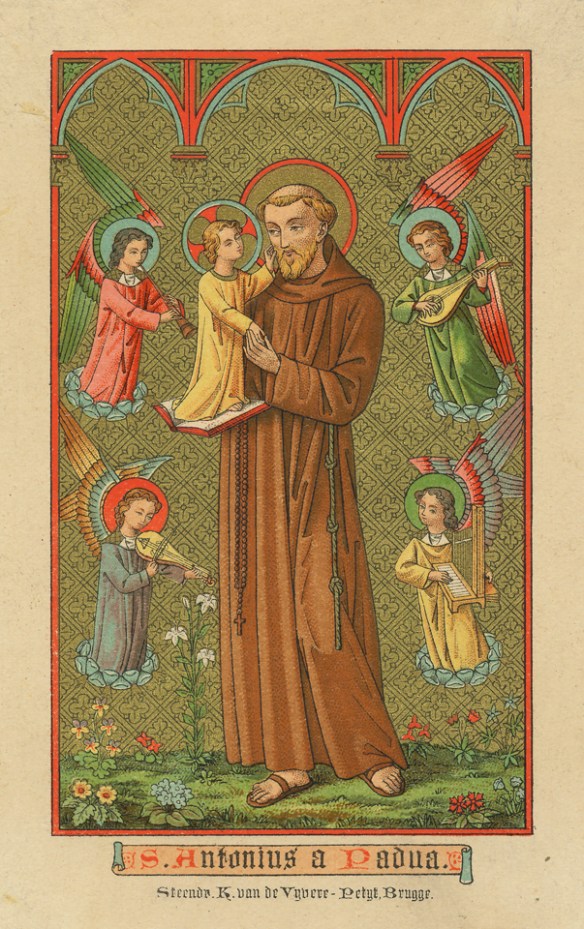
Saint Anthony of Padua 1195-1231

FullSizeCard_@2
Wonder and miracles are infused with every story of Saint Anthony
. Though he has been dead for almost 800 years, he is still the most popular saint in the world and his statue is found in every Catholic Church. Saint Anthony is best known as the patron saint of lost articles but he is invoked for help in all life situations. In his own day he was called the “Wonder Worker’ and credited with the ability to stop the rain, raise the dead and reattach severed limbs. He was such a charismatic preacher that when a crowd of heretics in Rimini refused to listen to his preaching, the fish raised themselves out of the water to hear him. Born Fernando de Bulhes in Lisbon, Portugal, he disappointed his noble family by rejecting his luxurious life and joining the Augustinian religious order.

A scholar by nature, he read every book in the monastery, devoting his time to contemplative prayer. Eventually, he befriended a group of itinerant Franciscan monks and became fascinated with this new religious order. Much impressed by their dedication to simplicity, poverty and their belief in returning to the original words of Christ, he joined their ranks, changing his name to Anthony in honor of Saint Anthony of the Desert, the patron of their little church. Returning home from a failed missionary venture in Morocco, his ship was blown off course and he wound up in Messina, Sicily. A group of Franciscan friars insisted he go north with them for a great gathering of all Franciscans, with their founder Francis of Assisi. Anthony remained in Italy and discovered his great gift of preaching when a superior ordered him to speak at an ordination, telling him to say whatever the holy spirit had infused into him.

He astonished his audience, not only by his skills as an orator but by the depth of his knowledge. He was sent throughout northern Italy and southern France on evangelical preaching missions which gathered crowds in the tens of thousands. His popularity among the people increased as he used his position to get real changes enacted for their protection. While based in Padua, he observed the crushing power of debt upon the common people. At Anthony’s insistence, the local municipality enacted a law protecting those who could not pay their debts that is still enforced today. Anthony exhausted himself preaching out in fields and in piazzas as there was not cathedral large enough to hold all who came to hear him. At the age of thirty six, his health began to fail him and a local Count donated a woodland retreat for his recovery.

One morning the Count heard the sounds of a baby giggling and he looked out to see Anthony surrounded in light, playing with the baby Jesus. That Christ would choose to appear to one of his saints in such a vulnerable state is a testament to the loving and kind nature of Saint Anthony. Because he is depicted holding a baby, women having trouble conceiving invoke his aid.

Being of Portuguese descent, Anthony’s feast day is very auspicious for marriages in Portugal and Brazil and in those cultures, he is known to assist women seeking a husband. According to legend, Saint Anthony earned the title patron saint of lost articles when a novice borrowed his psalter and failed to return it. Saint Anthony prayed to get it back and the novice was visited by terrifying visions that sent him running back to Anthony with the book. In iconography, Anthony always holds the baby Jesus and a lily for purity. Many times the returned book of the gospels is included. Patron of: Lisbon, Portugal, Padua, amputees, barren women, domestic animals, draftees, oppressed people, orphans, paupers, the poor, pregnant women, prisoners, sailors.

Novena to Saint Anthony
Holy Saint Anthony, gentle and powerful in your help, Your love for God and charity for His creatures, made you worthy when on earth, to possess miraculous powers. Miracles waited on your word, which you were always ready to request for those in trouble or anxiety. Encouraged by this thought, I implore you to obtain for me
(mention your request here).
The answer to my prayer may require a miracle. Even so, you are the saint of miracles. Gentle and loving Saint Anthony, whose heart is ever full of human sympathy, take my petition to the Infant Savior for whom you have such a great love, and the gratitude of my heart will be ever yours. Amen

It is customary to donate to Saint Anthony’s Bread, a charity started in Saint Anthony’s lifetime, in gratitude to answered novena prayers.

If you live or are visiting New York City please visit Saint Francis of Assisi Church
on 31 Street.  They have a  Saint Anthony Shrine and you can donate money
for Saint Anthonys bread.

Sacred Heart of Jesus

FullSizeCard_1 2
“Behold the heart which has so much loved men that it has spared nothing, even exhausting and consuming itself in testimony of its love….”

Patron of: family peace, anything
Feast Day: June 8

The iconography of the Sacred Heart speaks to us on such a basic level that its image can be found everywhere in everyday life – from tattoos on bikers to stained glass windows in cathedrals. Traditionally, many Catholic homes display the Sacred Heart of Jesus to insure domestic peace and a loving atmosphere. This ancient concept depicting Christ’s heart in flames was first meditated on in privacy by the 4th century hermits in the desert and taken up by mystics in religious communities in the 11th and 12th centuries; it did not become a popular devotion until the 17th century.

On December 27, 1673, a young Visitation nun in Burgundy, France, named Margaret Mary Alacoque was praying in the convent chapel when she heard a strong inner voice identifying itself as Jesus Christ. In later visits the voice requested that she begin a devotion to an image of Christ’s heart in flames, bleeding and encircled by thorns. The flames were for His ardent love for mankind, the thorns were to remind us of His sacrifice on the cross and the blood was because He was God made man. There is no indication that Margaret Mary Alacoque had ever seen this image before. Indeed, she was puzzled by it and greatly mistrusted herself as being qualified to relay any spiritual messages no matter who they purportedly came from. When she reported her communications to her Mother Superior she was scoffed at as delusional and forbidden to perform any of the devotions she was instructed to carry out. It was only after her Confessor, Claude de La Columbiere heard her describe her visions that she was taken seriously.

Unlike the Mother Superior or Margaret Mary, he was well aware of the private devotions of Bernard of Clairvaux and Mechtilde of Helfta, religious mystics who lived centuries before, inspired by same image. La Columbiere did much to publicize devotion to the Sacred Heart based on the messages Christ gave to Margaret Mary. According to her, Christ was greatly troubled by the indifference and sacrilege He was being treated with by the average person.

As a reward for contemplating this image He promised: 1. I will give them all the graces necessary for their state of life. 2. I will give peace in their families. 3. I will console them in all their troubles. 4. I will be their refuge in life and especially in death. 5. I will abundantly bless all their undertakings. 6. Sinners shall find in my Heart the source and infinite ocean of mercy. 7. Tepid souls shall become fervent. 8. Fervent souls shall rise speedily to great perfection. 9. I will bless those places wherein the image of My Sacred Heart shall be exposed and venerated. 10. I will give to priests the power to touch the most hardened hearts. 11. Persons who propagate this devotion shall have their names eternally written in my Heart. 12. In the excess of the mercy of my Heart, I promise you that my all powerful love will grant to all those who will receive Communion on the First Fridays, for nine consecutive months, the grace of final repentance: they will not die in my displeasure, nor without receiving the sacraments; and my Heart will be their secure refuge in that last hour.

Since there is no way to physically depict the soul, it is thought that the image of the Sacred Heart comes closest. The heart is the seat of love in the body and the wounded heart represents Christ’s sacrifice at the crucifixion as well as His ongoing pain at the state of mankind.

Novena:

O Lord, Jesus Christ, to your most Sacred Heart I confide this intention. Only look upon me, then do what your love inspires. Let your Sacred Heart decide. I count on you. I trust in you. I throw myself on your mercy. Lord Jesus, you will not fail me.
(Mention your request.)
Sacred Heart of Jesus I trust in you. Sacred Heart of Jesus I believe in your love for me. Sacred Heart of Jesus, your kingdom come. Sacred Heart of Jesus, I have asked you for many favors, but I earnestly implore this one. Take it, place it in your open heart. When the Eternal Father looks upon it, he will see it covered with your Precious Blood. It will no longer be my prayer, but yours, Jesus. Sacred Heart of Jesus, I place all my trust in you. Let me not be disappointed. Amen.

Visions of Mary: Our Lady of Perpetual Help Icon

olph22
Our Lady of Perpetual Help is the patroness of Haiti and Italy.

The feast day of Our Lady of Perpetual Help is June 27.

Icons are visual prayers. Artists who painted them were usually monks who spent whole days in contemplation, meditating on the mysteries of God. In the East, icons not only serve as instructive visual stories but because of the spiritual atmosphere in which they are channeled, they are also venerated along with the word of God. Our Lady of Perpetual Help is an icon whose style bridges both Eastern and Western Churches. Its subject is called the Virgin of the Passion, because it deals with Mary’s role in the Crucifixion of Christ. Like most of these works, the artist is anonymous but most likely came out of the Andrea Rizo de Candia (1422–1499) school of Crete. This mesmerizing picture, which spent years in anonymity, is now venerated and honored in all corners of the world and enjoys universal devotion.

Written remembrances of the image date back to the 1400s, when it was venerated in a church on the island of Crete as The Miraculous Picture of the Mother of God. In the late 1490s, a local merchant aware of all the wondrous stories surrounding the icon, stole it and took it with him to Rome. During the voyage over, a violent storm terrified the crew. Aware that the merchant was traveling with the painting, they had him take it out for them to pray in front of. They attributed their safe crossing to the intercession of the Virgin in the picture. While in Rome, the merchant became mortally ill. Repenting of his theft, he asked the friend he was staying with to promise to see that the painting was given to a church. The friend agreed and took the painting upon the merchant’s death. However, the man’s wife was so charmed by the image, she hung it in her bedroom and the merchant’s request was never honored. Mary appeared twice to the family’s six-year-old daughter, and it was in these visions that she first announced herself as Our Lady of Perpetual Help. She asked that the family stop hoarding the picture and give it to a church that was located between Santa Maria Maggiore and San Giovanni in Laterano. After consulting with a priest, the family gave the painting to the Church of San Matteo, an obscure, out-of-the-way parish. It was installed on March 27, 1499. Almost immediately, pilgrims from all walks of life came to seek comfort in contemplation in front of the icon. For the next three hundred years, the painting known as The Madonna di San Matteo, remained undisturbed as it acquired a loyal group of devotees. In 1798, Napoléon’s troops conquered Rome, and San Matteo was one of the thirty churches destroyed by the French army. The Irish Augustinian monks who were in charge of the church brought the icon to the Monastery of Saint Mary in Posterula in the Trastevere section of Rome and placed it in a private chapel. Its existence was all but forgotten as the original band of monks from San Matteo were dispersed to Ireland and America. 

Michael Marchi, an altar boy who served Mass at Saint Mary in Posterula remembered one of the last of the old monks: “This good brother used to tell me with a certain air of mystery and anxiety, especially during the years 1850 and 1851, these precise words, ‘Make sure you know, my son, that the image of the Virgin of Saint Matthew is upstairs in the chapel; don’t ever forget it . . . do you understand? It is a miraculous picture.’ At that time the brother was almost totally blind.”

Michael Marchi entered into religious life, taking orders in the Redemptorist Missionaries. In 1855 they purchased Villa Caserta in Rome to house their order. What they did not realize was, that this estate had been built over the ruins of the Monastery and Church of San Matteo. An investigation into the history of the property turned up writings about an ancient icon of the Mother of God that had enjoyed “great veneration and fame for its miracles,” which was once housed in San Matteo. In 1863 a famous Jesuit preacher came and gave a sermon about the now lost icon of The Virgin of Perpetual Help. Father Marchi realized this was the same dust-laden picture he had always seen above the altar of the house chapel of the Augustinian Fathers at Saint Mary in Posterula.

“There was no devotion to it, no decorations, not even a lamp to acknowledge its presence . . . it remained covered with dust and practically abandoned, many were the times when I served Mass there, that I would stare at it with great attention.”

This providential discovery came to the attention of Pope Pius IX, who remembered praying before the image in San Matteo as a boy. He ordered that the icon of Our Lady of Perpetual Help be brought to the new church of Saint Alfonso for public veneration. Situated on the Esquiline Hill, this is the exact location, between the two basilicas of Santa Maria Maggiore and San Giovanni in Laterano, that the Virgin Mary had originally requested for it to be placed. Pilgrims come from all over the world to be in the presence of the icon.

The pope did not give the Redemptorists the icon just to keep in their church for visiting pilgrims, but rather to make it their mission to disseminate this image of Mary throughout the world. Copies of this icon are considered just as capable of working miracles as the original. Shrines and legions of devotees to Our Lady of Perpetual Help can be found in the United States, Haiti, Ecuador, Peru, Suriname, Chile, Brazil, Mexico, Ireland, Italy, Poland, France, Spain, Singapore, and the Philippines. 

Mary is the largest figure in this icon, but the focal point or center of the picture is her hand being clutched by her Son’s. Jesus is a young boy who has just run to his mother in such a fright that one of His sandals is dangling off his feet. Mary calmly shields Him, confident of her power to protect and comfort Him. On either side of them are the objects of the Child’s fear. The archangels Gabriel and Michael have revealed to Him the Cross, the spear, and the sponge, foreshadowing his future torment and execution. Since the birth of her Son, Mary knew He was destined to suffer and die for humankind, yet she firmly believed in His redemption. Therefore, she was able to calm the Child Jesus in this moment of anxiety. If God Himself can reach out to Mary for refuge, then anyone is able to approach her, no matter what we fear, our future or our past actions. Regardless how we judge ourselves, she has total belief and faith in us. Greek letters on either side of Mary’s head are abbreviations for the title, “Mother of God.” Beside the head of Jesus are the Greek letters for “Jesus Christ.” It is important to note that Mary is not holding Jesus’s hand in a tight grip but she leaves it open in invitation to the viewer to join them. Jesus has his hand palm turned down into His mother’s. This symbolizes the grace and favors that He distributes through her intercession. Mary looks directly at the viewer, offering love and comfort to all who gaze at the image.

It is said that Our Lady of Perpetual Help never refuses a request, no matter how small or frivolous it may seem. Many who have felt unworthy to call on her in their direst need report hearing a calm voice saying, “Why don’t you just ask?”