Unknown's avatar

About sandra dipasqua

graphic designer

SOME SAINTS FOR MARCH


patrick-52


Saint Patrick

 389 – 461 

Though not usually considered a novena saint, Saint Patrick is called upon by many for faith in the most trying of circumstances. Since he himself was forced to submit to living in a country not of his own choosing, he asists in accepting difficult situations where there is little hope of change. The patron saint of Ireland, he is credited with single-handedly changing the beliefs of the entire Irish nation through the purity and intensity of his faith. Saint Patrick’s following has spread to wherever the Irish have settled, especially in North America and Australia. He could never have imagined the astounding impact that his work in Ireland would have on the world.

 Novena to Saint Patrick

     O great apostle of Ireland, glorious Saint Patrick,

     To whom under God so many are indebted for the most

     Precious of all treasures, the great gift of faith,

     Receive our fervant thanks for the zeal and charity

     That have been to thousands the blessings so

     invaluable. We ask your intervention in receiving


     (Mention your request here). Ask for all who dwell in this land and the land of thy labors the precious light of Faith, and beg for us on whom its

glorious rays have long since beamed, the grace to regulate our lives by its sacred maxims. Amen


Say this novena nine times in a row for nine days in a row.

 Feast Day: March 17

 Patron Saint of: Ireland, Nigeria

 Invoked: for Faith, against rabies, serpents, the torments of hell


joseph2


Saint Joseph 

First Century

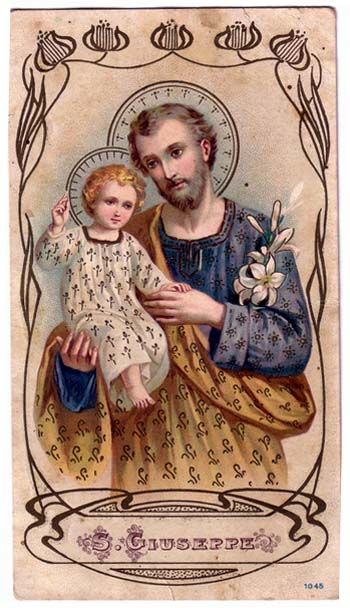
 A poor carpenter and a direct descendant of the house of David, Saint Joseph was selected by God from all the men in the world to be the earthly father of Jesus Christ, an average person exalted to he highest level of respect and achievement. He readily accepted this and other directives for God and never shirked his responsibilty to his family. Thus, Joseph epitomizes the role of father-protector. Many of the greatest saints have called on Joseph for protection. His novena is considered to be powerful, one that can be invoed for any trouble. Saint Teresa of Avila said, “I don’t recall up to this day ever having petitioned him for anything that he fails to grant. It is an amzing thing, the great many favors God has granted me through the meditation of this blessed saint.” In Italy, where his feast is a major religious holiday, Saint Joseph is believed to have the power to break all natural law. It is said that since Jesus always obeyed Joseph when he was his father on earth, Joseph is accorded the same power in heaven.

 Novena to Saint Joseph

 O glorious Saint Joseph, faithful follower of Jesus Christ, to you we raise our hearts and hands to ask your powerful intercession in obtaining from the compassionate heart of Jesus all the helps and graces necessary for our spiritual and temporal welfare, particularly the grace of a happy death, and the special grace for which we now ask.

(Mention your request here).

O guardian of the Word Incarnate, we feel animated with confidence that your prayers for us will be graciously heard at the throne of God.

(The following is to be said seven times in honor of the seven joys and seven sorrows of Saint Joseph).

O glorious Saint Joseph, through the love you bear for Jesus Christ, and for the glory f his name, hear our prayers and grant our petitions.

 This novena can be practiced at any time of year. It is particularly effective if done for the seven Sundays prior to the feast of Saint Joesph in honor of his seven sorrows and seven joys.


Say this novena nine times in a row for nine days in a row.

 Feast Day: March 19

 Saint Joseph is the patron of: Austria, Belgium, Canada, Mexico, Peru, Vietnam, Carpenters, fathers

 Invoked: against doubt, for the sale of a house, to find work


Above two novenas from “Novena: The Power of Prayer”

By Barbara Calamari and Sandra DiPasqua


Dining with the Saints in Honor of St. Joseph

san-giuseppe-di-riberacm-152

Pasta Con La Mollica

San Giuseppe, husband to Mary, patron saint of orphans, unwed mothers, the needy, the homeless, and all things family, both good and unfortunate, is one of the most important saints in Italy and in the Catholic world. He is a patron saint of Southern Italy and of Sicily in particular, having, through the peoples’s prayer, saved the island from a serious drought in the Middle Ages. His feast day, March 19, is known as La Tavola di San Giuseppe and is celebrated with enormous banquets. Every conceivable type of food is offered, and churches’ altars are festooned with decorative breads, sweet and savory, in honor not only of him but also of the spring solstice and the ancient tradition of celebrating the renewed fertility of the earth. The breads are shaped into fish, lambs, fruits, flowers, and just about any other of God’s creations.

San Giuseppe is also the patron of pastry cooks, so sweets play a big part in the celebration. Sfinci—deep-fried cream puffs filled with ricotta or custard—are the best-known pastries made in St. Joseph’s honor. You can find them in Palermo and in Brooklyn and in Philadelphia. In Naples they make the unfilled versoin called zeppole. Cassateddi, a sweet ricotta-filled ravioli, is a beautiful creation you’ll find on the St. Joseph’s Day table in many Sicilian homes. The sweet theme even extends to pasta. One of my favorite Saint Joseph’s Day dishes is pasta con la mollica. Mollica means soft bread crumbs in Italian, but the dish, probably from the Renaissance, also includes sugar, cinnamon, and a little garlic. The bread crumbs symbolize the sawdust that would have covered the floor of Joseph’s manger. The combination of flavors might sound odd, but they make a beautiful and strangely appealing dish worth tasting. Serve it in small portions as a first course, or even as a dessert.

Pasta Con La Mollica for San Giuseppe

(Serves 6 as a first course)

Extra-virgin olive oil
1/2 cup homemade bread crumbs, not too finely ground
Salt
1 tablespoon sugar
⅛ teaspoon ground cinnamon
1 pound spaghetti
3 tablespoons unsalted butter
3 garlic cloves, peeled
Freshly ground black pepper
¼ cup dry Marsala
A handful of lightly toasted slivered almonds

In a medium-size sauté pan, heat a tablespoon of olive oil over medium flame. Add the bread crumbs, and season with a pinch of salt. Sauté until lightly golden and crisp. Pull the pan from the heat, and add the sugar and the cinnamon, stirring them in to the breadcrumbs.

Set up a large pot of pasta cooking water, and bring it to a boil. Add a generous amount of salt, and drop in the spaghetti.

In a large skillet, heat 2 tablespoons of olive oil with the butter over low heat. Add the garlic, and sauté slowly, just until it turns lightly golden, about 4 minutes. Add the Marsala, and let it boil for about a minute, leaving some liquid in the skillet. Take out the garlic.

When the spaghetti is al dente, drain it, leaving some water clinging to its strands, and add it to the skillet, along with the almonds. Toss gently over low heat until the spaghetti is well coated with the garlic oil. Add salt and a generous amount of freshly ground black pepper, and add more olive oil if needed to coat the pasta.

Pour the spaghetti into a warmed large serving bowl. Sprinkle on the bread crumbs, and give it all a gentle toss. Serve right away.

Dining with the Saints is written by Erica De  Mane. This will be a regular feature of this blog. Erica is the author of several books on Italian cooking. She also has an Italian cooking blog at http://www.ericademane.com

Novena for February

agathazurbaran1

Saint Agatha

Feast Day: February 5

So Fierce are the powers attributed to Saint Agatha, it is said that even pagans and Jews flocked to pay homage to her soon after her death. Martyred in AD 251, Saint Agatha is credited with keeping the fires of Mount Etna from erupting and engulfing her home city of Catania in Italy. Millions of people still parade in her honor on her feast day. God’s reaction to her martyrdom was great and instantaneous: as she was being tortured a major earthquake erupted. Her crypt bears the inscription: “Do not offend Agatha’s nation, because she will avenge all offenses.”

Saint Agatha’s Novena Prayer

O Saint Agatha, who withstood the unwelcome advances from unwanted suitors, and suffered pain and torture for your devotion to Our Lord, we celebrate your faith, dignity, and martyrdom.

Protect us against rape and other violations, Guard us against breast cancer and other afflictions of women, and inspire us to over come adversity.

O Saint Agatha, virgin and martyr, mercifully grant that we who venerate your sacrifice may receive your intercession. Amen

(Mention your request)

Say this novena nine times in a row for nine days in a row.

Saint Agatha is invoked against: Breast Disease, Volcanic Eruptions

She is the patron saint of Bell Founders
 

Edited excerpt from “Novena: The Power of Prayer”
by Barbara Calamari and Sandra DiPasqua

Some Saints for February


valentine

Saint Valentine

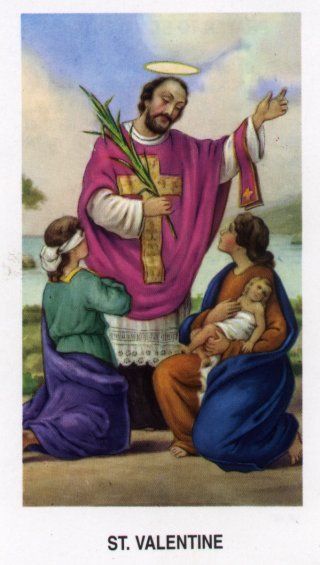
His feast day is embedded in Western civilization. His name has become synonymous with a certain type of romantic card, yet few realize that Valentine actually existed.  As a saint, his first great work was to unite young couples in marriage.

In the year a.d. 269, when the Roman Empire was under constant attack from barbarian tribes, Emperor Marcus Aurelius Claudius issued an edict outlawing marriage for young men. He speculated that more soldiers would join the legions to defend it if they were unfettered by wives and children. Valentine was a respected healer and priest in the outlawed Christian faith. He had great sympathy for those young couples whose plans for a life together were shattered by the state and he encouraged anyone who wished to wed to come to him to be married in secret. He was arrested and imprisoned in Rome for defying the emperor. But his reputation as a learned man remained untarnished and many of his followers would visit him in prison for counseling; others came for health cures. Personally afflicted with epilepsy, Valentine was particularly drawn to treating those also suffering from the disease.

 The jailer, having witnessed many successful healings at Valentine’s cell door, asked the saint to treat his daughter, who had been blind since birth. During her subsequent visits to the prison, Valentine read to the girl, taught her mathematics, and beautifully described the natural world. Valentine’s wisdom and kindness so impressed the jailer and his family that they converted to Christianity despite the fact that the young girl remained blind. This conversion established Valentine’s status as a true threat to the state, a charge punishable by death. His execution came on February 14, the eve of the Roman festival of Lupercalia. Valentine was beaten with clubs and then  beheaded. Before his sentence was carried out however, he sent a yellow crocus to the jailer’s daughter enclosed with a note that read, “With love, from your Valentine.” The bright color of this flower was the first thing she ever saw, her eyesight having been miraculously restored. She is said to have planted an almond tree on Valentine’s grave, and to this day the almond tree is considered a symbol of friendship and devotion.

     Valentine was buried on the Flaminian Way in a catacomb that still bears his name. A church was dedicated to him there in a.d. 496. The wall of the city, the original Flaminian Gate, was a pilgrim’s first stop upon entering Rome and was known as Porta S. Valentino until the seventeenth century, when it was renamed Porta del Popolo. In the ninth century, relics of the early martyrs were removed from the catacombs and transferred to local Roman churches. Valentine, too, was reinterred in the church. His body was moved to the church of Saint Praxedes, very near his original burial place. Many cities besides Rome claim his relics, among them Terni, Italy; Madrid, Spain; Dublin, Ireland; Glasgow, Scotland; and Rocamador, France.

     It is no coincidence that the liturgical feast day of the patron saint of love falls on the eve of Lupercalia, an erotic Roman fertility festival. It was common practice for church holidays to coopt pagan celebrations. The Romans considered this the official beginning of Spring, a time of reawakening fertility and warming weather. One of the activities held in honor of the goddess Februata Juno consisted of the city’s bachelors drawing the names of unmarried women out of an urn. They would then become a couple for the rest of the year, with many of these matches resulting in marriage. In twelfth century southern France, this practice was reawakened as part of the Langue d’Oc poetry movement. This was a time when art and literature took on a heightened importance to the ruling classes. Noble youths known as gallants wrote missives of love they called galantines. The local pronunciation confused this with the word valentine and Valentines clubs sprang up. On February 14, after a Mass in honor of Love, a silver casket containing the names of unmarried local men was presented to the single women in town. The men whose names each woman drew was required to be the guardian of that lady, providing her with flowers, poems, and gifts throughout the year. He was to guard her honor chivalrously. Marriage between these Valentines was strictly forbidden.

     Because of the wide dispersal of his remains, the cult of Saint Valentine became extremely popular in Northern Italy, southern France, and England. His head, which was reputed to be in England, was said to bestow incredible miracles and healings on those who kissed it. Since the middle of February was considered the time of year when birds began to pair, the English, like the Romans a thousand years before them, looked upon this as the beginning of mating season. Celebrating the Feast of Saint Valentine by citing the fidelity of doves seems to be an English tradition. The oldest valentine note in existence today was written by Charles, Duke of Orleans, to his wife in 1415, while he was imprisoned in the tower of London.

     By the middle, nineteenth century sending and receiving anonymous Valentine’s cards and poems declaring one’s love became common in both America and England. By then, the story of the saint who had inspired this industry might have faded away, but his name and feast day is celebrated universally.

In art Saint Valentine is sometimes depicted as a bishop since it is believed he could possibly be the same person as the first martyred bishop of Interamna (Terni, Italy). Frequently a pair of doves symbolizing faithful unions, the sword he was martyred with, the sun of honest knowledge, and the rose of ardent love can be found as part of his portrait as well as martyr’s palms. Because he suffered from epilepsy, he is invoked against that disease, as well as fainting spells.
 

valentine-cards-12


Prayer to Saint Valentine

O glorious advocate and protector, 

Saint Valentine,

look with pity upon our wants,

hear our requests,

attend to our prayers,

relieve by your intercession the miseries

under which we labor,

and obtain for us the divine blessing,

that we may be found worthy to join you

in praising the Almighty for all

eternity; through the merits of

Our Lord Jesus Christ.

Amen.


Excerpted from “Saints: Ancient and Modern” by Barbara Calamari and Sandra DiPasqua



Fever / Genevieve, 422–500, Feast Day: January 3

 
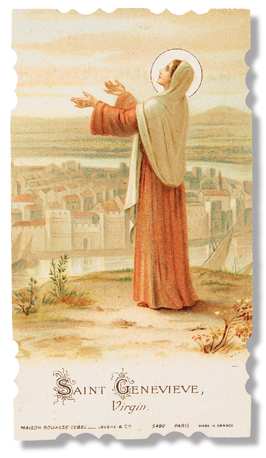
This young mystic saved the city of Paris from starvation after an invasion by the Franks. She was so respected by the conquering forces that she converted the king. She later repelled an invasion by Attila the Hun with the power of her prayer. When an unstoppable plague of fever killed many in the city in 1129, a parade of her relics through the streets was credited with ending it.

religious_cards-00143 Paris; the Women’s Army Corps; chandlers, shepherds, shepherdesses

Invoked: against plague, leprosy; for an end
to excessive rain, the
healing of kings


infantjesus-prague1The feast of the Infant of Prague  January 14
Appeal to the Infant of Prague in times of desperation, to stop an epidemic or for abundance
Few novenas promise the instantaneous results of those to the Infant of Prague. It necessitates a suspension of all doubt as it is completed in one day over a nine-hour time span. Perhaps the most invoked aspect of Christ in the world, this novena promises that anything is possible for those who believe. Christ is presented as both a kindly child and a king. The Infant of Prague is a statue of the child Jesus dressed in actual clothing. Instead of the modest garments of a poor child, he is wearing the sumptuous gown of royalty. Because the Infant of Prague looks like a little doll, we are welcome to approach him with the open faith of a child. Reflecting the faith of Jesus, the novena requires an intensity of devotion. Many people have a version of this statue in their homes, as it is said to guarantee abundance. This novena, frequently utilized by those in financial difficulties, can be said during any desperate situation.
POWERFUL NOVENA IN TIMES OF DISTRESS TO THE INFANT OF PRAGUE
Divine Infant of Prague, dearest Jesus, you who so lovingly said,
“Ask and it shall be given you; seek and you shall find;
knock and it shall be opened to you,” have mercy on me now,
and through the intercession of our most holy Mother,
I humbly ask you to grant me the grace I need.
(Mention your request)
Divine Infant of Prague, dearest Jesus, you who so compassionately taught,
“If you can believe, all things are possible to him who believes,”
have pity on me now. I do believe; help me.
Increase my weak faith through the Blessed Mother’s intercession.
I humbly ask you to answer my request.
(Mention your request)
Divine Infant of Prague, dearest Jesus, you who once said to the Apsotles:
“If you have faith like a mustard seed, you will say to the mulberry tree,
‘Be uprooted and be planted in the sea,’ and it will obey you.”
Hear my prayer, I humbly ask.
Through the intercession of Mary most holy,
I feel certain that my prayer will be answered.
(Mention your request)
Because this novena is said for those in great distress or emergency situations, it is completed in one day.
Say this novena nine times in a row at the same time every hour for nine consecutive hours.
An edited excerpt from “Novena: The Power of Prayer”

Dining with the Saints

caravaggio_-_burial_of_st_lucyrev

Cuccia for St. Lucy’s Day

Sicilians eat cuccia in honor of St. Lucy to this day because of a miracle attributed to her that happened in 1582. That year Sicily was suffering from a terrible famine, and a flotilla of ships carrying grain showed up on December 13—either in Palermo or in Siracusa. December 13 is St. Lucy’s saint’s day. The people of Sicily felt that this huge blessing was the work of their beloved saint.

The people where so famished that they didn’t wait to grind the wheat; rather they boiled the grains whole. Sicilians honor the memory of Santa Lucia on December 13 by refusing to eat anything made with ground flour—no bread, no pasta, the staples of their diet.

Sicilians eat sweet cuccia on Santa Lucia’s day and only then. It’s especially popular in Palermo and in Siracusa, where Lucy was born. It’s made by mixing boiled whole wheat berries with sweetened ricotta, usually sheep’s milk ricotta. It’s served warm and makes a really delicious afternoon snack. Every cook, usually the mom in a Sicilian family, flavors cuccia in their own personal way, creating a taste their family comes to expect each year. You can add candied citron or orange peel, honey, a few shavings of chocolate, cinnamon, orange flower water. I prefer mine with toasted pine nuts and raisins, sugar, and a dusting of cinnamon.

Sweet Cuccia with Pine Nuts and Raisins

(Makes 4 servings)1 cup hard wheat berries (avoid red wheat berries, as they don’t cook up soft enough)

Sicilian sea salt (from Trapani)

1 cup whole milk ricotta, cow or sheep’s milk

3 tablespoons powdered sugar

A few drops of vanilla extract

¼ cup toasted pine nuts

¼ cup raisins soaked in a tablespoon or so of sweet Marsala

A dusting of ground cinnamon

Soak the wheat berries overnight in abundant cool water. Drain them. Pour them into a saucepan. Cover them with  fresh water by at least four inches. Add about ¼ teaspoon of sea salt. Bring the water to a boil over medium-high heat. Turn the heat down so the wheat can cook at a low simmer, partially cover the pan, and cook until the wheat is tender and has just started to burst, about an hour. If the water level gets low at any time during cooking, just add a little.


Drain the wheat and pour it into a pretty serving bowl. Mix the ricotta with the powdered sugar and the vanilla, and fold it into the wheat. Add the pine nuts and raisins with their Marsala soaking liquid. Mix gently. Dust the top with ground cinnamon. Serve warm.


Australia / Francis Xavier, 1506–1552, Feast Day: December 3

A friend of Ignatius Loyola, founder of the Jesuits, Francis became one of the most successful missionaries in history. Dedicated to working in the Far East, he converted over forty thousand people in Goa, India, Malaysia, the Philippines, and the outer islands of Japan. He died before he could reach China. After his death, he often became the patron of territories in newly discovered regions of the world.

Other patronages: Borneo, China, India, Japan, Pakistan, Portugal; foreign missions; sailors, tourists Invoked: against hurricanes, plague