Unknown's avatar

About sandra dipasqua

graphic designer

Saint Rita of Cascia

 1386-1457

Feast Day: May 22

Patronage: Impossible Causes, Bad Marriages, Victims of Spousal Abuse, Widows

Invoked Against: Sterility, Loneliness, Bodily ills, Smallpox

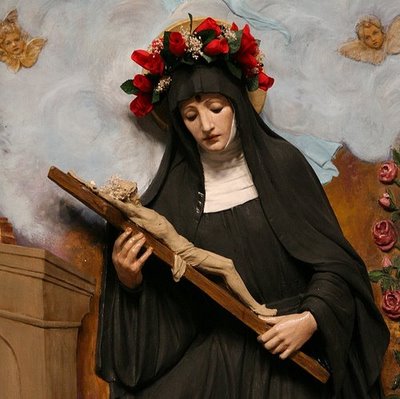
Symbols: Roses, Bees, Figs, Nun with cross receiving wound, Crown of thorns, Crucifix

       Margarita Lotti was the answer to the prayers of a devoutly Catholic older couple in Roccaporena, Italy. During the pregnancy, her mother had a vision of an angel telling her “You will give birth to a daughter marked with the seal of sanctity, gifted with every virtue, a helper to the helpless and an advocate of the afflicted.” Her father named the child Rita, as the Angel had called her.  After the baby’s baptism, bees would hover over her while she slept.  A symbol of divine presence, they never harmed nor woke her.

       Rita came of age at the time of a deep schism in the Church – the Pope had fled to Avignon and the future of many religious communities was uncertain. Her true wish was to become a nun but she obeyed her parents and married instead, to support them in their old age. The husband chosen for her, Paolo Mancini, was a good provider though gradually revealed a violent, volatile nature. He was unfaithful, abusive and domineering. Heavily involved in the factional infighting that gripped the Italian landscape, he made many enemies.

        Rita prayed fervently that her husband would have a change of heart and become a better husband and father to their twin sons.  Paolo experienced a conversion when he was sent a vision of himself as he was seen by others. He begged Rita’s forgiveness for the difficult life he had subjected her to and vowed to change. They had been married for 18 years when Paolo was ambushed on his way to work and murdered, his mutilated body dumped on the family’s doorstep. Their enraged teenaged sons vowed a vendetta. Entreaties by their mother to turn the other cheek were scoffed at.  Rita begged God to stop her boys before they also committed murder. Within that year, before they could act on their anger, both boys contracted an illness and died. Rita was distraught at the loss of her entire family, but took some comfort in the fact that her sons died in a state of grace.  

            Devoting herself to charity, Rita decided to pursue her early wishes of joining a convent. It is said that the local order of Augustinian nuns refused her on the grounds that she was not a virgin. A more probable reason for rejection, several of the nuns came from families of Paolo’s declared enemies and they did not want to inflame the convent with tensions brought in from the outside world. Rita implored her patron saints for help, Saint John the Baptist, Saint Augustine of Hippo and Saint Nicholas of Tolentino. Three times she requested admission to the convent and three times she was denied. One tale of how she was eventually accepted has Rita hearing a knock at her door during her prays to her three patrons. Though no one was there, a voice called to her, “Rita! Rita! Fear not, God will admit you into the cloister as His spouse.”  When she resumed praying, John the Baptist appeared to her and told her to follow him to the Convent of Mary Magdalene. Along the way, they were joined by Saints Augustine and Nicholas of Tolentino, radiant in light.  The saints blessed her at the convent door then disappeared. Rita was found the next day by the astonished nuns, inside their convent! After she recounted the story of her miraculous entrance, it was decided that she should remain with them. The other tale explains that through prayer and meditation Rita was able to create such an atmosphere of serenity about her that it enabled her to affect a signed truce between her husband’s family and the family of his enemies. Impressed by her dedication and sincerity, the prioress of the convent admitted her.

       As a nun, Rita tended the elderly and sick sisters and devoted much time to prayer, and meditation, allegedly sleeping only two hours a night. When she had lived in the convent for 25 years, she heard a sermon on the Passion and Death of Jesus Christ which focused on his crown of thorns. While later meditating on this in her cell she felt an intense pain in her head. A wound opened on her forehead.  Never healing, it grew foul smelling with infection and eventually filled with little worms.  Rita was shunned as repulsive by the rest of the nuns and remained isolated in her cell, praying and meditating with a mystical fervor. In 1450 the Pope declared a Jubilee Year and Rita requested permission to travel to Rome with the other nuns. She was told she could not leave until her wound healed. After a day of prayer all trace of the wound vanished and Rita made the pilgrimage. Upon walking over the convent’s threshold on her return, the festering wound instantly reappeared.

       Rita’s parents were known for their ability to make peace between the warring factions of Guelphs and Ghibellines, and she too had a gift for peacemaking. Citizens of Cascia sought her out to mediate arguments and disagreements that seemed impossible to settle. She gained a reputation for the powers of her prayers, healing those beyond the help of medical science. While Rita was dying of tuberculosis, a cousin came to visit her the winter before her death. When asked if there was anything at all that she wanted, she replied, “Bring me a rose from my childhood garden in Roccaporrena.”  The cousin assumed that being January, this request was impossible to fill.  Yet there in the garden she found two roses in bloom and brought them to Rita. “Would you like anything else?” asked the cousin.  Rita requested two figs from the same garden. There they were found, hanging from a tree in the dead of winter.

       Upon Rita’s death in May of 1457, the bells of every church in the surrounding villages began to ring of their own accord. Rita’s body exuded the odor of roses and her cell was filled with light. As the town gathered to pay their last respects, spontaneous healing occurred among the mourners. Many reported intense joy and feelings of love, the burdens of life lifted. Her body was preserved and is still on view at the Sanctuary of Saint Rita in Cascia. Because so many women identify with her difficult life, her cult quickly spread throughout Europe and is particularly strong in Italy, Spain and South America, where girls are frequently given the name of Rita. Her feast day brings thousands of pilgrims to Cascia as she is one of the most popular saints in the world.

  Though she died in the mid 15th century, Saint Rita of Cascia was the first female saint of the 20th Century. By that time, devotion to this woman who had been an abused wife, a mother who lost her children, a widow of a murdered husband, and finally, a nun, had spread throughout the world. Roses are an important part of the imagery of Saint Rita and on her feast day there is a procession when roses are blessed and their petals distributed. Six centuries after her death a swarm of bees still live in the wall of her cell. Occasionally Rita is depicted with her twin sons, but generally, she is shown as a nun in a black habit with a crown of thorns, a crucifix and a wound in her head.

 Novena to Saint Rita

                        O glorious Saint Rita, your pleadings before the divine

                        crucifix have been known to grant favors

                        that many would call the impossible.

                        Lovely Saint Rita, so humble, so pure, so devoted in your

                        love for thy crucified Jesus,

                        Speak on my behalf for my petition which seems so impossible

                        from my humbled position. (Mention your request).

                        Be propitious, O glorious Saint Rita, to my petition,

                        showing thy power with God on behalf of thy supplicant.

                        Be lavish to me, as thou has been in so many wonderful cases

                        for the greater glory of God.

                        I promise, dear Saint Rita, if my petition is granted, to glorify thee,

                        by making known thy favor, to bless and sing thy praises forever.

                        Relying then upon thy merits and power before the Sacred Heart

                        of Jesus I pray. Amen

Excerpted from the book: “Saints: Ancient and Modern” ny Barbara Calamari and Sandra DiPasqua.

Patron Saints of May

Doves / Columba of Rieti, 1467–1501, Feast Day: May 20


Named Angelella Guardagnoli by her parents, during her baptism a dove flew down the aisle of the church to her. From then on she was known as Columba (“dove”). A devout girl, she developed the gifts of prophecy and healing, and many sought her out for spiritual advice. Settling in Perugia, Italy, she offered her own health in exchange for that of the city during an epidemic. After falling ill, she herself was healed through the intercession of Saint Catherine of Siena.

Other patronages: Perugia

Invoked: against sorcery, temptation

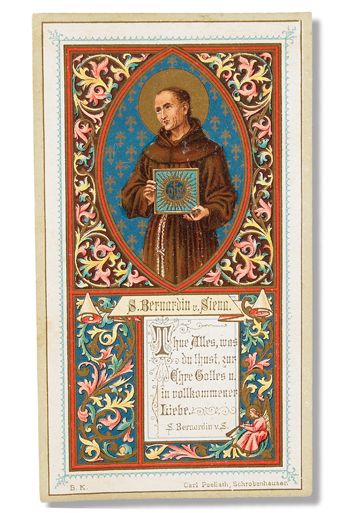
Lung Diseases / Bernadine of Siena, 1380–1444, Feast Day: May 20


An immensely popular Franciscan preacher, Bernadine vowed to preach in every part of Italy.
Thoroughly entertaining to common people, he would speak in the open air for four hours at a time. Because he often strained his voice, he suffered from hoarseness, like patients with
pulmonary problems. A master communicator, he designed the IHS visual emblem of Christ.

Other patronages: advertisers, pugilists, weavers, wool merchants

Invoked: against hemorrhages, hoarseness, tuberculosis


Judges / Ivo of Kermartin, 1253–1303, Feast Day: May 19

A lawyer from Brittany, Ivo joined the Franciscan tertiaries and became a legal representative for the poor. Appointed to higher legal offices, he was known as an extremely honest and fair judge, especially interested in the fate of orphans. After he was ordained a priest, he gave free legal advice to his parishioners.

Other patronages: Brittany; lawyers, notaries; orphans

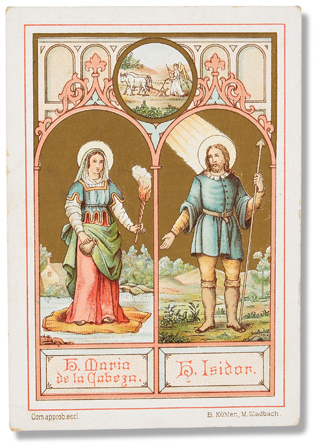
Laborers / Isidore the Farmer, 1070–1130,
Feast Day: May 15

A field hand who spent his entire life working on the same farm outside of Madrid, Isidore and his wife were simple and devout people. When their young son died, they attributed it to God’s will that they have no children, and lived chastely thereafter. They spent so much time praying that their employer suspected them of shirking their duties. When he paid them a surprise visit, he found angels plowing the fields while Isidore prayed.

Other patronages: Madrid; livestock; rural communities; farmers, ranch hands; death of children;

Invoked: for rain


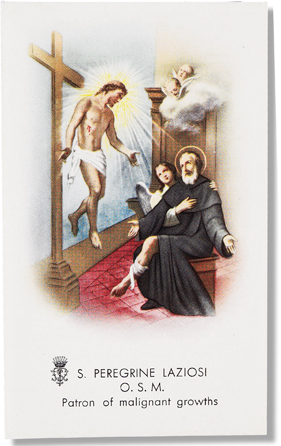
Cancer / Peregrine Laziosi, 1260–1345, Feast Day: May 1

An antipapist political leader, Peregrine converted to Catholicism after his violence against the papal legate was rebuffed with kindness. He eventually became a popular preacher, dedicating himself to working with the hopelessly ill. He himself was diagnosed with cancer. The night before he was to have his leg amputated, Christ came to him and healed him in his cell.

Other patronages: incurable illnesses, running sores

Invoked: for medical breakthroughs

The above patron saints are excerpted from the book Patron Saints: A Feast of Holy Cards by Barbara Calamari & Sandra DiPasqua

All images are from the collection of Father Eugene Carrella

Dining With the Saints

Saint Rita of Cascia

 Saint Rita of Cascia was born in the 14th century in the beautiful, hilly countryside of Umbria in Central Italy. Some years ago when I visited the neighboring town of Norcia, I noticed a lovely statue dedicated to her in the town square. In Cascia itself, a huge shrine to the Saint was built in the early 20th century, and you can still visit the house where she was born. Her feast day is celebrated on May 22.

 Saint Rita came to be associated with roses and with fresh figs, both of which are placed on altars to celebrate her Saint’s day. Evidently near the end of her life, when Saint Rita was bedridden in the convent, a cousin visited her and asked if she desired anything from her old home. Saint Rita said she would like to have a rose and a fresh fig from the garden. Since it was January her cousin didn’t expect to find either. However when her cousin went to the house she discovered, in the little snow covered garden, a single blooming rose as well as a fully ripened, edible fig, both of which she brought back to Saint Rita.

 Coincidently fresh figs come into the market right around May 22 (and in California their season extends into January, so possibly this story is not unfeasible). I thought a great way to celebrate St. Rita’s feast day would be by preparing this salad which incorporates some of May’s most fragrant and beautiful produce; fresh figs, chives, mint, and watercress.

 Green Fig Salad with Watercress, Chives, and Mint

  (Serves two)

 1 large bunch of watercress, thick stems removed

5 fresh green figs (or use the black skinned variety if you wish), cut in half

About 10 chives, chopped (with blossoms if available)

1 small shallot, very thinly sliced

A dozen fresh mint leaves

The grated zest and juice from ½ a lemon

A pinch of sugar

Salt

2 tablespoons extra virgin olive oil

Freshly ground black pepper

A small chunk of Parmigiano Regggiano

Place the watercress in a medium salad bowl. Add the figs, the chives (and blossoms if you have them), shallot, and mint leaves.

 In a small bowl whisk together the lemon juice and zest, sugar, a little salt, and the olive oil.

 Grind some black pepper over the salad and the pour on the dressing. Toss gently. Shave some thin slices of Parmigiano over the top and serve.

 Dining with the Saints is written by Erica De Mane. Her food blog can be found at http://www.ericademane.com


Novena for April

Our Lady of Good Counsel

Madonna of the Popes


(State your petitions)
Holy Virgin, moved by the painful uncertainty we experience in seeking and acquiring the true and the good,
we cast ourselves at thy feet and invoke thee under the sweet title of Mother of Good Counsel.
We beseech thee: come to our aid at this moment in our worldly sojourn when the twin darknesses of error and of evil
that plots our ruin by leading minds and hearts astray.

Seat of Wisdom and Star of the Sea,
enlighten the victims of doubt and of error so that they may not be seduced by evil masquerading as good;
strengthen them against the hostile and corrupting forces of passion and of sin.

Mother of Good Counsel, obtain for us from thy Divine Son the love of virtue and the strength to choose,
in doubtful and difficult situations, the course agreeable to our salvation.
Supported by thy hand we shall thus journey without harm along the paths taught us by the word and example of Jesus our Savior,
following the Sun of Truth and Justice in freedom and safety across the battlefield of life under the guidance of thy maternal Star,
until we come at length to the harbor of salvation to enjoy with thee unalloyed and everlasting peace. Amen.

(By Pope Pius XII, 23 January 1953)

Patron Saints for April

Italy / Catherine of Siena, 1347–1380,
Feast Day: April 29

As a young girl, she defied her parents and took up the religious life. A tertiary in the Order of St. Dominic, she tended the incurably ill. Catherine received the stigmata, and she developed a following of young people. Her series of dictated letters are classics of Italian literature. She convinced the Pope to return the Holy See from Avignon, France, to Rome, and this made her the patron of Italy.

Other patronages: Europe; fire prevention, nursing services; firefighters, laundresses; sick people

Invoked: against burns, miscarriage, temptation

Novena to Saint Catherine of Siena


England / George, d. 304, Feast Day: April 23

A soldier from Palestine fighting for the Roman army in Libya, George killed a dragon that was eating two townspeople a day. He then rescued the king’s daughter and was given a white banner with a red cross on it, which he used to convert the town. George’s cult was brought back to England during the Crusades, when soldiers reported seeing him on horseback. His banner was adapted for soldier’s uniforms and official seals in England.

Other patronages: Aragon (Spain), Catalonia (Spain), Genoa, Georgia, Germany, Greece, Istanbul, Lithuania, Moscow, the Netherlands, Palestine, Portugal, Venice; horses; the Crusades; equestrians, farmers, scouts

Invoked: against herpes, leprosy, snakebite, syphilis