Unknown's avatar

About sandra dipasqua

graphic designer

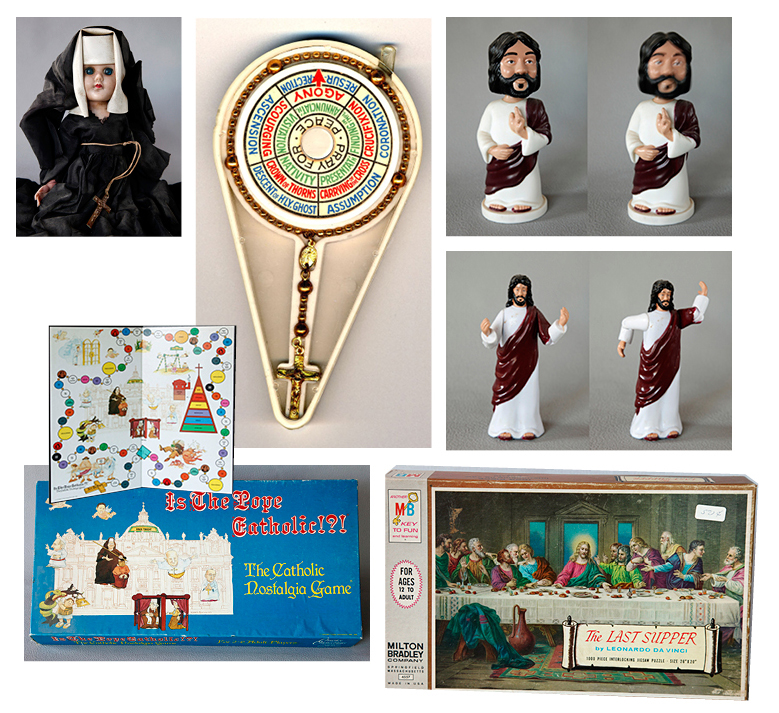
Larry Racioppo shares his Catholic toys with us.

Did you get any CATHOLIC TOYS for Christmas?

Do they still make any except for plastic Jesuses?

Here are some Catholic toys from my collection.

Plastic Jesus with articulated arms (and hidden wheels on bottom) and the bobblehead Jesus are new.

The puzzle, board game and nun doll are yard sale purchases in
poor condition.

My most unusual yard sale item, and I think most Catholic, is the ‘Agony’ toy. No matter how I move the dial, the pointer stays put on Agony.

Novena.com is interested in any Catholic toys you would like to share. We will feature them thru-out the year.

Dining With the Saints

The Feast of San Sebastian

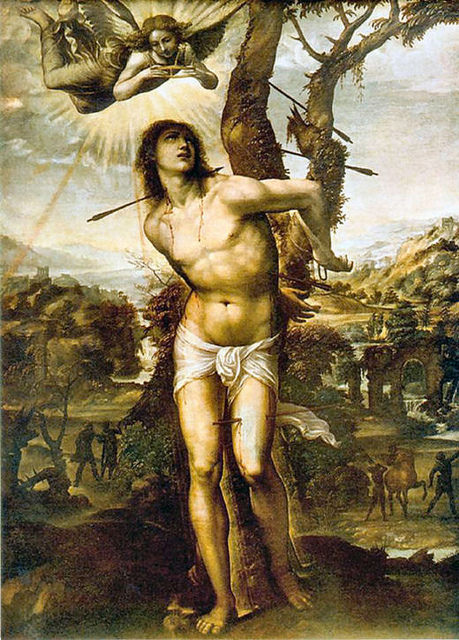
The image of San Sebastian, his young body riddled with arrows, is a strikingly familiar one to religious and non-believers alike. He was martyred for converting Christians, but has also become in recent times a symbol for the persecution of homosexuals, and his image is used in much gay art and literature.

He is a patron saint of athletes because of his physical endurance (he actually recovered from his arrow wounds), and for his energetic way of spreading and defending the faith. Saint Sebastian is also patron to all soldiers.

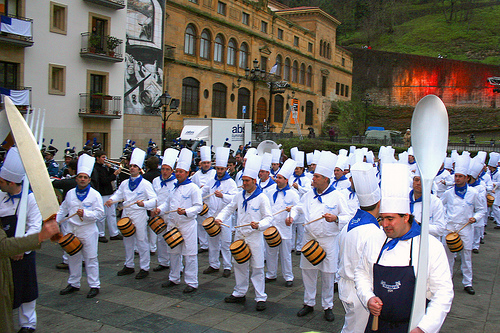
La Tamborrada is celebrated in the town of San Sebastian in Basque Spain on January 20th, San Sebastian’s feast day. This is a loud and exuberant affair where the people hit the streets to a crescendo of drum and barrel playing. The action starts at midnight on the 19th in the Parte Vieja (the old quarter) when the mayor raises the city’s flag in Plaza Konstituzioa.

People dress as soldiers and march around the town accompanied by their ear bending percussion. But the ceremony has also taken on a culinary tradition in more recent years. Nobody is completely sure why this connection was made, but people also dress as chefs and marchers representing San Sebastian’s gastronomic societies, most of which only allow male members, are always present. As you can imagine food has become the theme of this celebration and many Basque specialties are offered. One of my favorites is this traditional dish of braised tuna with potatoes and the region’s famous dried chilies. Many fine Basque wines are consumed during this festival. If you’d like to try one to accompany this lovely dish, see if you can locate a Txacoli, a crisp white DO wine from the province of Getariako Txakolina.

Marmitako

(Serves five as a main course)

2 dried ancho chiles

Spanish extra virgin olive oil (such as Nunez de Prado)

1 large sweet onion, such as a Vidalia, cut into medium dice

1 red bell pepper, seeded and cut into thin strips

2 garlic cloves, very thinly sliced

5 or 6 large thyme sprigs, leaves chopped

3 large all-purpose potatoes, peeled and cut into ½ inch cubes

½ tablespoon Piment d’Espelette (Basque semi-spicy paprika)

Salt

1 ½ pounds fresh tuna, cut into 1 ½ inch cubes

A handful of flat leaf parsley leaves, lightly chopped

Place the chilies in a small saucepan and cover them with water. Bring this to a boil over high heat. Turn off the heat and let the chilies sit in the water until softened, about ½ hour. Now slit them open and seed them. Scrape out all the flesh with a sharp knife and set it aside (you’ll have a little pile of soft chili paste).

In a large casserole heat about ¼ cup of olive oil over medium heat. Add the onion and the pepper strips and sauté until they’re just starting to soften, about 5 minutes. Now add the garlic, thyme, potatoes, the reserved chili paste, and the Piment d’ Espelette. Season with salt and sauté for a minute to blend all the flavors.  Now add warm water to cover by about 2 inches. Cover the casserole, turn the heat down a bit and simmer until the potatoes are tender, about 20 minutes.

Uncover the casserole and add the tuna. Turn off the heat and let it stand on the turned off burner for 5 minutes (the residual heat from the casserole will cook the tuna through gently. Now add a generous drizzle of fresh olive oil.

Let the casserole sit, off the burner for another 5 minutes or so to develop flavor. If you like, you can mash up a few of the potato cubes to thicken the sauce. Add the parsley. Serve in warmed soup bowls with bread that has been toasted, rubbed with a cut garlic clove and brushed with Spanish olive oil.
Dining With the Saints is written by Chef and Writer, Erica DeMane. Find her at her website: EricaDemane.com

Painting:”Martyrdom of  Saint Sebastian” by Il Sodoma (Giovanni Antonio Bazzi) 1525

Bottom photo: Feast Day of Saint Sebastian as celebrated in San Sebastian, Spain.
Novena for January

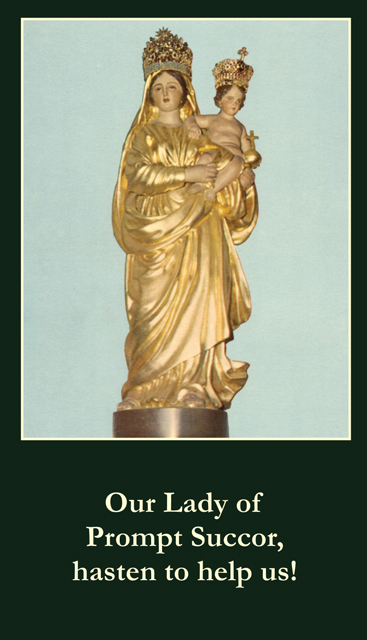
Our Lady of Prompt Succor

Our Lady of Prompt Succor is the name of a statue created about two hundred years ago as the result of a nun’s answered prayers. Devotion to the Virgin Mary under this title is extremely strong in the city of New Orleans, where the statue’s shrine is. She is invoked for a quick and favorable response by all those in need, and it is common practice for her devotees to recite the prayer, “Our Lady of Prompt Succor, Hasten to help us!” for protection against hurricanes, which frequently threaten that part of the United States.

The French Ursuline nuns, a religious order devoted to the education of young girls, first arrived in New Orleans in 1727. They created several schools with the help of nuns from Spain. In 1800 Louisiana reverted back to French control, and the Spanish nuns fled, fearing the anti-clericalism of the French government. Severely lacking in staff, the Mother superior wrote to her cousin in France for more nuns to join them. At that time, the French government made life extremely difficult for religious orders. Mother Saint Michel Gensoul, the recipient of the letter, was discouraged  by her bishop from leaving France. The order was shorthanded, and he felt he could not afford to lose any teachers to the New World. He gave her permission to write to the pope to formally request this transfer and  agreed to abide by whatever decision she received. Because he was then a prisoner of Napoleon, it seemed unlikely that the pope would even see her letter, much less grant her request.

As she sent her letter, Mother Saint Michel prayed to the Virgin, “O most Holy Virgin Mary, if you obtain for me a prompt and favorable answer to this letter, I promise to have you honored at New Orleans under the title of Our Lady of Prompt Succor.”

Much to everyone’s amazement, she received a favorable ruling from the pope in just six weeks’ time. In gratitude, she commissioned the statue Our Lady of Prompt Succor, and in 1810 brought it with her to New Orleans, where it was placed in the convent’s chapel.

During the Battle of New Orleans, the citizens of the city became truly aware of the intercessionary powers of this aspect of Mary. Louisiana had been purchased from France by the United States in 1803, but during the War of 1812 the young nation and Britain fought a second war that lasted about two years. During the last weeks of 184, the British threatened to attack and loot New Orleans. General Andrew Jackson led a smaller force of several thousand troops, mostly militiamen and volunteers, against a much larger army of experienced regular British soldiers; the people feared total defeat and destruction. By January 1815 the British army was sailing into the port and the citizens on land mobilized as best they could to defend their city. The bishop of Louisiana directed the clergy to hold public services in all Catholic churches to pray for God’s protection. The Chapel of Our Lady of Consolation at the Ursuline convent on Chartres Street was filled with praying women and children. On January 7 they prayed before the statue of Our Lady of Prompt Succor for the entire night. The mother superior of the Ursulines made a vow to have a mass of thanksgiving sung every year if the Americans were victorious. As Mass was being said on January 8 for General Jackson and his troops, it was interrupted by a courier who shouted, “Victory is ours!” The battle had lasted only twenty-five minutes and there was little loss of life for the Americans.

The mostly Roman Catholic population  of New Orleans were not the only ones who credited Our lady of Prompt Succor for help with the victory. Andrew Jackson himself insisted that the victory was a “signal interposition of heaven.” In gratitude, he went out of his way to visit the Ursuline nuns at their convent and thank them for their prayer, “Our Lady of Prompt Succor, Hasten to help us!”

Today, this original statue has been placed above the high alter in the shrine on State Street in New Orleans. Devotees from all over the United States visit it and it is a familiar stopping point for most citizens of New Orleans.

Excerpted from the book: “Visions of Mary” by Barbara Calamari and Sandra DiPasqua.

Short Novena Prayer to Our Lady of Prompt Succor


O Mary, Mother of God, who amid the tribulations of the world, watches over us and over the Church of Thy Son, be to us and to the Church, truly, Our Lady of Prompt Succor. Make haste to help us in all our necessities, that in this fleeting life Thou mayest be our succor, and obtain for us (here ask the particular favor you desire).

Help us to gain life everlasting through the merits of Jesus, Thy Son, Our Lord and Redeemer. Amen.

Our Lady of Prompt Succor, hasten to help us. (Three times)


Novena to Saint Thomas Aquinas

Novena to the Infant of Prague

Patron Saints for January

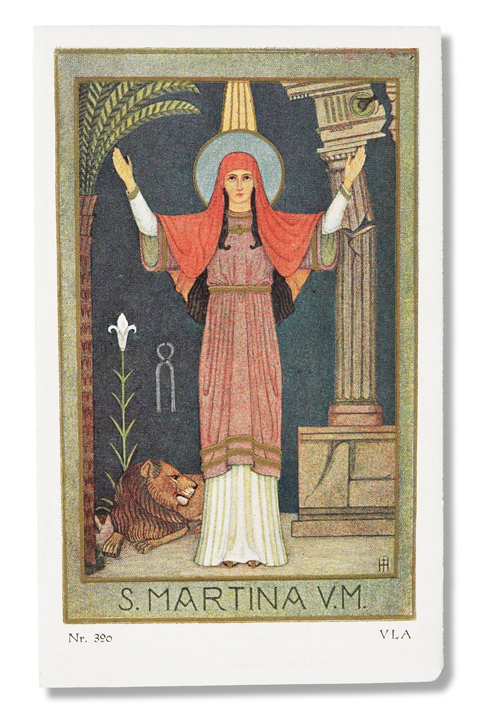
Breastfeeding / Martina, d. 228, Feast Day: January 30

A Roman noblewoman who converted to Christianity after being orphaned, her remains were discovered in the seventeenth century. Martina was said to have been tortured for days, and when she was executed with a sword, milk flowed from her body instead of blood. A church was built for her in the Roman Forum.

Other patronages: Rome

Deafness / Francis de Sales, 1567–1622,
Feast Day: January 24

A priest with great influence on the laity, Francis wrote the most popular spiritual book of the seventeenth century, Introduction of the Devout Life. He is credited with inspiring a resurgence of faith in France and Switzerland. At a time when the deaf were considered mentally deficient, he developed a method of teaching the catechism to a deaf man by using his own set of symbols and sign language.

Other patronages: Catholic Press, editors, journalists, writers

Floods / Margaret of Hungary, 1242–1271,
Feast Day: January 18

A princess whose parents promised her to God in thanks for stopping an enemy invasion, Margaret refused to leave the convent where she was placed. As an act of penance, she refused to wash and tended the hopelessly ill. Her father built her a convent of her own on an isle in the middle of the Danube River. Whenever it was threatened by flooding, she protected it with prayer.

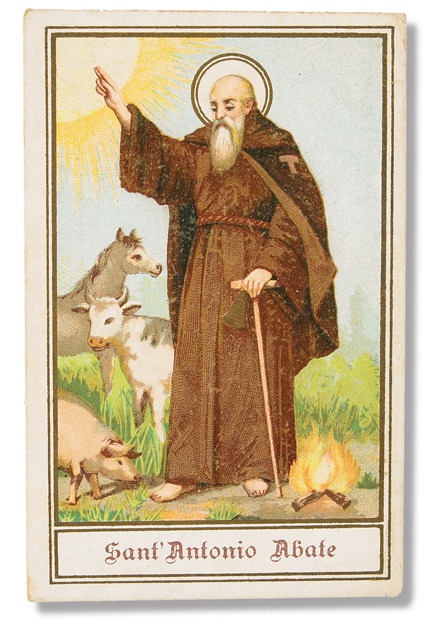
Skin Diseases / Anthony the Abbot, 251–356,
Feast Day: January 17

Known as the father of Christian monasticism, Anthony lived a solitary existence in the desert under the motto “pray and work.” Constantly tempted by the Devil, he is frequently depicted with his pet pig. In the Middle Ages, pig products were used to calm skin inflammations, and praying to Anthony was said to relieve the pain of shingles and a contagious skin disease known as “St. Anthony’s Fire.”

Other patronages: domestic animals, pigs; bell makers, bell ringers, butchers, brush makers, firefighters, gravediggers, grocers, hermits, swineherds

Invoked: against the fires of hell, infections

Dining With the Saints in Honor of Saint Antonio Abate

Chills / Placid, 515–541, Feast Day: January 15

Sent to study with Saint Benedict at the age of seven, Placid was saved from drowning in a freezing river when his plight appeared to Benedict in a vision. His father was so grateful at Benedict’s intercession that he donated the land for the great Monte Cassino monastery to the Benedictine Order.

Invoked: against drowning

Colds / Maurus, 510–584, Feast Day: January 15

A disciple of Saint Benedict, Maurus was praying with his mentor when Benedict had a vision of a fellow monk, Placid, falling into the freezing river and being carried away by the current. He ordered Maurus to rescue him. Maurus ran across the surface of the water and brought Placid to safety. He later crossed the Alps on foot and founded his own monastery.

Other patronages: charcoal burners, coppersmiths

Invoked: against chills

Animals / Gerlac of Valkenburg, 1100–1172, Feast Day: January 5

A Dutch mercenary who led a wild life as a soldier and highwayman, Gerlac was devastated by news of his wife’s death. He converted to Christianity and spent the rest of his life doing penance. After caring for the sick in Jerusalem for seven years, he went back to his native Netherlands and returned to nature, living in a hollowed-out tree and communing with the denizens of the forest.