Dining With the Saints

File:Fra Angelico 074.jpg

Blessed Fra Angelico

The early Italian Renaissance painter Fra Angelico (1395-1455) was a priest and a master in creating lush, gorgeously colored religious scenes. In his book ‘The Life of the Artists’, Vasari describes him as having “a rare and perfect talent”. As a result of his artistry and piety, Pope John Paul 11 beautified him in 1982.

His namesake Liqueur is a work of art in its own right. The hazelnut flavored drink dates back about three hundred years to early Christian monks living in the hills of Northern Italy. Even though Fra Angelico was a Dominican, it’s widely believed the liqueur was named after him.

This year to celebrate the work of this amazing artist, I’ve created a winter salad using the lovely Fra Angelico liqueur as a base for a vinaigrette.  I hope you will have an opportunity to gaze at some of his art (The Metropolitan Museum in Manhattan owns ‘The Crucifixion’) and possibly make this salad on February 18th, his feast day.

Orange and Hazelnut Salad with Fra Angelico Vinaigrette


(Serves two)


1 medium head of frisee, torn into pieces

A few sprigs of fresh tarragon, leaves lightly chopped

2 small oranges, peeled and sliced into thin rounds

A handful of peeled and very fresh hazelnuts

1 small shallot, very thinly sliced


For the vinaigrette:


1 tablespoon Fra Angelico liqueur

The grated zest from 1 orange

1 teaspoon Spanish wine vinegar

A pinch of salt

Freshly ground black pepper

3 tablespoons hazelnut oil


Place all the ingredients for the salad in a large bowl.


In a small bowl, add the Fra Angelico, the orange zest, and the vinegar. Season it with salt and black pepper. Whisk in the hazelnut oil, pour this over the salad and toss. Divide it up onto two salad plates and serve right away.


Top Image: Detail from “The Deposition of Christ” by Fra Angelico, thought to be a self portrait painted between 1437 and 1446.

“Dining With the Saints” is a monthly column by writer and chef, Erica DeMane. Check out her website: EricaDeMane.com.
Saints for February

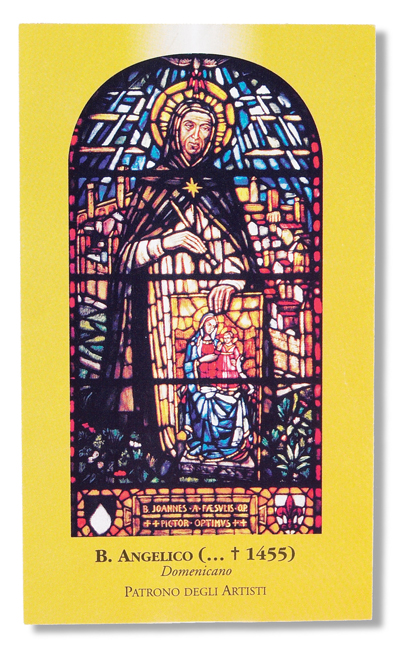
Artists / Blessed Fra Angelico, 1387–1455,
Feast Day: February 18

Born Guido di Pietro in Tuscany, Italy, Fra Angelico became a Dominican monk in Florence. Believing that one must be Christlike to visually depict Christ, he lived a truly Christian life, living humbly and nursing the sick. He meditated and prayed before beginning his paintings, which are considered among the greatest works in art history. He earned the title “Blessed Brother Angel” because of the beauty of his work and the beauty of his soul.

Bulgaria / Cyril and Methodius, 827–869 / 826–885,
Feast Day: February 14

Known as “the Apostles to the Slavs,” these two brothers gave up the comfortable lives into which they were born to become priests. They were summoned to work in Moravia, where they began to teach in the native language, instead of the traditional Greek or Latin. They are credited with inventing the Cyrillic alphabet and are also considered the fathers of Slavonic literature. After their deaths, their methods of teaching were spread to Bulgaria, Serbia, and Russia.

Other patronages: Europe; professors, teachers

Childless People / Julian the Hospitaller, dates unknown, Feast Day: February 12

A noble layman, Julian was out hunting when a stag warned him that one day he would kill his own parents. To avoid this fate, he moved far away and married. After years of searching, his parents located him and went to surprise him. Returning to his house, he saw two figures in bed. Thinking his wife was with another man, he killed them. Turning back the covers, he saw it was his parents. He and his wife then gave up everything and went on a pilgrimage. Julian did penance, helping the poor and opening a sanctuary for lepers, until he earned divine forgiveness.

Other patronages: hospitality; boatmen, circus workers, clowns, fiddlers, innkeepers, jugglers, murderers, pilgrims, shepherds

Invoked: to find lodging while traveling

Dentists / Apollonia, d. 249, Feast Day: February 9

During festivities celebrating the Roman occupation of Egypt, a violent mob began attacking Christians. Apollonia, a revered deaconess, was repeatedly hit in the face until her teeth were broken. Confronted with a raging bonfire if she did not denounce her faith, she voluntarily threw herself into the flames. Another version of this story says that she was tortured by having her teeth pulled with pincers before being burned.

Invoked: against toothache

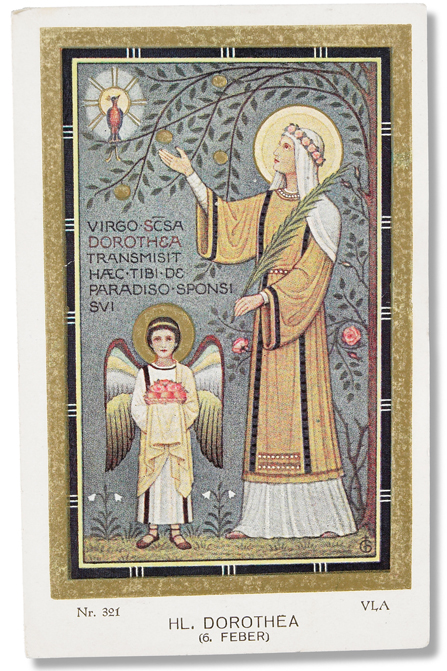
Florists / Dorothy of Caesarea, d. 311,
Feast Day: February 6

Her name means “gift of God.” Dorothy was a young Christian girl living in what is now Turkey. As she was being led away to her martyrdom, a lawyer in the jeering crowd mocked her by asking her to send him some flowers and fruits from the heavenly garden to which she was going. After her death, a child came by his house with Dorothy’s veil. Wrapped in it were three apples and three roses; this was in the middle of winter. The lawyer immediately converted and suffered the same fate as Dorothy.

Other patronages: brewers, gardeners, midwives; brides, newlyweds

Denmark / Ansgar, 801–865, Feast Day: February 3

Born in northern France, Ansgar earned the title of “Apostle of the North” by accompanying the newly baptized King Harald home to Denmark, where he set up the first Christian missions in Scandinavia. He was invited to Sweden, where he erected the first Christian church in an area extremely hostile to the new faith. As the bishop of Bremen, Ansgar witnessed the destruction of all he had worked for when the Vikings leveled his churches. His visions assured him his work would not be in vain. Two hundred years after his death, missionaries succeeded in evangelizing these northern countries in his name.

Other patronages: Germany, Iceland, Sweden

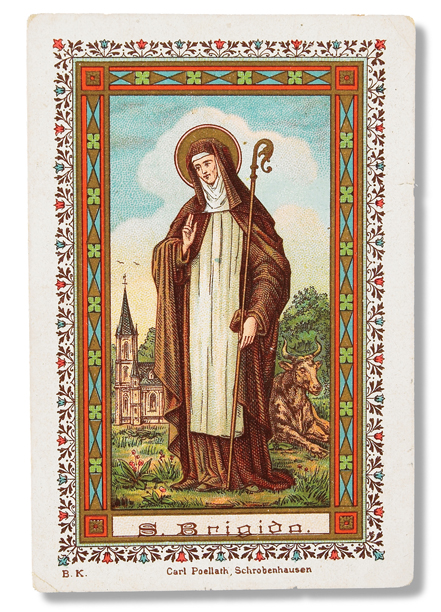
Dairy Workers / Brigid of Ireland, 453–523,
Feast Day: February 1

The daughter of a pagan king and a Christian slave, Brigid helped her mother run her owner’s  dairy with great success, despite the fact that she gave away more than they sold. After refusing to marry, Brigid entered into religious service and started the great Monastery of Kildare for men and women, which had a world-famous art school. She traveled extensively, founding religious houses throughout Ireland, and is buried with Saints Patrick and Columba.

Other patronages: Ireland, New Zealand; nuns, poultry workers, sailors, scholars, travelers; children with unmarried parents, fugitives, newborns

Invoked: against fire

Above Patron Saints excerpted from the book: “Patron Saints: A Feast of Holy Cards” by Barbara Calamari and Sandra DiPasqua. All images are from the collection of Father Eugene Carrella.

Novena for February

   Saint Blaise

One of the Fourteen Holy Helpers

D. 316     Feast Day: February 3

An Armenian bishop known for his healing powers, Blaise took refuge in a forest during a time of persecution. When many animals stayed by his side, angry hunters reported him to the authorities. While in prison, he healed a boy choking on a fishbone by praying in his cell. Condemned to death, he then promised to protect all who brought a candle to church on his feast fay. He is commemorated on his feast during the “Blessing of the Throats.”

Other Patronages:  Croatia, sick cattle, wild animals, builders, carders, laryngologists, mattress makers, swineherds, wind musicians, wool workers

Invoked against: Goiter, Throat Disease

(Above excerpt from the book, “Patron Saints: A Feast of Holy Cards” by Barbara Calamari and Sandra DiPasqua. Image from the collection of Father Eugene Carrella.)

Novena to St. Blaise to Cure Disorders of the Throat

O God, deliver us through the intercession of Thy holy bishop and martyr Blaise, from all evil of soul and body, especially from all ills of the throat; and grant us the grace to make a good confession in the confident hope of obtaining Thy pardon, and ever to praise with worthy lips Thy most holy name. Through Christ our Lord. Amen.

St. Blaise, gracious benefactor of mankind and faithful servant of God, who for the love of our Saviour didst suffer so many tortures with patience and resignation; I invoke thy powerful intercession. (Your intention here.)Preserve me from all evils of soul and body. Because of thy great merits God endowed thee with the special grace to help those that suffer from ills of the throat; relieve and preserve me from them, so that I may always be able to fulfil my duties, and with the aid of God’s grace perform good works. I invoke thy help as special physician of souls, that I may confess my sins sincerely in the holy sacrament of Penance and obtain their forgiveness. I recommend to thy merciful intercession also those who unfortunately concealed a sin in confession. Obtain for them the grace to accuse themselves sincerely and contritely of the sin they concealed, of the sacrilegious confessions and communions they made, and of all the sins they committed since then, so that they may receive pardon, the grace of God, and the remission of the eternal punishment. Amen.

My Lord and my God! I offer up to Thee my petition in union with the bitter passion and death of Jesus Christ, Thy Son, together with the merits of His immaculate and blessed Mother, Mary ever virgin, and of all the saints, particularly with those of the holy Helper in whose honor I make this novena.

Look down upon me, merciful Lord! Grant me Thy grace and Thy love, and graciously hear my prayer. Amen.

Novena to Saint Agatha  Feast Day: February 5

Novena to Our Lady of Lourdes  Feast Day: February 11