Novena for September

Saint Michael the Archangel


Justice in action and fierce protection are requested when we call on Saint Michael the Archangel. Devotions to him predate Christianity. Three major religions – Judaism, Christianity and Islam – consider him to be the greatest and most powerful of all angels. He is cited in the Book of Revelation as the angel who defeated Lucifer in his uprising against God. Lucifer, God’s most beautiful and favored angel, insisted he was equal or superior to God. He led a band of angels in a revolt against God and his omnipotence. Michael was the standard bearer against them. He defeated Lucifer and his allies and cast them out of heaven. He then took the name Mi-cha-el, meaning “Who is like God?”

 The ancient Jewish people referred to Michael as “the Viceroy of Heaven” and considered him the protector of Israel. In the New Testament he is cited as the angel that will come at the end of the world to slay the Antichrist on Mount Olivet. Saint Michael was one of the three voices directing Saint Joan of Arc in her campaign to unite France. He is said to take an active role in the world and its protection and is called upon when a group, city, or nation is in danger. Also, it is Michael who meets the soul upon its earthly death and guides it to its afterlife. He is frequently shown with a pair of scales to weigh sins and virtues. This is probably why he is the patron saint of grocers.

 From the earliest Christian times, the cults of devotion to Saint Michael were very popular, particularly in the East, where he was invoked to protect against illnesses. A church was dedicated to him in Constantinople to protect the health of the citizens in the fourth century. As his popularity spread, devotions to Saint Michael supplanted those to many of the pagan gods. In Germany, on the banks of the Rhine, he replaced Wotan, and in Roman Gaul he replaced Mercury. Statues depicting an angel with a battle helmet and sword began to appear in such far-flung places as India and Persia. On May 8, 492, he was sighted in a cave on the summit of Mount Gargano in southern Italy, causing it to become one of the first Christian pilgrimage sites. One hundred years later, as a plague raged in Rome, Pope Gregory I saw Michael sheathing a bloody sword over Emperor Hadrian’s tomb. He took this to mean that the city was now under Michael’s protection, and soon thereafter the plague ended. A church dedicated to Saint Michael was built over the tomb. It is now know as Castel Sant’Angelo (Castle of the Holy Angel). The most famous shrine to Michael is Mont-Saint-Michel in Normandy. This Benedictine abbey was found in the tenth century to commemorate an earlier apparition.

 Michael is usually shown holding a banner and a pair of scales and brandishing a sword with his foot on the neck of the devil, who is frequently represented by a dragon. Besides being the patron saint of grocers, Saint Michael is invoked to protect soldiers and policemen as well as to guard against illnesses. Because of the famous visions of Michael, there are local feast days to him on May 8 in Gargano and October 16 in Mont-Saint-Michel. His official feast day, the Feast of the Archangel, is September 29, which he shares with the archangels Gabriel and Raphael.

 Feast Day: September 29

 Patron Saint of: Grocers, Soldiers, Policemen

 Invoked for: Protection against illness

 Novena to Michael the Archangel

 Saint Michael the Archangel, loyal champion of God and his people, I turn to you with confidence and seek your powerful intercession. For the love of God, who made you so glorious in grace and power, and for the love of the Mother of Jesus, the Queen of the Angels, be pleased to hear my prayer. You know the value of my soul in the eyes of God. May no stain of evil ever disfigures its beauty. Help me to conquer the evil spirit who tempts me. I desire to imitate your loyalty to God and Holy Mother Church and your great love for God and men. And since you are God’s messenger for the care of his people, I entrust to you this special request.

(Mention your request.)

Saint Michael, since you are, by the will of the Creator, the powerful intercessor of Christians, I have great confidence in your prayers. I earnestly trust that if it is God’s holy will, my petition will be granted.

Pray for me, Saint Michael, and also for those I love. Protect us in all dangers of body and soul. Help us in our daily needs. Through your powerful intercession, may we live a holy life, die a happy death, and reach heaven, where we may praise and love God with you forever. Amen.

 (Recite one Our Father, one Hail Mary, one Glory Be.)

 Say this novena nine times in arrow for nine days in a row.

Excerpted from the book: “Novena: The Power of Prayer” by Barbara Calamari and Sandra DiPasqua


Dining With the Saints

In Honor of San Gennaro

San Gennaro (Saint Januarius in English) is the patron saint of Naples, and the city celebrates his feast day on September 19. The Christian Bishop of Naples during Roman times, Gennaro was martyred by decapitation.  His followers secretly stored his blood in glass ampules and a church was built around his relics. These ampules are held up three times a year, and they miraculously liquify. It is thought to be a sign that Mount Vesuvius will erupt if this miracle does not occur. Neapolitan communities all over the world, await the word if their city has earned the saint’s protection or not. There are elaborate religious processions through the streets in Naples, but the real focus, as far as I’m concerned, is the celebration of the city’s beautiful street food.. The celebration of San Gennaro gives New York City’s its most famous Italian Feast and with it, a huge array of street food.

If you like things fried, as I do, Naples does them better than anywhere else. At the feast you can get batter-fried zucchini flowers, calamari, artichokes, eggplant, even fried cow’s brains. Or a slice of Naples’s famous pizza margherita. Or you might require calzone stuffed with escarole or ricotta, or pizza fritta (basically a deep-fried calzone), crocche (potato croquettes), zeppole, or a sweet, flaky sfogliatelle. While the kids eat spumoni, the old men walk the streets munching on roasted chickpeas from little bags and drinking red wine out of plastic cups. That ritual seems very austere compared with everything else going on at the feast, which makes it very appealing and romantic. You can still get roasted chickpeas at the Little Italy feast in New York, but they are as hard as pebbles and, in my opinion, almost too dangerous to eat. Like most things, if you really want them right you’ve got to make them yourself. So here is my recipe for roasted chickpeas. They’re crisp and brown outside, but with a creamy center. Not only are they delicious and crunchy, but they’re almost fat-free, and they’re a great carb choice, low on the glycemic index. With all the red wine you’ll need to ease them down, they are a health meal made in Naples. For the wine, try a glass of Campanian red, such as a Lacryma Christi Del Vesuvio. Terredora is a good producer.


Roasted Chickpeas with Rosemary and Garlic

2 cups home-cooked chickpeas, drained (use good-quality canned ones if you prefer, but rinse them)
2 tablespoons extra-virgin olive oil
5 garlic cloves, unskinned and crushed with the side of a knife
Sea salt
A generous pinch of ground hot red pepper
A pinch of sugar
3 sprigs rosemary, the leaves well chopped

Preheat the oven to 450 degrees. Lay the chickpeas out on a sheet pan. Drizzle them with the olive oil. Scatter on the garlic cloves, and season everything with salt and the ground hot pepper. Toss the chickpeas with your fingers so they’re well coated with the seasoning. Spread them out again in one layer.

Roast the chickpeas until they’re fragrant and starting to brown, about 20 minutes. Pull the sheet pan from the oven, and scatter on the rosemary, and sprinkle on the pinch of sugar. Toss quickly, and put back in the oven for another 5 minutes or until the chickpeas are browned and crunchy-skinned but still have soft centers. Let them cool on the sheet pan. Serve warm or at room temperature.

Erica DeMane is a chef and writer. She the popular food blog:  EricaDemane.com 

Image: 2007 Poster from the New York City Feast of San Gennaro

Patron Saints for September

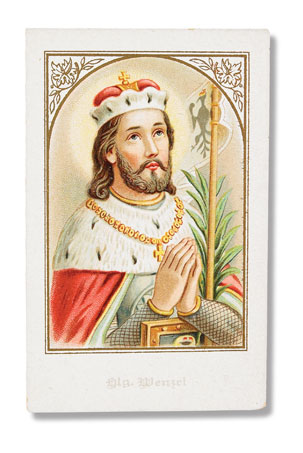
Czech Republic / Wenceslaus, 907–929, Feast Day: September 28

Influenced by his Christian grandmother, Ludmila, Wenceslaus inherited the throne of Bohemia (located within the Czech Republic) and opened international relations with other Christian countries. He was so devout that he grew the grapes for the Communion wine and prepared the bread for the Eucharist. After he was murdered by his brother outside the doors of the church, he became a national hero.

Other patronages: Bohemia, Prague; brewers; prisoners


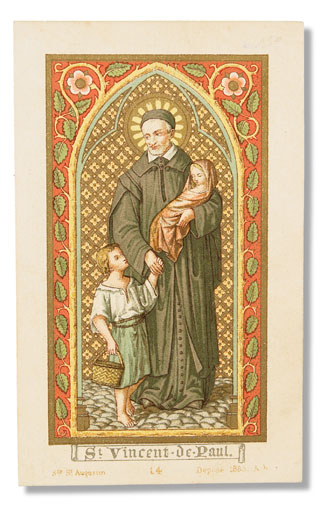
Madagascar / Vincent de Paul, 1581–1660, Feast Day: September 27

A peasant from Gascony, France, Vincent became a priest at the age of twenty. On a voyage from Marseille, he was sold into slavery by Turkish pirates. After converting his owner, he went to Paris, where he devoted himself to the poor, the forgotten, and prisoners. Depending upon divine providence, he developed a welfare system and a network of charities, which he brought to the French countryside, Scotland, Italy, and the territory of Madagascar.

Other patronages: Richmond (Virginia); charitable societies; charity workers; abandoned children, orphans, prisoners, slaves

Invoked: against leprosy

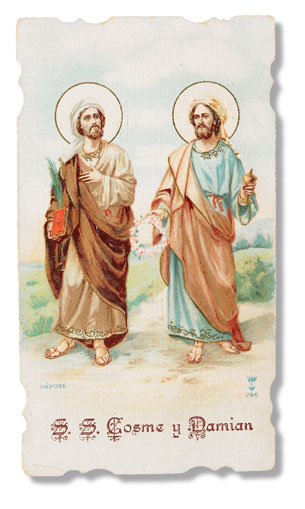
Barbers / Cosmas and Damian, d. 303, Feast Day: September 26

Twin brothers in Syria who were both holy healers, Cosmas and Damian were martyred and buried together. Devout Christians, they never accepted money for their medical treatments of people and animals. They are patrons of barbers because, in ancient times, barbers performed surgery. In Florence during the Renaissance, the Medici family adopted them as patrons and named their children after them.

Other patronages: Florence, Prague; hospitals; candy makers, chemical workers, dentists, eye doctors, druggists, midwives, surgeons

Invoked: against bladder disease, gangrene, glandular inflammation, indigestion, kidney disease


Volcanic Eruptions / Januarius, d. 304, Feast Day: September 19

A bishop martyred in nearby Pozzuoli, Januarius’ relics were moved to Naples, where a church was built to house them. A vial of his blood is preserved there. The residents of Naples traditionally
invoke the saint when they are threatened by the eruption of nearby Mount Vesuvius. The blood in the vial boils three times a year: on his feast day and on the anniversaries of successful interventions. When it does not boil, there are eruptions from the volcano.

Other patronages: Naples; blood banks; nail makers

Invoked: against the evil eye


Philologists / Hildegard of Bingen, 1098–1179, Feast Day: September 17

An abbess living on the banks of the Rhine, Hildegard of Bingen is considered one of the greatest minds of the twelfth century. She was a poet, composer, prophetess, and physician, equally at home in the arts and sciences. Her compositions are widely performed today. An adviser to popes, emperors, and other abbots and abbesses, Hildegard credited a mystical episode that occurred at the age of forty-two when she was infused with divine understanding of all she read and saw.


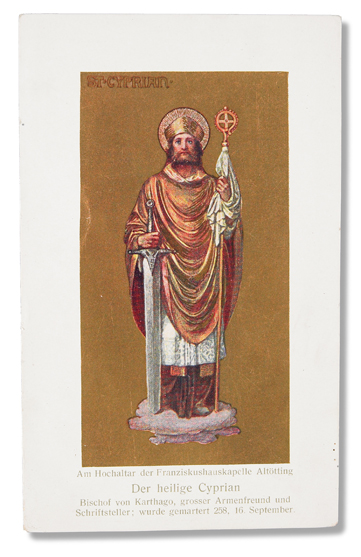
Algeria / Cyprian of Carthage, 190–258, Feast Day: September 16

Known as “the African Pope,” Cyprian did not convert to Christianity until the age of fifty. After living so long as a wealthy dissolute, he began to devote his life to chastity, obedience, and poverty. He was extremely popular throughout northern Africa and was proclaimed bishop one year after becoming a priest. His writings did much to shape the early Church. He was martyred by the Romans in his own villa.
Other patronages: North Africa

Invoked: against plague

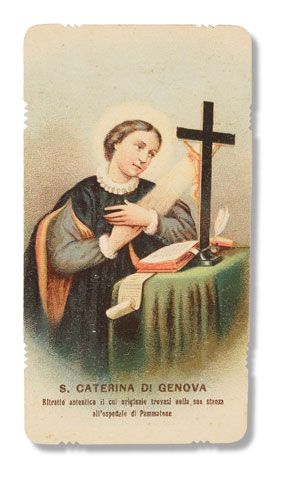
Difficult Marriages / Catherine of Genoa, 1447–1510, Feast Day: September 15

Born into Genoese nobility, Catherine was married to a rival family’s son. Her husband was an unfaithful spendthrift who reduced them to bankruptcy. He frequently complained about Catherine’s shrewish behavior. Estranged from each other, they had no children. Ten years into their marriage, Catherine experienced a blinding ray of light that completely changed her life. She converted her husband and they devoted themselves to tending the sick and the poor. Catherine’s mystical writings on purgatory are well known.

Other patronages: brides, childless people, those ridiculed for piety, victims of adultery, widows

Invoked: against temptation

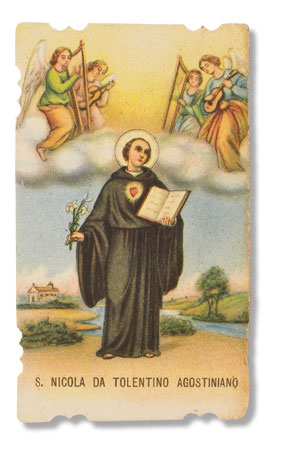
Injustice / Nicholas of Tolentino, 1245–1305, Feast Day: September 10

Born in Umbria, Italy, Nicholas was a preacher known for working miracles. When he was born, and again in the year before his death, a star was seen wherever he went. He was a peacemaker in a town torn by political strife. Nicholas worked with the poor and with prisoners, many of whom he worked to free. He was especially devoted to praying for the recently dead and the souls in purgatory.

Other patronages: Cordoba (Spain), Lima; partridges, sick animals; boatmen; babies, dying people, souls in purgatory, women in labor

Invoked: against fever, fire, thunderstorms, pestilence