Dining With the Saints

 assumption - poussin

The Feast of the Assumption


August 15th is the Feast of the Assumption of the Virgin, a national holiday celebrated throughout Italy. This is a joyous occasion that celebrates the taking of the Virgin Mary, body and soul, into heaven. It also marks the start of the summer vacation season for all Italians. Weary, irritated families start leaving big cities in droves, making their way, often in horrendous traffic jams, to every shore and mountain resort of Italy. It’s also a time when baskets are packed with traditional Italian picnic food. Anything that can be sliced, assembled, and served at room temperature, either bought or homemade, is loaded up for the journey. Frittatas cooked with summer vegetables, rice and bean salads, cheeses, fruit, bread, cured meats such as prosciutto and mortadella, and savory and sweet tortas using summer produce are all great things to bring along or prepare at a summer house. Here’s an easy torta using ripe August tomatoes and a light, easy to work with olive oil crust. Let this torta cool for at least an hour before slicing.


Tomato Tart with Pecorino and Rosemary

 (Serves four as a lunch or light dinner, or eight as an appetizer)


For the crust:

2 cups all purpose flour

2 sprigs of rosemary, leaves well chopped

Salt

¼ cup extra virgin olive oil

¼ cup water

A 9 inch tart pan with a removable bottom, preferably one with smooth not fluted sides (you can also use a tart ring, if you like)


For the filling:

 Approximately 2 doz. cherry tomatoes cut in half

1 tablespoon Dijon mustard

1 large garlic clove, peeled and smashed with the side of a knife

2 tablespoons extra virgin olive oil

2 sprigs of rosemary, leaves well chopped

1 teaspoon sugar

Salt

Freshly ground black pepper

½ cup grated young pecorino Toscano

¼ cup heavy cream

1 large egg

 In a large bowl, mix the flour with the rosemary and a little salt.  In a small bowl, stir the egg, olive oil, and water together and pour it over the flour. Stir to blend everything, and then dump the dough out onto a work surface and knead it very briefly, just until it holds together in a more or less smooth ball.  Wrap the dough in plastic wrap and let it rest, unrefrigerated, for about an hour.

 Place the tomatoes in a bowl. Add the mustard, olive oil, garlic, rosemary, and sugar. Season with salt and black pepper, and toss well. Let the tomatoes sit at room temperature, tossing them around a few times, while the dough is resting.

 Preheat the oven to 375 degrees.  Coat your tart pan with a little olive oil. Roll out the dough and drape it into the tart pan, cutting off the overhang. Sprinkle half the cheese into the tart shell. Line the tart with the tomatoes, in slightly overlapping circles. Save the juice left from the tomato marinade. Sprinkle the tomatoes with a little extra salt and black pepper.

 Whisk together the remaining cheese, cream, egg, and about a tablespoon of the tomato marinade liquid. Season with a little salt and black pepper and pour this evenly over the tomatoes. Bake until browned and set, about 35 to 40 minutes.


“Dining With the Saints” is a monthly column written by the chef and foodwriter Eric DeMane. Her website is: EricaDeMane.com

edith stein

SAINT TERESA BENEDICTA OF THE CROSS

Also known as Edith Stein

 1891 – 1942

Feast Day: August 9

Patronage: Europe, World Youth Day, loss of parents, martyrs

Symbols: carmelite habit, cross, concentration camp wire, star of David


I had given up practicing my Jewish religion when I was a 14-year-old girl and did not begin to feel Jewish again until I had returned to God.”

                                        Edith Stein


            Edith Stein was a brilliant scholar of philosophy who was born a Jew, declared herself an atheist, converted to Catholicism and joined the Carmelite Order taking the name Teresa, Blessed of the Cross. From her isolation she wrote meitative studies and prayed for the world. Though cloistered in the neutral country of Holland for her protection during World War II, she was not spared from being gassed by the Nazis at Auschwitz.

             Born in Breslau, Germany on the Jewish Day of Atonement, Edith Stein was the youngest of 11 children in a traditionally Jewish family.  Her father ran the family’s large timber business and when he died suddenly when Edith was two. Her mother, was forced to fend for herself and her children, took control of the floundering company and proved herself to be a brilliant businesswoman. Though opportunities in higher education had only just opened up for women in Prussia, she mother stressed the value of higher education for all of her children, male and female alike. Edith’s sisters became doctors and teachers. Edith, who was a child prodigy, reading Friedrich Schillers since she was six year old, was fascinated by philosophy. Her mother encouraged her to become a lawyer but then acknowledged that Edith probably knew best about her own career.

            As a teenager, Edith became an atheist and stopped practicing her religion. In her own words she was a “radical suffragette” passionately devoted to women’s issues. She immersed herself in the study of philosophy, and in 1913  transferred to Gottingen University where she was accepted as a student by Edmund Husserl, the philosophic genius who developed Phenomenology, an early form of Psychology devoted to the individual’s view of reality. Husserl had a great influence on the intellectual and philosophical circles of his day and many of Germany’s best young minds vied to be near him. He recognized Edith Stein’s keen intelligence  and appointed her as his teaching assistant. Edith was fascinated with find the truth in everything. Phenomenology stresses the importance of returning to “things”. Not viewing the world as the individual perceives it, but as it is without preconceived notions. Between 1916 and 1921 Edith Stein wrote four treatises for Husserl’s journal that are still required reading for students of this philosophy, as many feel she surpassed her mentor in explaining and exploring his theories.    

            During the First World War  she volunteered as a nurse in an Austrian field hospital and was confronted with the spectre of young people dying and suffering on a daily basis. When a good friend – one of Husserl’s assistants – was killed in the war, Edith was paralyzed with grief. Moreover, she dreaded seeing his widow as she felt incapable of offering any solace. To her amazement, it was his widow, a devout Protestant,  who comforted Edith. She writes of this time as “…my first encounter with the Cross and the divine power it imparts to those who bear it…”  Phenomenologists did not share the prejudice against religious beliefs that is common among scientists and intellectuals. Though Husserl himself was an agnostic, a good number of his students were adapting Christian beliefs. While writing her dissertation “The Problem of Empathy”, Edith visited the Frankfurt Cathedral. To her amazement, she saw a woman come straight from the market with her groceries and enter the church to say a brief prayer. Years later she wrote, “This was something totally new to me. In the synagogues and Protestant churches I had visited, people simply went to the services. Here, however, I saw someone coming straight from the busy marketplace into this empty church, as if she was going to have an intimate conversation. It was something I never forgot.”

            Anticipating a day when women would be allowed to become professors, Edith earned her doctorate summa cum laude in 1917. In her pursuit of absolute objectivity of judgement she read religious tracts and wrote articles about the philosophical foundation of psychology. Though still an atheist, Edith tried doing Ignatius Loyola’s Spiritual Exercises, out of curiosity. To her own surprise, she found in herself a thirst for God. While vacationing with friends – recent Protestant converts and students of Husserl’s – Edith happened on the autobiography of Teresa of Avila. She devoured it in a single night and exclaimed, “This is the truth!” She seemed to assimilate and fully identify with the inner spiritual journey of the great Spanish mystic. Since Teresa of Avila was part Jewish herself, Edith felt her to be a kindred spirit in her search for truth. She believed that she belonged to Christ not only spiritually, but through her bloodlines as well. The study of Catholicism became her new passion and she was baptized on January 1, 1922 with the future intention of becoming a Carmelite nun in the footsteps of Teresa of. Avila. Though her mother was devastated by her daughter’s decision, she retained a close relationship with her youngest child.

            Her desire to live in seclusion from the world by becoming a cloistered nun were discouraged by her spiritual directors. They insisted that she employ her true talents as a teacher and scholar. Throughout the 1920’s she worked in the Dominican Sisters’ school as a German and history teacher, positions far beneath her abilities. She also ran a teacher training course at Saint Magdalen’s Convent in Speyer. She was a popular speaker on women’s issues and she returned to her philosophical roots by translating Thomas Aquinas and then writing a study of his central concepts using her background in Phenomenolgy to base her thoughts on. All the while, Edith kept in close contact with the Benedictine Monastery of Beuron, going there to celebrate holy days and to continue her contemplative exercises.

            By 1932, laws against hiring women in academia were relaxed and Edith had assumed a lecture position at the Institute for Educational Studies at the University of Munster. When the National Socialists took over the government in 1933, Edith suffered first hand the persecution that the Jews of Germany were experiencing. New racial laws forbid the hiring of Jewish Professors and Edith’s career ended. Her attempts to gain an audience with Pope Pius XI and her requests that he write an encyclial against the persecution of the Jews were never acknowledged. She turned down an opportunity to work in Argentina, preferring to remain in Germany. “By now it dawned on me that God had laid His hand heavily on His people, and that the destiny of these people would also be mine.”

            Edith was accepted into the Carmelite Convent in Cologne. She went home to say goodbye to her family, attending synagogue for the holy days with her mother. She has said that this was the most difficult thing she had ever had to do. Her mother wept in inconsolable despair. Edith wrote to her mother every week from the convent but never received a response. She was invested in the Carmelite order in April of 1934, taking the name Teresia Benedicta a Cruce, Teresa, Blessed of the Cross. At 42 she was almost 20 years older than the other novices. After so many worldly honors she found doing such chores as cooking and sewing for the first time in her life “a good school for humility”. 

            She discovered that by entering the Carmelite Order she was not escaping the world but using the time spent in isolation and prayer to intercede for the world. She particularly concentrated on the plight of the Jews in Germany, “I keep thinking of Queen Esther who was taken away from her people precisely because God wanted her to plead with the king on behalf of her nation. I am a very poor and powerless little Esther, but the King who has chosen me is infinitely great and merciful. This is great comfort.”

            After her Final Profession in 1938, Edith was again researching and writing full time. Her mother had died in 1936 and one of her older sisters, Rose  had joined her in the convent. When the mass deportations of Jews began, her superiors transferred Edith and Rose to a convent in Echt, in the neutral country of Holland. Edith spent these years writing meditative studies on the cross and its meaning. Her last work was an essay on Saint John of the Cross, the father of the Discalced Carmelite Order. It was his words, “Henceforth, my only vocation is love.” that she had quoted at her induction into the convent.

            In January of 1942 Holland fell under Nazi occupation and both Edith and Rose were forced to wear the star of David on their habits. On July 26, 1942 every Catholic church in Holland read a Pastoral letter from Archbishop Jong condemning the Nazi deportations of the Jews. Reprisals were immediately taken. The SS began arresting all Catholics of Jewish origin and deporting them to death camps. On August 2 two SS officers came to the convent and demanded the Stein sisters accompany them. Edith’s last known words were, “Come, let us go for the sake of our people.” Forced into cattle cars with thousands of others, it took them four days to reach their final destination, Auschwitz. They died in the gas chambers on August 9, 1942.

             Because of her great notoriety as a scholar, there are numerous photographs of Edith Stein throughout her career. In art she is depicted as a nun with the Star of David on her habit. In recent years a debate  has questioned the church’s usage of “martyr” to categorize her since she was not killed for being a Christian but for being born a Jew. But since she was deported and executed as a response to the Church in Holland’s stance against Nazi genocide, the term “martyr” is an apt one.


                   Prayer for the Intercession of Saint Teresa Benedicta


                               Lord, God of our fathers, You brought Saint Teresa Benedicta

                         to the fullness of the science of the cross at the hour of her martyrdom.

                               Fill us with the same knowledge, and, through her intercession,

                                       allow us always to seek after you, the supreme truth,

                                     and to remain faithful until death to the covenant of love

                        ratified in the blood of your Son for the salvation of all men and women.

                                                  We ask this through Christ, our Lord.

                                                                          Amen

Excerpted from the book “Saints: Ancient and Modern” by Barbara Calamari and Sandra DiPasqua



RAF53258

SAINT CLARE OF ASSISI


Abbess and Founder of the Poor Clares


1193-1254

Feast Day: August 11

Patron of: embroiderers, eye disease, gilders, goldsmiths, laundry workers, occulists, telephones, television

Invoked: against fever, against blindness, for good sight

Symbols: monstrance, cross, olive branch, lily, sometimes a lamp


 “Love God, serve God: Everything is in that.”

                                                Clare of Assisi


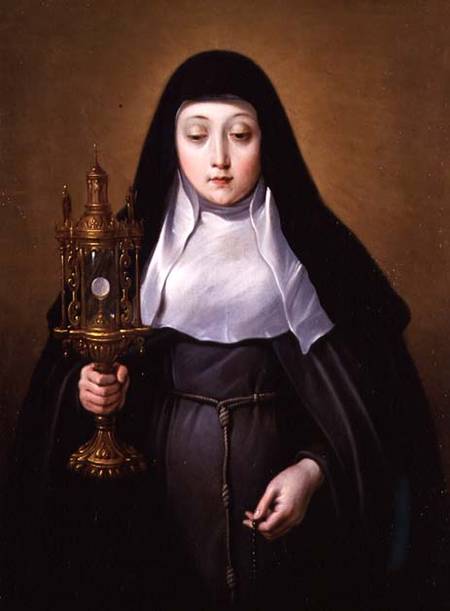
            Without ever leaving  her convent on the outskirts of Assisi, Saint Clare founded orders of nuns throughout Italy, France, and Germany. Though she maintained a vow of silence, Popes, Cardinals and royalty came to her for spiritual advice. Only twelve years younger than her mentor, Saint Francis of Assisi, she quietly helped him lead a movement of young people that confronted the church hierarchy for their material excesses and  revolutionized religious expression by embracing simplicity and poverty.

            Chiara Offreduccio was the daughter of a wealthy Count and Countess in Assisi, Italy and displayed little interest in the worldly advantages offered by her highborn state. She was eighteen and destined for an arranged, profitable marriage when she heard Saint Francis deliver the Lenten sermon at her church.  Inspired by his simple message of living with complete trust in God, she conspired to run away and live like this new order of mendicant friars, dependent solely on alms received from begging. The turning point for her occurred on Palm Sunday of 1212 . That day, Clare went to the Cathedral of Assisi in her finest clothes for the blessing of the palms. While others went to the altar rail to receive their palms, she sat in her seat, too shy to move. With the entire congregation as witnesses, the bishop stepped down from the altar and delivered the palms to her. She took this as a sign to act on her plan.

            Homes in Assisi were built with two doors, one for regular use and one called the Door of the Dead, opened only to remove a coffin from the house. That night, Clare secretly cleared the debris from the Door of the Dead and stepped through it, renouncing her former life and the material world forever. She slipped through the woods to the chapel of the Portiuncula, where Francis and his small community of men were at prayer. Clare exchanged her finery for a penitential tunic of coarse cloth tied with a rope, and  Francis cut off her luxurious hair in front of the Blessed Virgin’s altar. Having no separate living facility for women, he then took her to the local Benedictine convent.

            Clare’s family embarked  on a rescue mission, sparing no expense. During a violent struggle to drag Clare her from the convent, her clothing was torn off, and her shorn hair revealed. She declared to her shocked father, “The only spouse I will have is Christ, and further attempts to remove me from my chosen life will make me more steadfast!”  Her powerful father had to submit to her will and leave her behind. To his great anguish his younger daughter Agnes joined Clare two weeks later. Thus began a retreat of wealthy young women turning their backs on privilege and society in order to follow a higher spiritual path. Francis of Assisi had offered his peers a way of living that shook the foundations of society in the Middle Ages. Instead of becoming dependent behind the walls of staid, established religious orders, he encouraged his followers to exist in a day-to-day manner, experiencing nature and depending on the good will of others. The joy he and his band of friars exuded was infectious and he developed a following wherever he went. Clare was the first young woman with the courage to join him. 

            In 1215 when Clare was twenty two years old, Saint Francis installed her as the Abbess of the Order of Poor Ladies in a small house across from the Church of San Damiano. These women followed the Franciscan rule, forbidden to own property or material goods and entirely dependent on the alms the Friars Minor could beg for them. Upon the death of her father, Clare did not veer from Saint Francis’s teachings. She gave her vast inheritance to the poor rather than to her own religious community. This act of devotion caused much controversy – church authorities expected women to give their dowries to the religious orders they joined. This was to ensure that the nuns would be supported throughout their lives and would not serve as a burden to their parish communities.

            Despite this disagreement with church hierarchy, convents of “Poor Clares” as the order became known, were started in cities all over Italy, gradually spreading to France and Germany. These first convents attracted many educated and wealthy women who not only walked away from titles and estates but also lived in a state of self imposed austerity that was considered extreme for men and unheard of for women. They went barefoot, wore sackcloth, slept on the ground, ate no meat and maintained a vow of silence, speaking only out of necessity. Agnes, daughter of the King of Bohemia, broke her engagement to become Empress of the Holy Roman Empire to start an order of Poor Clares. The correspondence between Agnes and Clare leaves a lasting portrayal of the intellectual brilliance and good nature of the order’s founder.

            Because of her great mind,  Saint Clare was an invaluable advisor to Saint Francis. When he was wrestling with the choice of becoming a religious hermit or going out in the world to evangelize his movement, she encouraged him to go out to the people. It was Clare who nursed Francis through the last days of his life, and it was under her care that he composed one of his greatest works, “Canticle of the Sun.” After Francis’s death Clare could never be convinced to relax his strict rules of poverty remaining the most loyal adherent of his teachings.

            Though she was Abbess of her own order of nuns, Clare lived as humbly as possible. She served at the table, tended the sick and washed the feet of the lay sisters when they returned from begging. Because of the austere manner in which she lived, Clare’s health suffered, and  like Francis, she had the reputation for mystical powers. When she prayed she exuded a rainbow aura  and enjoyed a silent rapport  with animals. While bedridden, she would embroider altar cloths for neighboring churches and her cat would bring her whatever she needed..

            In 1234 the army of Frederick II was at war with the Papal States, and the convent of Poor Clares came under attack by a band of Saracen mercenaries. Clare rose from her sick bed and took a monstrance containing a host from the chapel. While ladders were being set up for the invaders to scale the walls, Clare calmly prayed, “Does it please Thee, O God, to deliver into the hands of these beasts the defenseless children whom I have nourished with Thy love? I beseech Thee good Lord, protect these whom now I am not able to protect.” She then heard the voice of a child saying, “I will have them always in my care.” In response, she turned to the terrified nuns and told them to have no fear but to trust in Jesus. In that instant, the attackers were seized with an incredible wave of dread and they fled the convent. The citizens of Assisi credit Clare with saving them from a later assault by the same army. Telling her nuns that they needed to support the city which had given them so much charity, she had them pray through a day and night until the attacking army inexplicably gave up and retreated.

            Two days before her death at the age of 59, Pope Innocent IV approved the rule for her order which she had formally written herself. As she lay on her death bed her sister and the early followers of Saint Francis were at her bedside, reciting the same prayers for her as they had said for him.

            In art, Saint Clare is usually depicted holding the monstrance which she held in driving out the Saracens. Those working in embroidery as Clare did, frequently suffer from eye problems, and so she is their patron as well as patron to those who treat the eyes. Because gold work requires intense use of the eyes, gilders are also under her patronage. Because her name ‘Chiara’ means “clear”, she is called upon for clarity of vision.  Since laundresses work at dawn and her name reminds one of the effects of the rising sun, they are also under her protection. Vision and clarity accompanied Clare throughout her life. When she was too ill to attend Christmas midnight mass, she was able to visualize it on her wall, amazing those who did attend by relaying exact information of the events. Because of this miracle she was named the patron of television, telegraph operators and the telephonein 1958.


Prayer of Saint Clare of Assisi


                                    Go forth in peace, for you have followed the good road.

                             Go forth without fear, for he who created you has made you holy,

                                     Has always protected you, and loves you as a mother.

                                          Blessed be you, my God, for having created me.


Excerpted from the book “Saints: Ancient and Modern” by Barbara Calamari and Sandra DiPasqua

Novenas for July

maria goretti1

SAINT MARIA GORETTI

1890 – 1902

        Because of her gentle nature, Saint Maria Goretti has been called the Saint Agnes of the twentieth century; but unlike the ancient girl martyrs before her, Maria Goretti was not a heroic victim of the state. Murdered for refusing to submit to rape, her tragic fate was transformed into a remarkable example of the healing power of forgiveness. It is the amazing work that she accomplished after her death that caused her to be canonized as a saint in 1950. Through her intercession, her unrepentant killer became living proof of the power of love and forgiveness to transform an individual. His visions of Maria offering him flowers so moved him that his testimony became crucial in her canonization. Saint Maria Goretti is the patroness of rape victims and young girls. She is called upon for comfort, strength and guidance. She is particularly sympathetic to the plight of young teenagers in the face of peer pressure. Her own story is an illustration of how great good can supplant evil.

      Maria Goretti was born in Ancona, Italy, in 1890. She was the third of six children. Her family moved to Nettuno, where her father worked as a field hand. His death of malaria in 1900 left the family destitute, forcing his wife to take his place in the fields while Maria stayed home and cared for the younger children. Alessandro Serenelli, the twenty-year-old son of a neighboring farmer, began pestering Maria while her mother was away at work. Not wanting to cause trouble for his family, she rebuffed him as best she could, without telling anyone. On the evening of July 5, 1902, as she sat mending a shirt and minding her baby sister, Alessandro burst in and dragged Maria into the bedroom. She refused his sexual advances and he stabbed her fourteen times, leaving her for dead. She was found by family members and rushed to a hospital, where she clung to life for another twenty hours, during which time she expressed great concern for the plight of her mother and also for the soul of Alessandro Serenelli. She said that she fully forgave him and that she wanted him to be with her in paradise. Maria Goretti died immediately after making this statement. She was just eleven and a half years old. Unrepentant, Serenelli was convicted and sentenced to thirty years in prison. In the eight year of his incarceration he had a vision of Maria standing in a garden, dressed in white with an armful of lilies. Smiling at him lovingly, she beckoned him and encouraged him to take the flowers. As he accepted them, each lily transformed into a still, white flame. Stricken with remourse, Alessandro became totally devoted to the memory of the girl he had murdered. When he was released from prison in 1930, the first thing he did was beg Maria Goretti’s mother for forgiveness.

      The story of Maria Goretti’s forgiving words became world famous. Soon after her death people began to pray to her for strength and guidance. Many, along with Serenelli, attested to her positive intervention. He cult became so popular that there were 250,00 people crowded into Vatican Square on the day of her canonization. Saint Maria Goretti is depicted with the martyr’s palms and her bouquet of lilies.

 Saint Maria Goretti is the Patron Saint of: Young Girls, Rape Victims

She is invoked against: Peer Pressure

 Feast Day: July 6


NOVENA TO SAINT MARIA GORETTI

Saint Maria Goretti, strengthened by God’s grace, you did not hesitate, even at the age of eleven, to sacrifice life itself to defend your virginal purity. Look graciously on the unhappy human race that has strayed far from the path of eternal salvation. Teach us all, and especially our youth, the courage and promptness that will help us avoid anything that could offend Jesus. Obtain for me a great horror of sin, so that I may live a holy life on earth and win eternal glory in heaven. Please intercede for me in obtaining the favor I now ask. Amen.

(Mention your request).


(Recite one Our Father, one Hail Mary, one Glory Be).

Say this novena nine times in a row for nine days in a row.

Excerpted from the book “Novena: The Power of Prayer” by Barbara Calamari and Sandra DiPasqua.

joachim and anne giotto

SAINT ANN AND SAINT JOACHIM

 First Century, BC

            Novenas to saints Joachim and Ann, as the parents of the Virgin Mary and the grandparents of Jesus Christ, are known for their intense power. Having suffered almost every trial a couple on earth may experience, they are approachable for the solving of any family crisis. Shamed by infertility, they were married for twenty years before they had their only child. They faced their daughter’s unexpected pregnancy and her near-desertion by her fiancé with great faith and tolerance. After Saint Joachim died, Saint Ann, in the throes of widowhood, watched as her beloved grandson became a prisoner and was crucified. Saints Joachim and Ann offer the loving acceptance and wisdom of grandparents, and one should never be ashamed to turn to them for any reason.

            Very little factual information is available about the parents of the Virgin Mary. Saint Ann is said to have been twenty years old when she married the forty-nine-year-old Joachim. Comfortable financially, they lived in Nazareth and were faithful followers of the Jewish religion. Each year they divided their income into thirds, offering the first part to the temple for the worship of God, distributing the second to the poor, and keeping the third to maintain their moderate lifestyle. Their great misfortune was their barrenness. At the time, this was considered a divine punishment, and it led ultimately to Joachim’s offering being refused at the temple. Their community began to snub them, considering them inferior. Both Ann and Joachim made a vow to the Lord that if they did have a child, they would consecrate it to his service. After twenty years of marriage and no children, and once again humiliated when his offering to the temple was rejected, Joachim, too ashamed to return home, went to live among his shepherds. There, an angel came to him, ordered him to return to his wife, and told him that she was pregnant, saying, “Delayed conceptions and infertile childbearing are all the more wonderful! Your wife will bear you a daughter and you will call her Mary. As you have vowed, she will be consecrated to the Lord from infancy and filled with the Holy Spirit from her mother’s womb.”  Simultaneously, Saint Ann had been given the same news. She gave birth to the Virgin Mary at the age of forty. Saint Joachim was sixty-nine. Devoted to God, they raised Mary accordingly. True to their promise, they sent her to live in the temple to serve God when she was three years old. This was an extremely difficult act of faith on their part, surrendering the one thing they cherished most to God. So it was that Mary never lived among common people. She was given extraordinary parents and a sheltered, religious life in the service of God.

            Saint Ann is the better known of the two saints and her cult goes back to the beginning of the church. She is the patroness of housewives and women in labor. Because she kept her home in perfect order, she is the patron of cabinetmakers. In Brittany, Saint Ann has an exalted place. There were many sightings of her there in the 1600s. She is also the patroness of Canada.

Saint Ann is the patron Saint of : Housewives, Pregnancy, Family Crisis, Cabinetmakers, Brittany and Canada. She is invoked against: Infertility.

Together, Saints Ann and Joachim are the Patron Saints of Parents and Grandparents.


Their Feast Day is July 26.


Novena to Saints Joachim and Ann

Saints Joachim and Ann, grandparents of Jesus and parents of Mary, we seek your intercession. We beg you to direct all our actions to the greater glory of God and the salvation of souls. Strengthen us when we are tempted, console us during our trials, help us when we are in need, be with us in life and in death.

O divine Savior, we thank you for having chosen Saints Joachim and Ann to be parents of our Blessed Mother Mary and so to be your own beloved grandparents. We place ourselves under their patronage this day. We recommend to them our families, our children, and our grandchildren. Keep them from all spiritual and physical harm. Grant that they may ever grow in greater love of God and others.

Saint Joachim and Ann, we have many great needs. We beg you to intercede for us before the throne of your divine Grandson. All of us here have our own special intentions, our own special needs, and we pray that through your intercession, our prayers may be granted. Amen.


(Mention your request here).


Say this novena nine times in a row for nine days in a row.

 Excerpted from the book “Novena: The Power of Prayer” by Barbara Calamari and Sandra DiPasqua.

OurLadyOfMtCarmelsmall

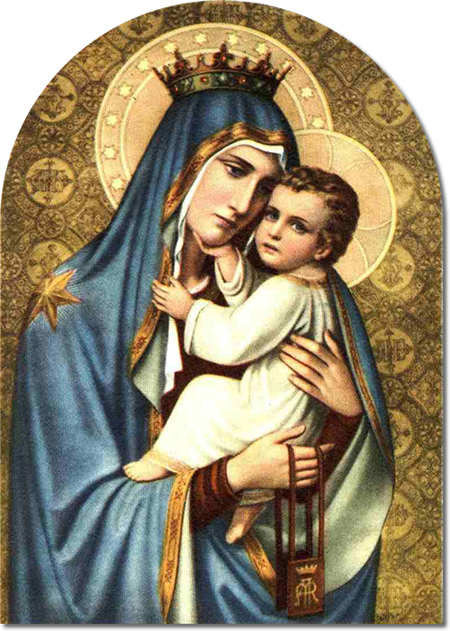
OUR LADY OF MOUNT CARMEL

             In this novena, we are offered the protection afforded us from being a member of a family.  The more extensive our family, the more safely we are able to walk through the world. Our Lady of Mount Carmel represents the role of Mary as mother of the family of man and honors Mary’s protection of the ancient sect of contemplatives who settled Mount Carmel, as well as the symbol of this protection, the scapula. Those who wear this religious picture in present day declare their commitment to Jesus. Devotion to Our Lady of Mount Carmel is extremely widespread throughout the world. This novena is particularly effective when we are feeling vulnerable and in need of protection. All are welcome to recite it. In saying this novena, one accepts a role in the extended spiritual family of the Carmelites.

             The spiritual legacy of Mount Carmel goes back to 800 BC, when the prophet Elijah ascended the holy mountain of Carmel in Israel and began a life of contemplation and prayer. In his prophetic visions, Elijah became aware of the coming of the Mother of God. He and his followers mystically dedicated themselves to her, and it was the descendants of the followers of Elijah who were the first to be baptized by the Apsotles.  Upon meeting Mary, they were overcome with her majesty and sanctity and they returned to the mountain of Carmel to build the first chapel ever dedicated to the Madonna.

             Mount Carmel continued to be a place of pilgrimage and spiritual retreat, housing many hermits who devoted themselves to prayer and contemplation.  These hermits became the first order of Carmelite friars. During the Crusades, the Saracens began making it difficult for these monks to continue these holy practices. A young English pilgrim, Saint Simon Stock, had joined the group while on a visit to Jerusalem. This ultimately resulted in the order’s move to England in the year 1241. The Baron de Grey gave the monks a manor house in the town of Aylesford. In England, the Carmelites developed from a loose-knit group of monks into a traveling society of mendicant friars, opening schools and mission houses in the major capitals of Europe.  In 1251, Saint Simon Stock had a vision of Mary in the house in Aylesford. She handed him the first scapular and said, “This shall be the privilege for you and all Carmelites, that anyone dying in this habit shall not suffer eternal fire.”  This scapular consisted of two brown wool panels joined by strings, to be worn over the shoulders. On one panel was a woven image of Mary holding the baby Jesus. Today, the scapular has this image on one panel and an image of Mary handing the scapular to Saint Simon Stock on the other. The word “scapular” comes from a form of clothing worn over the shoulders as an apron; it is part of the religious habit of monks, nuns and friars.

             Through the years the scapular given to Saint Simon Stock became the symbol of a way of life and an expression of being open to God and his will. It also honors Mary by asking her for her protection, and it establishes a bond between us and the original saints of Mount Carmel.

 Feast Day of Our Lady of Mount Carmel: July 16

 Our Lady of Mount Carmel is invoked for: Protection, Universal Family


Novena to Our Lady of Mount Carmel

O most holy mother of Mount Carmel, when asked by a saint to grant privileges to the family of Carmel, you gave assurance of your motherly love and help to those faithful to you and to your Son. Behold us, your children. We glory in wearing your holy habit, which makes us members of your family of Carmel, through which we shall have your powerful protection in life, at death, and even after death. Look down with love, O Gate of Heaven, on all those now in their last agony! Look down graciously, O Virgin, Flower of Carmel, on all those in need of help! Look down mercifully, O Mother of Our Saviour, on all those who do not know that they are numbered among your children! Look down tenderly, O Queen of All Saints, on the poor souls!

(Pause and mention your request).

(Recite one Our Father, one Hail Mary, one Glory Be).

Our Lady of Mount Carmel, pray for us.


Excerpted from the book “Novena: The Power of Prayer”  by Barbara Calamari and Sandra DiPasqua
Dining With the Saints

madonna-fiumarola

Festa dei Noantri

 July 16th, the feast day of La Madonna del Carmine, is celebrated throughout Italy, but in the Trastevere district of Rome the day has a special significance. Since around 1920, the festival there has been called Festa dei Noantri or La Madonna de Noantri, our own Madonna, because, legend has it that in 1535 a group of Roman fishermen pulled a wooden case from the Tiber that contained a statue of the Madonna. This revered Madonna became the protector of all Trasteverini. Today that same statue resides in the Church of St. Agatha. Every summer on the Saturday before July 16th, La Madonna dei Noantri is carried, in an elaborate procession, from her home in St. Agatha’s through the streets of the Trastevere to the church of St. Crisogono, several blocks away, where she spends the eight days while the festival is in full swing. At the conclusion of the festival, the Madonna is placed on a boat for a short ride on the Tiber to Ponte S. Angelo. Crowds line up on bridges to watch and cheer as she takes her symbolic sail. The procession then continues on land, taking the Madonna through the streets once more, back to her home at St. Agatha.

 During the eight days of this jubilant festival, restaurants and shops set up food stands on the streets of the Trastevere. Wine from the Castelli Romani area, just south of Rome, is drunk in large quantities. Stalls selling thick slices of porchetta, a slow cooked pork loin seasoned with garlic and rosemary, are everywhere. You can buy skewers of grilled lamb or chicken, or plates of bucatini carbonara or spaghetti tossed with spicy tomato sauce and pecorino Romano. Sweet Ricotta cakes are also a tradition. Everyone strolls around the piazza under strings of lights, drinking, dancing, and singing. And since it’s high summer many places offer bruschetta, toasted Roman bread, topped with summer vegetables of all types. Here are two you might want to try for your own celebration.


(Both recipes serve eight)


Bruschetta with Broccoli Rabe, Summer Garlic, and Pecorino Romano


2 bunches of broccoli rabe, well stemmed

Salt

Extra virgin olive oil

3 cloves of fresh summer garlic, thinly sliced

1 small fresh red chili, minced (seeded if you like less heat)

A generous pinch of ground fennel seed

A squeeze of fresh lemon juice

8 good sized sliced of crusty Italian bread

A chunk of pecorino Romano


Set up a big pot of water and bring it to a boil. Add a generous amount of salt. Add the broccoli rabe and blanch it for 3 minutes. Drain it into a colander and run cold water over it to stop the cooking and to bring up its green color. Squeeze as much water as possible from the broccoli rabe. Now give it a rough chop.

 In a large skillet, heat about 3 tablespoons of olive oil over medium-high heat. Add the garlic and the fresh chili and sauté a minute just to release their flavors. Add the broccoli rabe, seasoning it with salt and the ground fennel seed. Sauté until it’s well coated with flavor and tender, about 3 minutes. Add a squeeze of fresh lemon juice.

 Grill or broil the bread slices on both sides. Brush them on one side with olive oil. Spoon some of the broccoli rabe onto each slice and then shave a few big slices of pecorino Romano over each brushcetta. Serve hot.


Bruschetta with Grape Tomatoes, Mint, and Capers

Extra virgin olive oil

2 scallions, thinly sliced, using some of the tender green

2 summer garlic cloves, thinly sliced

3 anchovy fillets, minced

2 pints grape tomatoes

Salt

Freshly ground black pepper

A splash of dry white wine

A palmful of capers, rinsed and dried

About 10 large sprigs of mint, leaves lightly chopped

8 good sized slices of crusty Italian bread


In a large skillet, heat about 2 tablespoons of olive oil over medium-high heat. When hot, add the scallions, garlic, anchovies, and the tomatoes. Season with salt and black pepper and sauté until the tomatoes start to burst and give off some juice, about 4 to 5 minutes. Add a splash of white wine and let it boil for a few seconds. Add the capers. Turn off the heat and add the mint.

 Broil or grill the bread slices on both sides. Spoon some of the tomato mixture with some of its skillet juices onto each bruschetta. Give each one a drizzle of fresh olive oil. Serve hot.

 Erica De Mane is a cookbook writer and chef specializing in Italian cooking. She has an Italian food blog at http://www.ericademane.com


marymagdalenetitian

SAINT MARY MAGDALENE 

Apostle to the Apostles 

First Century

Feast Day: July 22

Patronage: Provence, contemplatives, converts, druggists, gardeners, glove makers, hairdressers, penitents, perfumers, pharmacists, prisoners, reformed prostitutes

Invoked against: sexual temptation

Symbols: alabaster jar, long hair, skull

 “Do not hold on to me, for I have not yet ascended to My Father; but go to my brethren and say to them, “I am ascending to My Father and your Father, and to My God and your God.”“

            Christ to Mary Magdalenee according to John 20:17


             The subject of much debate about her true identity, there is one aspect of Mary Magdalene that all ecclesiastical writers agree upon: she never left Christ during His crucifixion and she was the first person to see Him after His resurrection. Because He chose her as His first witness and because He told her to go and tell the others what she saw, she is known as the “Apostle to the Apostles.” But it the example she sets as a penitent and reformed sinner that she is most well known and honored.

            According to ancient Jewish texts, the seaside town of Magdala was known as a place of loose morals. Mary had the surname of this town instead of a  man’s, signifying her unmarried state. It was said that Mary had wealth and took great pride in her appearance enjoying luxuries and lapsing into promiscuity. Many shunned her because of her reputation for lewdness and it is as this sinner that we are first introduced to her. After Jesus had raised the son of a widow from the dead, a man named Simon invited him to be guest of honor at a dinner.  While they were at the table a notorious woman walked into the room carrying an alabaster box. Weeping, she threw herself down and wiped Jesus’ feet with her hair then anointed them with the oil. Simon was outraged that Jesus would accept such tribute from someone so disgraceful.  Instead of judging the woman Jesus rebuked Simon, “Does thou see this woman? I entered into thy house – thou gave me no water for my feet. But she with tears has washed my feet,, and with her hair has wiped them. Thou gave me no kiss. But she, since she came in, has not ceased to kiss my feet. My head with oil thou did not anoint but she with ointment has anointed my feet. Wherefore I say to thee: Many sins are forgiven her, because she has loved much. But to whom less is forgiven, he loves less.” He then told the penitent woman to go in peace, all her sins were forgiven.

            In the next chapter of Luke he mentions the travels of Christ and his followers in Galiliee, among them is “Mary Magdalene, out of whom seven devils had gone forth.” Though other Christian sects disagree, Catholics believe the penitent woman is Mary Magdalene, who after being exorcized by Christ became one of his greatest and most loyal followers. The day before Christ’s entry into Jerusalem he dined with Lazarus and his sisters Martha and Mary. Because she too wipes his feet with her hair and anoints them with oil in the same manner as the penitent woman, it is thought that Lazarus’ sister is Mary Magdalene. When Judas objects to the use of such expensive oil he is rebuked by Christ for being so self-righteous. “…For the poor you have always with you….but me you have not always…”

            When Christ was crucified, Mary Magdalene followed His passion on Calvary. Unlike His other disciples, she never renounced Him or ran from Him. She stood with His mother until He was dead, helped take Him down from the cross  and wept outside of His tomb. On Easter morning it is Mary Magdalene who returns at dawn to keep a vigil. When she found the great stone covering the tomb rolled away, she ran back to tell Peter and the others that someone had taken Jesus’ body. They ran a head of her, saw that this was true, and not knowing what to do about it, they left. It was Mary Magdalene who stayed behind, searching the tomb and weeping. Two angels dressed in white appeared and ask why she was weeping. “They have taken my Lord, and I know not where they have laid him.” Another man, a gardener asked her the same question and she begged the man to tell her where he might have put Christ’s body.  “Mary,” said the man and she knew who this was. When she went to embrace him he told her “Touch me not!” ( The phrase Noli me tangere in the Latin bible). After she went off to tell the others the good news, the gospels have nothing more to say about Mary Magdalene.

            The rest of her life story was written in the early Middle Ages.  It says that after the resurrection of Christ, political leaders in Israel tried to quash the cult that was rapidly growing around belief in Him. In hopes that they would perish at sea, Mary Magdalene, her sister Martha, their brother Lazarus and other followers  were set out in a rudderless boat. Divine Providence brought them to the coast of Marseilles, France.  There they had much success converting the local people to Christianity. Mary took her apostolic mission to Provence and was greeted with equal enthusiasm. After converting the king and helping to install a bishop, she retired to a cave to live out the last thirty years of her life as a penitent. Existing without food or clothing, her hair grew long to cover her body and she repented for her previous deeds as a sinner. Once a day angels would carry her to heaven where she received her “daily sustenance”. Knowing her death was at hand, she sent for Maximinus, the bishop she had installed, received the eucharist and died in tears.

              Since each of the 12 original apostles of Christ had areas of the world where they evangelized, and Mary Magdalene and her family were favorites of Christ, early French ecclesiastical writers claimed them as their evangelists. This divine favoritism then extended to France and the French people. Miraculous discoveries of her relics abounded from Provence to Burgundy. The Cathedral at Vezely was dedicated to her in the 12th century and became the center of her cult and an important stop on the pilgrimage to Campostela. Her feast, falling in the heart of summer was happily celebrated throughout France. 

            To the people of the Middle Ages, Mary Magdalene was a wildly glamorous figure, a beautiful woman with long, red hair. As towns grew into cities, they began to face an onslaught of urban problems such as prostitution. Though there is no mention in the bible of Mary Magdalene ever being a prostitute, preachers invented lurid tales of her youthful sexual indiscretions. The fact that God could extend forgiveness to such a willful, wayward creature gave hope to everyone for their own forgiveness. Homes for reformed prostitutes took her as their patron and the word “magdalene” became a description for a fallen woman. It was not until the 20th century that Mary Magadelene’s role as a penitent and devoted follower of Christ was stressed.

             Always a popular subject for artists, Mary Magdalene is  depicted as a beautiful, sorrowful woman with long hair. In some images she carries the alabaster unguent jar and in others a skull is present, the symbol of the penitent to remind us of how we are all going to end up. The English word “maudlin” is a derivative of Magdalene. Oxford University has a famous college named for her.  Because she loved luxury before her conversion, and bought expensive unguents after it, she is the patron of such trades as glove makers, hairdressers and perfumers. Since devils were cast out of her she is the patron of prisoners who cast off their chains.  Because Christ appeared to her as a gardener she is the patron of that profession. Her knowledge and use of unguents makes her the patron of pharmicists.


                                                     Prayer to Saint Mary Magdalene


                                            Saint Mary Magdalene, woman of many sins,

                                         Who by conversion became the beloved of Jesus,

                                            Thank you for your witness that Jesus forgives

                                                          through the miracle of love.

                                              You, who already possess eternal happiness

                                                            in His glorious presence,

                                               please intercede for me, so that someday

                                                 I may share in the same everlasting joy.

                                                                           Amen


From the  book “Saints: Ancient and Modern” , Viking Studio, by Barbara Calamari and Sandra DiPasqua                       


chrsitopher3

SAINT CHRISTOPHER

 One of the Fourteen Holy Helpers

 Third Century

Feast Day: July 25

Patron of: athletes, couriers, gardeners, ferrymen, fruit growers, fruit venders, motorists, pilgrims, porters, postal workers, railway workers, taxi drivers, travelers,

Invoked against: sudden death, plague, floods, hurricanes, hail

Symbols: carrying the Child Jesus, flowering staff


You were not only carrying the whole world, you had Him who created the world on your shoulders!”

            The Christ Child to Christopher


             A standard image in automobiles and taxi cabs, Saint Christopher is an unavoidable presence in modern society. He is the first saint that many nonCatholics come in contact with and his cult has faded and been resurrected over a span of 2,000 years. The stories of Saint Christopher are unique and fantastic. In the West, the story begins with a fearsome giant named Rebrobus.

            Born to a tribe in North Africa, Reprobus  was so proud of his great physical prowess that he vowed to serve only the greatest king in the world. He put himself in service to a ruler whom he believed to be supreme, but soon noticed that this king trembled and crossed himself at the mention of the devil. Witnessing the king’s fear  he realized that a more powerful leader yet reigned. He left the king’s court, found the devil and put himself in his service. One day, while traveling with the devil and his army they saw a cross on the road. The devil abruptly left this path and led them through the desert. When Reprobus saw that the devil was frightened, he demanded to know the reason. “There was a man named Christ who was nailed to a cross,” he was told. “And when I see the sign of his cross, I am filled with terror and I run away!”             Reprobus left  in disgust and set out to find this Jesus Christ who could make the devil quake in fear. In his travels he came across a hermit who lived besides a dangerous river. This hermit was a known Christian who spent his days guiding travelers over the rushing water. When Reprobus asked the hermit how he could join Christ’s service, the hermit  suggested that the mighty giant take on the task of carrying travelers across the dangerous river currents.  Reprobus gladly accepted this simple solution. He set up camp near the river and found a long pole to act as his steadying staff in the raging water.

          For a few days he carried travelers on his back through the currents. It came to pass that one day he heard the voice of a small child requesting to be carried across the river. He left his shelter but found no one there. He heard the voice a second time and still saw no one. The third time the child called, Reprobus again stepped outside and to his surprise saw a child standing on the riverbank. When the boy again requested to be carried over, the giant easily picked the child up, put him on his shoulders and began walking across the river. To his astonishment, as he neared the heavy current, the child’s weight seemed to increase. As the water grew rougher, the child grew heavy as lead. Engulfed in rapids and struggling to remain upright, Reprobus was sure they would both drown. When he finally reached the other shore, Reprobus put the boy down and admonished him, “My boy, you put me in great danger, and you weighed so much that if I had the whole world on my back I could not have felt it a heavier burden!” To his amazement, the child replied, “You were not only carrying the whole world, you had him who created the world upon your shoulders! I am Christ your king, to whom you render service by doing the work you do here.” The child then baptized him with the water from the river and told him that when Reprobus returned home, he was to plant his staff in the earth. “The next day you will find it bearing fruit as a form of proof of my identity.”  The child then vanished. Reprobus returned home and did what he was told. As promised, the next day he found his staff bearing the leaves and fruit of a palm tree. From that day on he took the name Christopher, which means “Christ bearer”.  

            The story continues, and the powerful message that Christopher’s flowering staff represented converted many to Christianity. The king, threatened by Christopher’s powers to relate to the common people had the humble servant brought before him. The king said that Christopher was a fool to take the name of a crucified man as his leader. If he would denounce Christ, Christopher would be granted entrance into the king’s service, and his life would be spared.. When Christopher refused, the king ordered him tortured and shot with arrows. As four hundred archers aimed at the giant, one stray arrows turned in midair and went through the king’s eye. Christopher told him not to worry. He said that upon his death, the king should rub some of the shed blood into his eye. Vision would be restored. Upon these words, Christopher was beheaded and the tyrant took some of the blood, rubbing it into the injured eye, saying, “In the name of God and Saint Christopher.” When his vision was restored, the king immediately converted to Christinaity, along with those who had witnessed these events.

            In the West the story of Saint Christopher is taken as a fable for Christians to teach them to figuratively  “bear Christ” in every aspect of their lives.  In the East, however, the story differs. There, Christopher was known as a member of a warrior tribe of dog- headed cannibals and traditional Orthodox iconography depicts him as a man with a dog’s head. This is thought to be a literal interpretation of the Greco/Roman tradition of describing all foreigners from outside f the empire as “cannibals” or “dog-headed.”  In truth, the historic Christopher was most likely from Berber tribes that resided in Libya. Many speculate he is the same person as the Saint known as Menas who always carried a picture of Christ near his heart. This holy man was martyred in Antioch and then taken to Alexandria to be honored by the Coptic Christians.

            Despite the different tales of his origin, Saint Christopher is best-known for his Western roots. His act of healing toward the king, his murderer, and his protection of travelers, led to his adoption both as an intercessor for the sick and for those who are responsible for the safety of others.

            Saint Christoper is often grouped with other saints thought to offer intercession of healing Collectively known as the Fourteen Holy Helpers, each of these saints specializes in curing different parts of the body. He was added to this group during the Middle Ages when the Black Plague raged through Europe. At this time paintings of Saint Christopher appeared on the outside of many churches and village public walls because it was thought that anyone who saw his image would be safe from death that day. After the plague had run its course these images became welcome sights to religious pilgrims who found assurance in his protection of them along the road.

            In the twentieth century, the cult of Saint Christopher saw great resurgence. As the patron saint of travelers and those who transport people, medallions bearing his image became prevalen, especially with the advent of the automobile.. In the United States this tradition was introduced by European immigrants and became so popular that even manynonCatholics have a Saint Christopher medallion in their vehicle for protection.

             Because of his flowering staff Saint Christopher is also the patron saint of gardeners and those who buy and sell fruit. Since he carried and delivered many to safety he is the patron of ferrymen and postal workers. Because he worked in such violent currents, he is invoked against the violence of water such as floods and hail. Being endowed with great strength and physical perfection he is also the patron of athletes. In art, Saint Christopher is always depicted carrying the Christ Child, his staff at his side.


                                                  Traveler’s Prayer to Saint Christopher

                         O Saint Christopher, hear our prayer,

                        Keep me in your loving care.

                        Whatever the perils of the way,

                        Let me not add to them this day.

                        So to our caution and attention,

                        We add a prayer for your protection,

                        And beg God’s blessing on this journey,

                        That we may travel safely near and far.


 From the book “Saints: Ancient and Modern”, Viking Studio, by Barbara Calamari and Sandra DiPasqua


Novenas for June

paul               SAINT PAUL THE APOSTLE          

 First Century

             Saint Paul offers the greatest example of a life totally transformed in an instant by the intercession of divine grace. Once a zealous prosecutor devoted to hunting down and imprisoning Christians, his conversion was so extreme that it is commemorated by its own feast day, January 25.  Bitten by snakes, stoned by mobs, tortured and shipwrecked, Saint Paul was left for dead many times. He is known as the Great Apostle because of his unstoppable energy and the success of his missionary journeys. Told to preach to the heathen nations and the non-Jews, he is known as the doctor of the gentiles because he traveled throughout Greece and Asia Minor converting thousands. He is invoked for strength, patience and faith. His numerous writings and long sojourns make him the patron saint of journalists and public relations.

             Born a Roman citizen at Tarsus in Cilica, his given name was Saul. His father, a devout man, sent him to study under the famous rabbi Gamaliel in Jerusalem. As a young man Paul was a model Pharisee, the most extreme of all the Jewish sects, and zealous in his pursuit and persecution of Christians. He firmly believed that the only way to preserve Jewish law was to wipe the Christians off the face of the earth. He was present at the stoning death of Saint Stephen, the first martyr. Ten months after Christ was crucified, Paul was on his way to Damascus to arrest Christians when he was blinded by light and fell from his horse. While on the ground a voice asked him, “Saul, Saul, why dost thou persecute me?” When Paul replied, “Who art thou Lord?”  The voice answered, “Jesus of Nazareth.” Paul was then told to continue to Damascus to await instructions. Paul spent the next three days unable to see or eat. It was during this time that he says he learned the Gospel. The entire teachings were infused in him. When he regained his vision on the fourth day,  he was baptized and changed his name from Saul, the name of a great king, to Paul, which means small as a sign of humility.

             Because of his reputation as a persecutor, Paul was at first mistrusted by the original apostles. After three years in Damascus,  his former allies in the synagogue were so incensed with his new preachings that he had to be lowered over the city walls in a basket in the dark of night to escape death.  When he returned to Jerusalem 12 years later he was arrested for creating chronic havoc and, because of his Roman citizenship, he was deported to Rome for a trial.  He survived shipwreck off Malta and was released in Rome. He then traveled to Spain and Ephesus and was arrested once again for his revolutionary preachings. He was brought back to Rome and beheaded in AD 67 in a place called Tre Fontane, Three Fountains, so named because it was said that Saint Paul’s head bounced three times when it was cut off and in each place it bounced, a fountain sprang from the earth. His body is buried in the basilica of Saint Paul Outside the Walls in Rome.

 Feast Day: June 29, shared with Saint Peter

 Patronage: Evangelists,  Malta, Journalists, Public Relations

Invoked against: Snakebite

     Novena to Saint Paul

   O holy apostle who, with your teachings and with your charity, taught the entire world, look kindly upon us, your children and disciples.

 We expect everything from your prayers to the divine master and to Mary, queen of the apostles. Grant, O doctor of the gentiles, that we may live by faith, save ourselves by hope, and that charity alone reign in us. Obtain for us, O vessel of election, will correspondence to divine grace, so that it may always remain fruitful in us. Grant that we may ever better know you, love you and imitate you, that we may be living members of the Church, the mystical body of Jesus Christ. Raise up many and holy apostles. May the warm breath of true charity permeate the entire world. Grant that all may know and glorify God and the divine master, way and truth and life. Obtain for me the special favors I am asking during this novena. (Your request here).

Lord Jesus, you know we have no faith in our own powers; in your mercy grant that we may be defended against all adversity, through the powerful intercession of Saint Paul, our teacher and father.

Say this novena nine times in a row for nine days in a row.