Novenas for October

saint jude

SAINT JUDE


First Century


Saint Jude, “Helper of the Hopeless”, is one of the most invoked saints of our century. He is the saint of the impossible, and it is said that he never fails to bring relief to those in desperate need. We turn to Saint Jude when all else fails. The flame of the Holy Spirit always burns over his head. He is a powerful presence, ever ready to step in and take control of a desperate situation. Because he was ever faithful to Christ and with him at the very beginning, he is in an especially exalted state of grace and can easily negate all common trials and tribulations.

 Jude Thaddeus was one of the original Twelve Apostles. Brother of James the Lesser and a cousin of Jesus, he grew up with Christ and played with him as a child. He is venerated in France and in Rome, where his relics are located; but devotion to Saint Jude all but disappeared in the Middle Ages. Because he was often confused with Judas Iscariot, the apostle who betrayed Christ, no one ever invoked Saint Jude for anything. This is why he became the saint of the impossible. In order to have people invoke him, he helped those in the most difficult circumstances. When a request is granted, the person praying must publish his thanks to Saint Jude. This way, more people will know to call on him. Daily and weekly newspapers are filled with small ads thanking him for his intercession.

 In his time, Saint Jude Thaddeus was known for his greatness of heart. It is said that he was so kindly and spiritual in nature, he glowed. He traveled through Edessa, Mesopotamia, and Pontus preaching Christianity. Abgar, the king of Edessa, was quite impressed with him. Since this king suffered from leprosy, he was anxious to meet Jesus so that he might be cured. He invited Jesus to come and share his kingdom. When he was told that this was not possible, he commissioned an artist to draw Christ’s portrait. The artist was so intimidated by the glow in Christ’s eyes, he could not draw. Christ took a linen cloth and impressed it on his own face. His image came off on it, perfectly rendered. Saint Jude took this portrait back to King Abgar, who rubbed it on his body and was cured of his leprosy. This is the large image that Saint Jude wears around his neck in art.

 Saint Jude is associated with Saint Simon, with whom he traveled to Persia. They were subjects of great curiosity and popularity among the people of the places they traveled. They frequently outwitted court magicians and priests, to the amusement of the local kings. Invited to have their losing antagonists executed, as was the custom of the day, the two apostles forbade this, saying they had been sent not to kill the living but to bring the dead back to life. Ultimately, Saint Simon and Saint Jude were martyred in the city of Samir after enraging the local priests. Saint Jude was beaten to death with a club. This is the staff he is always shown with in art.

 Feast Day shared with Saint Simon:  October 28

 Patron saint of: Impossible Causes


Novena Prayer to Saint Jude

Glorious apostle, Saint Jude Thaddeus, I salute you through the Sacred Heart of Jesus. Through his heart I praise and thank God for all the graces he has bestowed upon you. I implore you, through his love, to look upon me with compassion. Do not despise my poor prayer. Do not let my trust be confounded! God has granted to you the privilege of aiding mankind in the most desperate cases. Oh, come to my aid that I may praise the mercies of God! All my life I will be your grateful client until I can thank you in heaven. Amen.

(Mention your request.)

Saint Jude, pray for us, and for all who invoke your aid.


Say this novena nine times in a row for nine days in a row.

Your request will be granted by the eighth day. Publication of thanks to Saint Jude must be promised.


Excerpted from the book “Novena: The Power of Prayer” by Barbara Calamari and Sandra DiPasqua

stgerard

SAINT GERARD MAJELLA

1726 – 1755

 Saint Gerard Majella is an example of a hidden life revealed. Gardener, porter, tailor, and sacristan, he is known as the “Wonder Worker of the Eighteenth Century” due to the amazing mystical gifts he displayed in the last three years of his very short life. Always humble in his daily duties, Gerard was so intuitive that he could read into the hearts and souls of those around him. There are many novenas to Saint Gerard, but the most popular is the prayer for motherhood. His heightened sensitivity made his prayers for the health of pregnant women, women in labor, and those wanting to conceive children extremely successful. For this reason he is the patron saint of expectant mothers. He is invoked by women hoping to get pregnant as well as for a healthy pregnancy and safe delivery.

 Saint Gerard was born at Muro, south of Naples. According to his mother, he was the perfect child, always devout. His father was a tailor who died when Gerard was twelve. Supporting his mother and three sisters made him very sympathetic to the needs and sorrows of women. He was apprenticed to a tailor who constantly berated him. He then served as a house servant in the home of the bishop of Lacedogna. In poor health, Gerard asked for permission to enter the order of the Capuchin friars but was refused. He returned home, where he spent much of his day in prayer. Because of his mystical gifts and generosity, Saint Alphonsus Liguori, the founder of the Redemptorists, invited him into that order as a lay brother in 1752. Once, while visiting a family, he dropped his handkerchief as he was leaving. A woman picked it up and tried to hand it to him. He told her, “Keep it. One day it will be of service to you.” Although puzzled, she did keep it. A few years later, she faced life-threatening complications while giving birth. Remembering the handkerchief and Saint Gerard’s promise,  she had it brought to her and held it to her womb. Immediately all the complications ceased and she gave birth to a healthy baby. Thus, the miraculous bit of cloth was passed from mother to mother whenever someone was about to give birth. By the time Saint Gerard was canonized in 1904, only a shred was left. This relic is still used today to pass the miraculous grace of Saint Gerard onto other handkerchiefs.

 The greatest challenge of Saint Gerard’s life occurred when he was accused by a young girl of having an affair with another young woman. He never defended himself against the charges and quietly accepted the punishment meted out by his order. A few months later the girl recanted and admitted she made the story up. When asked why he never defended himself, Gerard said that silence is what he felt was required in the face of unjust accusations. He had always accepted his fate in life and saw no reason to change his behavior now.

 In art Gerard Majella is shown with lilies for purity. His charity, obedience, and selfless service also make him the patron saint of lay brothers. He was twenty-nine years old.

 Feast Day: October 16

 Patron Saint of: Expectant Mothers and Lay Brothers

Invoked Against: Infertility


Prayer for Motherhood


O good Saint Gerard, powerful intercessor before God and Wonder Worker of our day, I call upon you and seek your aid. You who on earth always fulfilled God’s design, help me to do the holy will of God. Beseech the Master of Life, from whom all paternity proceeds, to render me fruitful in offspring, that I may raise up children to God in this life and heirs to the Kingdom of His glory in the world to come.

 Amen.

Dear Mother Mary, speak to Jesus for me.


Say this novena nine times in a row for nine days in a row.

 Excerpted from the book “Novena: The Power of Prayer” by Barbara Calamari and Sandra DiPasqua

teresa_of_avila by gerard

SAINT TERESA OF AVILA

 Also known as “Teresa of Jesus”

 Doctor of the Church

Founder of the Order of Discalced Carmelites

 1515 – 1582

Feast Day: October 15

Patron of: Spain, Naples, Spanish “Military Service Corps.”, Catholic Writers, Lace Makers, People in religious orders

Invoked Against: Bodily ills, Fires of Purgatory, Headaches, Heart Ailments

Symbols: Flaming arrow, Book, Crucifix, Receiving a message from a dove


“There are more tears shed over answered prayers than over unanswered prayers.”

                                                                        Saint Teresa of Avila

             Denounced to the Inquisition, labeled a disobedient gadabout by the Papal Nuncio, and a troublemaker by her superiors in the Carmelite order, Teresa of Avila was one of the most brilliant minds of her generation.  In her day, the only other woman to equal her celebrity was Elizabeth I of England, and today, the writings of Saint Teresa continue to influence scholars, political reformers and spiritual teachers of every religion.

            Born into a Spain that had only recently expulsed its Muslim and Jewish populations, Teresa de Cepeda y de Ahumada was the granddaughter of a “converso”, a Jew who had been forced to convert to Catholicism to avoid exile or death. After changing his religion, her grandfather bought himself a knighthood and moved from his native Toledo to Avila. His son married a wealthy farmer’s daughter and had nine children, the third one being Teresa. Traumatized by the humiliation his family had suffered at the hands of the Inquisition, Teresa’s father was insistent that his children devote themselves solely to serious studies.  Her mother secretly loved romance novels, an addiction she passed on to her lively and charismatic daughter. As a young child, Teresa and one of her brothers were enamored with tales of the early Christian martyrs. They ran away from home, intending to go to North Africa to be sacrificed for their beliefs by the Moors. When an Uncle brought them back, they changed their game, pretending to be hermits living outside the city walls. Teresa enjoyed a happy and indulged childhood until the death of her mother when she was 14 years old. She writes in her autobiography that she frequently lied to her father about her social life and because he loved her so much he believed her.  When it became obvious to him that his daughter cared too much for new clothes, secret romances and flirting, he sent her away to live in an Augustinian convent as a boarder. To her surprise, after the initial shock of living away from her family, Teresa found she enjoyed convent life which at that time had an atmosphere far less rigid than the one her father had imposed at home.  When Teresa fell ill, she returned to her family to convalesce for 18 months. 

             By the time she was twenty years old, Teresa realized that she would have to choose between marriage and becoming a nun. Many of her brothers had opted for exciting lives of adventure, becoming conquistadores in the New World. Staying home and tending a household did not present an interesting future for Teresa. When her father refused to consent to her joining a religious order, she ran away to the local Carmelite Convent of the Incarnation.

            Life at the Convent of the Incarnation was far from the routine of contemplation and prayer adhered to by the founding hermits of the original Carmelite religious order. These nuns had luxurious suites and wore perfume and jewelry. They traveled freely back and forth to their homes, had parties and entertained liberally in the convent’s parlor. Many had “devotos”, gentlemen callers who visited them to allegedly give spiritual advice. Convents depended on dowries gifted them by their postulants, and those who donated more wealth held more prestige. Many of the nuns had no real religious calling, nor a desire to devote time to spiritual matters. Since a large portion of Spain’s male population had gone to the New World to make their fortunes, a generation of unmarried women were left behind with few other options.

                   Within a year of her profession, Teresa fell ill again and had to return home for treatment. An uncle gave her a book to pass the time about spiritual exercises of the Middle Ages, Francisco de Osuna’s “Third Spiritual Alphabet”. Teresa was fascinated with it and later wrote that the notion of quiet, interior prayer was a revelation to her, as she suffered from chronic “noise in the head”. At one point in her illness Teresa was declared dead.  Though they dug a grave for her, her father forbade anyone to bury her in it. She awoke three days later in a state of paralysis. She credits the intercession of Saint Joseph with her eventual cure from this particular illness.

                        It took three years for her to recover enough to return to the convent, but due to inadequate medical treatment, she never truly regained her health. Instead of continuing her spiritual exercises of mental prayer, she convinced herself that since hers was an unexamined, frivolous life, she was unworthy to address God with such familiarity.  Passing this off as an act of humility, for 18 years she lived a happy social life in the convent. When her father died his confessor warned Teresa that she was on a dangerous spiritual path and strongly advised her to return to quiet meditation. She has said that sitting quietly for one hour was virtually impossible for her, “This intellect is so wild that it doesn’t seem to be anything else than a frantic madman no one can tie down.” She used penitents Mary Magdalen and Saint Augustine of Hippo as her inspiration until she began to welcome her quiet time. Gradually withdrawing from all social interaction, Teresa heard clear interior instructions and began to see visions. Her less devout friends at the convent were suspicious of her self imposed seclusion and fits of rapture, attributing it to demonic possession. A Jesuit priest they called to investigate these phenomena insisted that Teresa’s visions were genuinely from God and advised her to start each day by asking God to direct her to do what was most pleasing to Him. Though such admired religious figures as the mystic Peter Alacantara and Saint Francis Borgia agreed with the holiness of Teresa’s experiences, she was continually the subject of ridicule and gossip from her former friends. When she complained of this situation in one of her inner conversations with Christ, he said to her, “But Teresa, that’s how I treat all of my friends.” She answered back, “No wonder you don’t have many of them.”

            In 1557 she experienced her most famous rapture.  An angel appeared to her and repeatedly thrust a flaming arrow into her heart. She declared “he left me on fire with a great love of God…” Teresa became inflamed with a desire to truly serve God by leading a pure life. She longed to embrace the original Carmelite Rule of humility, poverty and prayer.

Against incredible opposition she founded a reformed convent consisting of herself, her niece and three other novices. Connection to the outside world was kept at a minimum, silence was maintained throughout the day and the nuns were clothed in habits of rough wool. Because they wore sandals instead of shoes they were known as the Discalced (unshoed) Order of Carmelites.

Officials of the Carmelite Order were appalled at Teresa’s disobedience in appealing to higher church authorities to start her order. She had been a nun for 25 years and had amassed a group of powerful allies, priests and bishops from the Jesuit, Dominican and Franciscan orders. Her fellow sisters in the Convent of the Incarnation accused Teresa of practicing a form of vanity by imposing such a strict atmosphere on the town of Avila.  Fearing this little convent without a dowry would drain them for financial support, they wanted the group expelled from the town.

            Because of its founder’s wealthy admirers, the new monastery of Saint Joseph’s was allowed to stay.  Teresa remained in seclusion for five years, developing a Constitution of reforms that she felt were necessary in order to follow a truly spiritual life. Always surrounded in controversy, Teresa’s confessors felt that they themselves might someday need protection against possible investigations by the Inquisition. They ordered her to write her autobiography and then keep journals on her mystical visions and interior communications.  The first of these writings, “Autobiography” was written before 1567. A copy of it was passed around among the nobility. Many wealthy women, responding to the directness and humor in its prose, as well as its honest portrayal of life in the upper classes, identified with its author and clamored to sponsor other reformed monasteries. “The Way of Perfection”, a book she wrote for her own nuns about prayer, introduced her spiritual philosophy to the outside world. When the Father General of the Carmelites inspected her experimental monastery, he so greatly admired what she had achieved that he asked her to start similar houses for men. The great Spanish Saint, John of the Cross, joined her in this venture.

             Teresa traveled all over Spain to found more convents and monasteries, braving ice storms, searing sun, filthy inns, thieves and her own ill health. The severest challenge to her work came from inside the church itself. Considering the abuse an outspoken, part Jewish woman with mystical visions could suffer in 16th Century Spain, it is amazing that she never faltered in her mission. She insisted that the love of God had so taken hold of her that He enabled her to continue her work as a reformer. The Discalced Carmelites were formally separated from the Calced Carmelites and given their own constitution in 1580. Her final book, “The Interior Castle”, written in 1577 is her masterpiece. Using the image of a crystal castle of transparent rooms, Teresa guides the soul inward to discover the voice of Christ.

            Exhausted, Teresa died of her many ailments on October 4, 1582. Because the reform of the Gregorian calendar was enacted the next day, her official day of death became October 15. 

            In art, Teresa is frequently shown with a book of her writings, sometimes she is communing with the dove of the Holy Spirit, signifying her divine guidance. The flaming arrow is from her rapture and because it pierced her heart, she is the patron of heart ailments. As a writer and headache sufferer, she is invoked against headaches. In her visions she saw herself in Purgatory so she is invoked against its fires. Carmelite nuns made lace, so she is a patron of lace makers. Because she traveled all over Spain and gave it some of its greatest literature, she is the patron of that country. Her spirit of reform makes her the patron of the Spanish Military Corps.

Prayer to Redeem Lost Time by Saint Teresa of Avila


O my God! Source of all mercy! I acknowledge Your sovereign power.

While recalling the wasted years that are past,

I believe that You, Lord, can in an instant turn this loss to gain.

Miserable as I am, yet I firmly believe that You can do all things.

Please restore to me the time lost, giving me Your grace,

Both now and in the future, that I may appear before You in “wedding garments”.

Amen

Excerpted from the book: “Saints: Ancient and Modern” by Barbara Calamari and Sandra DiPasqua
caravaggio_stigmatizing_of_saint_francis

Saint Francis of Assisi

 Founder of the Franciscan Order: Friars Minor, The Poor Clares, The Third Order of Saint Francis

 1182-1226

Feast Day: October 4

Patron of: Italy, San Francisco, Animals, Ecology, Merchants, Nature, Tapestry Workers, Peace

Invoked: against dying alone, for harmony

Symbols: Preaching to birds, receiving stigmata, communing with crucifix


            “Go, Francis and repair my house which as you see, is falling into ruin.”

                        From the crucifix on the crumbling wall of San Damiano


             Reviled, ridiculed, and considered a raving madman by his contemporaries, Francis of Assisi turned his back on the comfortable world of his birth to revitalize the message of Christ. By the time of his death, his holiness was universally recognized and he had shaken the staid convictions of church and political officials to their core. Today,  his simple message of love for God, the earth and all its creatures makes him revered by Catholics and nonCatholics alike.

            Born Giovanni Bernadone  in the prosperous hill town of Assisi, he was a spoiled and indulged young man given to dressing well, playing pranks and carousing with friends.  His father, a wealthy cloth merchant, met his French mother during a business trip to Provence. This is why Giovanni was nicknamed “Francesco”( “the Frenchman”). On a boastful lark at the age of twenty he fought in a minor war against the neighboring town of Perugia. Everything changed when the enemy captured him and he spent a year in prison. When his father finally ransomed him home, Francis was ill with malaria and debilitated. Forced to endure months of quiet bed rest in order to recover, he found it hard to resume his old ways. Neither his friends nor his father’s business held much interest for him.

            In an effort to regain his former life, Francis made an attempt to fight for the Papal States  under Walter de Brienne. Equipped with the finest armor, he met a shabbily clad knight along the way and on a whim exchanged clothes with him. That night in a dream,  a voice told him to turn back and serve “the Master rather than the man.”  After his father and friends ridiculed him for his desertion, he roamed the countryside alone, in a state of spiritual crisis. One day, as he was wandering, Francis came upon a leper whose sores initially revolted him. However, instead of turning away, Francis leapt from his horse, gave the leper all his money and then kissed his hand. Thus began what he later called his conversion. It also began his daily ritual of visiting hospitals, leper colonies and meditating in the crumbling church of San Damiano..

            Just beyond the walls of Assisi, San Damiano had been deserted by the town’s faithful and was tended by a single elderly priest. In 1205, while Francis was praying in front of the crucifix, he heard a voice, “Go, Francis and repair my house which as you see, is falling into ruin.” Looking around at the decaying structure, Francis interpreted this request literally. He hurried to his father’s shop, bundled up as much fabric and drapery as he could carry and sold it in the marketplace in order to buy building supplies. His father was furious and dragged him to the city consuls, not only to recover the money for the fabric, but to force Francis to denounce his inheritance as well. At this meeting Francis insisted that he was a servant of God and should not be judged by a civil court. He relinquished the gold and stripped himself of all his belongings. Handing them to his father he said, “From now onwards, I can turn to God and call him my father in heaven!” He left Assisi dressed in the garments of a hermit.

            Although he was now penniless, Francis was still intent on keeping his promise to rebuild San Damiano.  He begged for stones and alms in the street, and the townfolk considered him a madman. He did eventually complete his task; however, and Francis went on to repair other churches including Santa Maria degli Angeli, known as the Porziuncola. Considered by Francis to be “one of the holiest places on earth”, this little chapel was originally erected in 353 by hermits from the Valley of Josaphat.  It housed relics of the Virgin Mary and became known as Our Lady of the Angels because people reported hearing the sound of singing angels  coming from inside at night. Francis, who had a deep connection to the Virgin Mary, built himself a hut near her church  and would pray for her intercession in giving him earthly direction. On February 24, 1209, while at mass, he heard the Gospel of Matthew 10:9, where Jesus told his followers,  “And going, preach, saying The Kingdom of Heaven is at hand… Freely have you received. Freely give. Take neither gold nor silver nor brass in your purses…nor two coats, nor shoes nor a staff…Behold I send you forth as sheep in the midst of wolves...” Francis  immediately cast off what few possessions he had until he was dressed only in the coarse woolen tunic of the poor.. He set out to Assisi to preach penance, brotherly love and peace. His manner was so warm and sincere that, instead of scoffing at him, people listened to what he had to say with fascination. Here before them was the most Christlike man they had ever seen. The Porziuncola  filled with his followers. By the end of that year, a small community of eleven men was following Francis and the simple Rule he wrote adapting the precepts of the gospel.

            In the summer of 1210, Francis and his companions traveled to Rome to seek the blessing of the Pope for this new order of Friars Minor. Papal ecclesiastical advisors declared that the Rule of the Order, though taken solely from Christ’s command, was impractical and unsafe and Francis’ request was rejected. That night Pope Innocent III had a dream of Francis holding up the Lateran Church with his shoulder. The next morning the pope immediately requested an audience with Francis and approved his mission. Upon the Friars’ return to Umbria, the Benedictine Order attempted to give them the Porziuncola for their monastery. Francis only accepted the use of the property. He strongly felt that their Order must always live in holy poverty, never owning anything. Even their name, Friars Minor (Little Brothers) reminded the men to them to never exalt themselves above anyone.

            The first Friars Minor traveled throughout Italy, joyfully preaching by day and sleeping in haylofts at night. Forbidden to take money, they supported their mission by working with laborers in the fields or begging for their meals. Having proved themselves adept at local peace making and sowing contentment, many of the Italian city states invited them to preach and set up small communities within their borders. Missions were sent to Spain, Germany, Hungary and France. Without trying to be revolutionaries, Francis and his followers completely changed the way the Church reached people. Because he truly believed that all of nature was wondrous and all creatures sacred to God, Francis introduced a new way of looking at the world, one accessible to rich and poor alike. His own order attracted a socially diverse group of men and spawned an affiliated women’s order with Saint Clare of Assisi. He later drew up a rule for laity who desired to associate themselves with the Friars Minor. This order of Franciscan Tertiaries, or the Third Order of Saint Francis, exists today with worldwide membership from the Catholic, Episcopal and Anglican Churches. Members follow the rules of humility, charity and voluntary poverty to this day.

            Francis was a true mystic. It was said that birds would quiet down and listen when he preached, and there are many tales of his ability to communicate with animals. When the citizens of Gubbio were being terrorized by a man-eating wolf, for example, Francis went up in the hills to find it. Upon seeing the vicious animal he made the sign of the cross and invited the wolf to come to him. The wolf docilely lay at his feet and Francis made a pact between the wolf and citizens of Gubbio; in exchange for being regularly fed by the town, the wolf would leave its residents in peace. Both sides agreed and Gubbio was freed from this menace.

            Francis’ life of sacrifice and self deprivation put an incredible strain on his body. When he prayed, the light he saw in his raptures was so intense that it caused him  to continuously weep. His followers feared for his eyesight, but he said he could not resist being in the presence of such a brilliant light. His devotions became more and more extreme and in August of 1224 Francis retired to the secluded mountain of La Verna for a 40 day retreat before the Feast of Saint Michael. He devoted most of his meditations to the wounds and suffering of Christ. At dawn on September 14, after a night of prayer, he had a vision of a Seraphim angel, nailed to a cross, flying at him.  When the vision vanished, his body bore the stigmata of the crucified Christ. He bore these in secrecy for the last two years of his life. They were visible upon his death in October of 1226.

             The contributions of Francis of Assisi were not limited to religion. A great writer and poet, “Canticle of the Sun”  his masterpiece inspired by Saint Clare, was written in his native Italian. Writing in a language other than Latin was uncommon at the time and it set the groundwork for the poetry of Dante Aligheri, a great admirer of Francis. Publicly acclaimed as a saint in his own lifetime, Francis of Assisi is one of the most documented lives of the Middle Ages. There are numerous biographies written by his followers within decades of his death.  The Basilica of Saint Francis, commissioned by the city of Assisi two years after his death, is considered one of the most important monuments of Europe. Giotto, Cimabue and Simone Martini, the greatest artists of their day, decorated the interior with scenes from the saint’s life. Assisi itself, exudes such an air of peace and love from having the presence of such a graceful being in its midst, that it remains an important site for pilgrims devoted to the memory and teachings of “Il Poverello” (“The Little Poor Man”) known as Saint Francis. 

            Because of his extensive travels through Italy, his great love of his native land and his important writings in Italian, Saint Francis is the patron saint of Italy. He is the patron of merchants and tapestry workers because of his father’s business. Since he is best known as one who lived in and greatly loved nature and all creatures, he is the patron of ecology, animals and nature. In art, he is depicted conversing with animals, sometimes with the wolf of Gubbio, most often with birds or receiving the stigmata. In 1223 Francis invented the Christmas manger, today a common sight in Catholic homes and churches.

Blessing of Saint Francis of Assisi


May the Lord bless you

and keep you;

may the Lord show his face to you

and have compassion on you!

May he turn his face to you

and give you peace!

Amen


Excerpted from the book “Saints:Ancient and Modern” by Barbara Calamari and Sandra SiPasqua


Therese2

SAINT THERESE OF LISIEUX


Doctor of the Church

 Also Known as: Therese of the Child Jesus and the Holy Face, The Little Flower

 1873 – 1897

Feast Day: October 1

Patron of: France, Russia, Vietnam, aids patients, concerns of children, florists, foreign missions, pilots, religious freedom in Russia, tuberculosis patients,

Invoked: for a loving atmosphere


 “...My vocation is love! Yes I have found my place in the Church….in the heart of the Church, my Mother, I shall be love.”

                           Therese of Lisiuex


            Considered the greatest saint of modern times, Therese of Lisieux lived and died in obscurity. A Carmelite nun who never rose above novice, she spent her days performing routine chores and dying just a few miles from where she was brought up. Hers was an interior life and she quietly developed a system of living that has since attracted hundreds of millions of devotees around the world.

            Born Therese Martin into an upper middle class family in Normandy, France, she was the youngest of five sisters. The Martin family were happy and pious as both parents had wanted religious vocations before they met and married. When Therese was four her mother died of breast cancer and the family moved to the town of Lisieux to be near extended family. Raised by her older sisters, Therese was outgoing and extremely spoiled. She later admitted that she refused to do any chores and the slightest rebuff of what she wanted would reduce her to hysterical fits and tears. When her eldest sister joined the local Carmelite convent, Therese, nine years old,  requested to follow her. She had decided that she wanted to become a saint. The Mother Superior advised her that the earliest she could enter would be at the age of 16. When a few months later, Therese fell gravely ill, her bedside was surrounded by concerned relatives.  According to her later writings she was instantly cured when she saw the statue of the Virgin Mary in her room smile at her. 

            The religious atmosphere of her home absorbed her three older sisters, by the time she was 14 years old they had all joined the convent. Her remaining sister, Celeste enjoyed babying Therese and made their father leave gifts in Therese’s shoes for Christmas, a custom enjoyed by only very young French children. As Therese raced home from church to receive her gifts, the girls overheard their father saying how glad he was that this would be the last year for something so silly. Instead of bursting into tears at this slight, Therese reported that her heart filled with an incredible warmth. She felt the presence of Jesus and suddenly was able to identify fully with her father’s feelings. Without acknowledging that she had heard the remark, she ran and received her gifts with enthusiasm. She declared that this was the point of her “conversion”. Shortly after she decided that she too would like to become a nun. Since she was far too young, the convent refused her. Steeling her resolve she petitioned the bishop. When he also refused her, her father decided to take his two remaining daughters on a pilgrimage to Rome to visit the Christian sites. This was one of the happiest experiences of her short life. Together with her sister, they saw where the early martyrs died and happily touched relics of the saints. While at an audience for Pope Leo XIII, Therese burst out of her seat and requested permission to join the Carmelites. She was told by him that it all depended on the will of God. Upon her family’s return to France, Therese was admitted to the Carmelite Order. Despite the fact that she was only fifteen years old, the Vicar General had seen in her the steely resolve needed to endure such a difficult life of sacrifice.

            According to Therese, all her romantic and pious notions of the sentimental holiness of convent life ended upon her admittance. For one thing, her beloved father had suffered a series of debilitating strokes and because she was a cloistered nun, she could not see him. For another, her daily routine consisted of hours of prayer interspersed with menial labor. She felt her prayers were not being heard and would often fall asleep grief stricken in a state of “spiritual dryness”.  She also knew that the life of a cloistered nun devoted to prayer was far from the active life of a great saint or martyr, instead, she came face to face with her personal failings and weaknesses. Feeling like a very little being she pictured herself as a small child being carried by Jesus. She later asked someone, “Why would I fear a God who made himself so small for me?”  She discovered that if she could not stand another nun, she would ask Jesus to become part of her and he would show her how to love that person. She began to apply this approach to everything in life, to food she could not stand, to chores she disliked, to being uncomfortable and cold in the convent. By accepting the reality of her own weaknesses and offering herself to God so that he could work through her, she began to see God as love personified and wrote,  “It is not so essential to think much as to love much.” Noting that everyone has their special talents and abilities, Therese decided that her special devotion would be to love. “…My vocation is love! Yes I have found my place in the Church….in the heart of the Church, my Mother, I shall be love.”

            Since the Carmelites had convents all over the world, Therese had the dream to travel to Viet Nam to be a missionary, welcoming possible martyrdom, she felt a strong desire to act as an apostle. Instead, she was diagnosed with tuberculosis and forced to remain in her convent. Her sister had been elected Prioress of their house and then asked Therese to sacrifice her desire to being a full fledged nun in order to allay fears that the Martin sisters were taking over the convent. Therese never advanced above the role of novice and lacked the privileges of the other nuns. She insisted that God would not give her the desire to be a saint if it were an impossible achievement. She became obsessed with finding a way to holiness by living a small and hidden life.

            By 1896 her health was deteriorating and she was ordered by her sister to write  a book of memories detailing her spiritual life. This is a common Carmelite exercise of self examination. As she approached her own death doubts began to plague her. She worried that there was no after life, that all the future held for her was a “nothingness of being”. In this spiritual autobiography “The Story of A Soul”, Therese details the development of her “Little Way”.  She realized that since great deeds were forbidden to her due to her personal circumstances, she would scatter small loving deeds, a smile, a kind thought, like flowers. By the end of her life, her devotion to love and her willingness to make small daily sacrifices had reconciled her to looking forward to her death. She knew that no act, no matter how small, was insignificant. Her wish was to spiritually come back to earth, to work without rest until the end of the world. When one of her sisters visited her on her deathbed and cried about how much she would miss her, Therese said “I will spend my heaven doing good on earth. After my death, I will let fall a shower of roses.”

            After her death in 1897, her memoir, “A Story of A Soul” was printed and sent out among the Carmelite sisters. This story had great appeal for Catholics struggling to find holiness while living everyday lives. It became a major best selling book all over France and has since been translated into over 60 languages. People everywhere felt an intense connection with Therese, her doubts and solution to accepting the life one is given made her a saint for modern times. Pilgrimages to Lisieux began and miraculous healings were reported. During World War I it was common for French infantrymen to carry her picture in their wallets. She was canonized in 1925 and declared a Doctor of the Church for her writings in 1997.  Devotion to her philosophies continue to grow. Her relics have visited the four corners of the world. Wherever they go, an outpouring of visitors numbering in the tens of millions come to be in their presence. These visits are used as opportunities to educate about the “Little Way”of Therese.   

            In art, Saint Therese is depicted holding a crucifix as roses, signifying graces fall from her hands. It is said that all who invoke her know their prayers will be answered when they see roses as a sign. She is the patron of foreign missions because of her interests in being a missionary and because of the fact her relics have visited so many countries of the world. The Carmelites have had a long time presence in Russia, their convent in Siberia has administered to exiled rulers from East Germany and Poland for centuries. Tensions with the Orthodox Church have made the advances of Roman Catholicism difficult there. It is thought that the Orthodox and Roman churches could be reconciled by enacting on Therese’s simple theories of divine love. Because of her dream to work in Viet Nam, she is patron of that country. She is also the secondary patron of France for her writings in French and for the love her countrymen have for her.  She is the patron of AIDS sufferers as well as tuberculosis, since she like many with these diseases have been cut off in the prime of life. Since it was her great dream to travel she is the patron of pilots.


Novena to Therese of the Child Jesus

O little Therese of the Child Jesus,

Please pick for me a rose from the heavenly

gardens and send it to me as a message of love.

O little flower of Jesus,

ask God today to grant favors

I now place with confidence in your hands…

(Mention specific request)

Saint Therese, help me to always believe as you did,

in God’s great love for me,

So that I might imitate your “Little Way” each day.

Amen

Say this novena nine times in a row for nine days in a row.

 Excerpted from the book “Saints: Ancient and Modern” by Barbara Calamari and Sandra DiPasqua


Novenas for September

raphael by perugino

Saint Raphael

 Archangel

                       Because angels have never had a human existence, their attributes are in the purest forms. There are seven archangels that sit before the throne of God, exalted above all others. Of these, three are mentioned in the Bible as interacting the most with humanity: Raphael, Gabriel and Michael. While entire nations invoke Michael, and Gabriel has a very specific purpose, the archangel Raphael is most effectively invoked when we are at our most human. Raphael, whose name means “Remedy of god,” might also be known as the angel of everyday life. For example, we pray to Saint Raphael in hopes of meeting a life partner, before we take a trip, or to heal our illnesses. He is known for infusing even the smallest, most mundane daily events with peace and happiness.

             It was Raphael who healed the earth after the fallen angels who were cast out of heaven landed on it. In ancient times there was a small body of water akin to a pond, called Probatica. Those with devastating illnesses could go there and wait in the water as an angel of the Lord came down and, moving the water over the afflicted, healed them. That angel was Raphael. Raphael’s relationship with humankind is such that he also sees to it that scientific knowledge is brought to its highest level. It was Raphael who instructed Noah on how to build the ark and King Solomon on how to build the great temple.

             One of the most famous stories of Raphael’s intervention is told in the Bible Book of Tobit. The story is significant because in it, Rapahel is petitioned by disparate people, but in a wholly loving fashion he managed to bring them all together in the most joyous of outcomes. Tobit, having gone blind and thus unable to travel with his son Tobias across the desert, called on Raphael to accommodate his son. Meanwhile, on the other side of the desert was a woman named Sara who also had been praying to Raphael for relief, because she’d lost seven husbands, all of whom died on their wedding nights, victims of a demon. Raphael, disguising himself as a man named Azariah, guided Tobias in his travels. Upon reaching their destination, the angel, as Azariah, pointed Sara out to Tobias and suggested that she would make a wonderful wife. He further advised Tobias on how to defeat the demon by praying for three days, burning the innards of a fish they had caught, and thinking of God on his wedding night. Tobias and Sara were blessed with a most happy marriage, and the demon was expelled into the desert. Raphael even restored Tobit’s sight. In responding to their prayers to him, Raphael was able to guide them all to a higher level of life. For this reason, prayers are said to Raphael in order to find a life partner that is on an equal spiritual level.

             Saint Raphael is also the patron of travelers; we ask him not only for a safe journey, but for a more enlightened one. He is always depicted leading Tobias, who is carrying the fish. The original feast day of Raphael is October 24, but his day was changed to the Feast of the Archangel, which he shares with Gabriel and Michael, on September 29.

 Saint Raphael is the patron Saint of: Travelers, the Blind, the Sciences, Healing

He is invoked for: Happy Meetings


Novena to Saint Rapahael

Glorious archangel Saint Raphael, great prince of the heavenly court, you are illustrious for your gifts of wisdom and grace. You are a guide to those who journey by land or sea or air, consoler of the afflicted and refuge of sinners.

I beg you, assist me in all my needs and in all the sufferings of this life, as you once helped the young Tobias on his travels. Because you are the “medicine of God”, I humbly pray you to heal the many infirmities of my soul and the ills that afflict my body. I especially ask of you the favor (mention your request) and the great grace of purity to prepare me to be the temple of the Holy Spirit. Amen.


Say this novena nine times in a row for nine days in a row.


Excerpted from the book “Novena: the Power of Prayer” by Barbara Calamari and Sandra DiPasqua


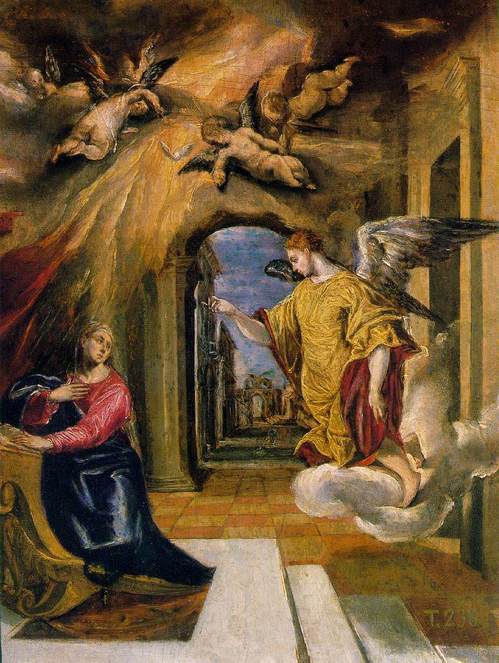
elgreco_the_annunciation-thumb-500x663

Saint Gabriel

Archangel

Communications of all kinds – in particular, consolation and guidance – are the basic attributes of the archangel Gabriel. His earthly visitations always portend a major change in human history. Islam credits the archangel Gabriel with dictating the Koran to the prophet Mohammed. Not only does the angel Gabriel, as a divine messenger, announce a coming event; he is also known to explain the meaning of the news, and to those who are frightened he offers consolation. It was Gabriel who remained with Christ on the eve of his crucifixion, giving him the fortitude to face his fate. The name Gabriel means “Strength from God” and thus he is invoked for courage.

The first mention of Gabriel the Archangel is in the Book of Daniel. In it, Gabriel visits the prophet Daniel, interpreting his dreams and explaining his visions to him. After Daniel prays for Israel, Gabriel goes to him and, by touching him, communicates the prophecy that “seventy weeks” of years would elapse before the coming of the Savior. The ancient Jews viewed the Archangel Gabriel as a judgmental figure, who meted out punishments. They believed that it was he who buried Moses, as well as leveled the cities of Sodom and Gomorrah.

It is assumed that it was the Archangel Gabriel who appeared to Saint Joachim to instruct him on the coming birth of his daughter, Mary. To the priest Zechariah he announced the coming birth of John the Baptist. When Zechariah scoffed at the angel because he and his wife were too old to be parents, Gabriel struck him dumb until the child was born. Gabriel is particularly devoted to Jesus and the Blessed Mother and his celestial intervention occurs throughout their earthly lives. The greatest visitation of Gabriel is known as the Annunciation. He visited the fourteen-year-old Mary and told her that she would soon give birth to the Divine Savior. When Mary asked how this could be possible, since she was still a virgin, he carefully explained the role of the Holy Spirit in Christ’s creation. It is said that the beauty expressed by Mary as she resigned herself to the will of God made the angel tremble. Saint Gabriel is known as the “Angel of the Incarnation” because he was present when “the Word was made flesh”. As he spoke to Mary, Jesus was created in her body. Gabriel then went on to comfort and reassure Joseph that this was indeed an act of God, so that he would stand by Mary. When the baby Jesus was born, it was Gabriel who spread the news of his birth to the shepherds in the surrounding region.

As Saint Raphael guides us on earth and Saint Michael meets us in death, Saint Gabrrl is the angel who selects souls from heaven to be given birth in the material world. He spends the nine months that the baby is forming instructing that soul on what he or she will need to know on earth. Because of his willingness to teach and to ensure that we understand the information he imparts, Saint Gabriel is the patron of parents and teachers. His role as a heavenly messenger also makes him the patron of postal workers and those in the communications industry. His feast has been changed from March 24 to the Feast of the Archangel, September 29.

Saint Gabriel, Archangel is the patron saint of: Communications Industry, Postal Employees, Parents, Teachers

NOVENA TO SAINT GABRIEL, ARCHANGEL

Saint Gabriel the Archangel, I venerate you as the Angel of the Incarnation, because God specially appointed you to bear the messages concerning the God-Man to Daniel, Zechariah, and the Blessed Virgin Mary. Give me a very tender and devoted love for the Incarnate Word and his Blessed Mother, more like your own.

I venerate you also as the “Strength from God”, because you are the giver of God’s strength, consoler and comforter chosen to strengthen God’s faithful and teach them important truths. I ask for the grace of a special power of the will to strive for holiness of life. Steady my resolutions; renew my courage; comfort and console me in the problems, trials and sufferings of daily living, as you consoled our Savior in his agony and Mary in her sorrows and Joseph in his trials. I put my confidence in you.

Saint Gabriel, I ask you especially for this favor: (mention your request). Through your earnest love for the Son of God made man and for his Blessed Mother, I beg of you, intercede for me that my request may be granted, it it be God’s holy will.

Pray for us, Saint Gabriel the Archangel. That we may be worthy of the promises of Christ.


Say this novena nine times in a row for nine days in a row.

 Excerpted from the book, “Novena: The Power of Prayer”  by Barbara Calamari and Sandra DiPasqua.

Novena App

saint michael giordano

Saint Michael

Archangel

Feast Day: September 29

Patron of: Brussels, Belgium, England, Germany, Umbria, Italy, Policemen, Soldiers, Firemen, Grocers, Mariners, Health, Knights

Invoked: for good health, physical protection, a holy death

Symbols: Sword, Scales, Defeating the devil or a serpent

As written in the Book of Revelation, Lucifer was the most beautiful and favored of God’s angels. When he dared consider himself God’s equal, war broke out between the angel who was Heaven’s protector and Lucifer and his faction. Throughout the battle the protecting angel and his legions cried out “Mi-cha-el?” (Hebrew, for, “Who is like God?”).  When Lucifer was defeated and cast into hell with his followers, the protecting angel took the name Michael.     The forces of Michael and Lucifer are perpetually at war to win over as many souls as possible.

Saint Michael predates all other saints, and even Christianity. Considered the most powerful in the hierarchy of angels, he is honored in the Muslim and Jewish faiths as much as he is by Catholics. Though he has never had a human existence Saint Michael is closely tied to the fate of mankind. He is the angel destined to slay the anti-Christ, end plagues and settle wars.  Despite rabbinical warnings against appealing to anyone but God, the ancient Jews saw Michael as an intermediary devoted to their protection, as he had defended God against Lucifer.  From its earliest days, church elders have looked to Michael as the Protector of Christianity as well. From scriptural passages in both old and new testaments, Michael has four mandates: 1) To fight against Satan. 2) To rescue the souls of the faithful from the power of the enemy, especially at the hour of death. 3) To be the champion of God’s people and protector of the Church. 4) To call away from earth and bring men’s souls to judgment.

Shrines to Saint Michael are always on rocky cliffs over the sea. In ancient times they were visible from great distances but nearly impossible to reach, increasing their mystical appeal. Skellig Michael, a steep rocky island eight miles from Kerry Ireland is home to a Celtic monastery built in 588. Monks lived there in the harshest conditions for over 600 years; its severe isolation ensuring its status as one of the most well preserved holy sites in the world. The most famous shrine to him is Mont-Ste- Michel in France. Situated on a rock rising out of the Atlantic Ocean a mile from the shore, this ancient monastery houses a relic of the cloth that Michael is said to have left on the altar at Gargano.

The Gargano caves in Apulia, Italy were said to be a sanctuary for the Archangel. In the year 490, a wealthy army commander was pasturing his herds on Gargano Mountain. When his finest bull wandered off, he went in search of it. After many hours, he found it standing at the mouth of a cave in an inaccessible part of the mountain. Enraged, he shot an arrow at the bull. Rather than penetrating the animal, the arrow was turned around by an unseen force and wounded the army commander in the foot. Shaken by this supernatural event, he sought advice from the local bishop who ordered three days of contemplative prayer. At the end of the third day Michael appeared to the Bishop saying, “I am the Archangel Michael, and am always in the presence of God. The cave is sacred for me, I have chosen it; I myself am its watchful custodian… There where the rock opens wide the sins of man can be forgiven… What is asked for here in prayer will be granted. Therefore, go to the mountain and dedicate the grotto to the Christian religion.” After much hesitation, the bishop agreed to consecrate the cave as a shrine. Michael returned to say, “I have already consecrated the grotto.” The town people marched in procession, sheltered from the glaring sun by the convocation of eagles soaring overhead. Arriving at the grotto they discovered that an altar, covered by a vermilion cloth, had been erected. Because it is the only place of worship not consecrated by human hand, this grotto is known as the “Celestial Basilica”. This became the first pilgrimage site in Christendom and is still much visited today.

During the Middle Ages Michael was the patron saint of Knights and there were many stories of his aid during battles and in warfare – in 1425, during the Hundred Years War between England and France, 120 knights dedicated to Saint Michael held off 8,000 invading English troops. News of this heroic defense gave hope to a mostly demoralized French public. Many biographers attribute the genesis of Joan of Arc’s loyalty to Saint Michael to her youthful fascination with this battle.

But in the early church Michael was called on for all manners of health. In the sixth century, as a plague devastated Rome, Pope Gregory I saw a vision of Michael sheathing a bloody sword over Emperor Hadrian’s tomb. He interpreted this as a sign that Rome was under the Archangel’s protection and that the plague would soon end. In gratitude, he had a church built over the tomb renaming it Castel San Angelo (Castle of the Holy Angel). Michael was especially beloved for the creation of sacred springs in Greece and Constantinople, and the Christians of Egypt placed the Nile River under his patronage.

Catholics believe Saint Michael and the Virgin Mary are the only beings besides Jesus able to descend into hell and release the souls suffering there. Since Michael is said to weigh the souls of the dead to decide who gets into heaven, he is always depicted with a set of scales. For this reason he is the patron of greengrocers. Because of his great military achievements against Lucifer and his constant vigilance and defense of the faithful, he is the patron of police and firemen and those who protect the general public. Many shops and stores display a statue of Michael as a reminder that the shopkeeper is under his protection.  By the Middle Ages, September 29, the feast day he shares with the Archangels Gabriel and Raphael, became a holy day of obligation. This day known as Michelmas Day was set aside for settling quarterly rents and choosing magistrates in England. These traditions began to wane in the 18th century.

Prayer Saint Michael the Archangel

                                                         Saint Michael the Archangel,
Defend us in battle.
Be our protection against the wickedness and snares of the devil.
May God rebuke him, we humbly pray;
And do thou, O Prince of the heavenly host,
By the power of God,
Thrust into hell
Satan and all evil spirits
Who wander through the world
For the ruin of souls.
Amen

Excerpted from the book “Saints: Ancient and Modern”  by Barbara Calamari and Sandra DiPasqua

More Saint Michael on Novena App

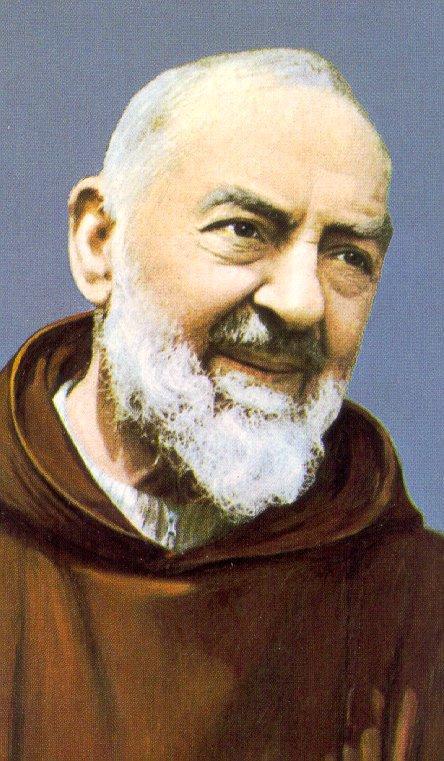
St_PadrePio

SAINT PIO OF PIETRELCINA

 “Padre Pio”


1887 – 1969

Feast Day: September 23

Patronage: none official

Invoked For: forgiveness,  healing of all kind

Symbols: stigmata, crucifix

  “Pray, hope and don’t worry”

            Padre Pio


            With these words Padre Pio was able to make people who never thought of spiritual matters, religious. He is known as the saint of the common people, always consoling, always accessible to those who visited or wrote to him  A mystic who could bilocate and read hearts, he had assured his fellow monks that he would become even more prevalent a force after his death. Today, millions of people a year flock to the little monastery he never left in order to be in his spiritual presence.

            Named for Saint Francis of Assisi, Francesco Forgione was born in Pietrelcina, a small town north of Naples. As a child he experienced many spiritual visions of Christ and the Virgin Mary but never mentioned them to anyone as he thought all people had them. Coming from a devout Catholic family, he entered the novitiate of the Capuchin Friars, an austere division of the Franciscans. He took the name Pio (Pious) and was ordained in 1910. Diagnosed with a form of tuberculosis, he was sent back to live with his family. Since he could not fulfill his duties as a priest he decided to offer himself as a conduit of suffering in the exchange of the salvation of others. While praying in his family’s home, wounds appeared on his hands, feet and side, similar to those inflicted on Christ. Embarrassed, he begged God to take these marks away. His prayers were answered and he was later conscripted into the army in 1916. While there, he fell ill with a fever that rose higher everyday. It is recorded that it broke the thermometer,  rising to 118 degrees, far higher than what would be considered fatal. Sent home to die, he recovered and his Father Superior ordered him to the remote monastery of Our Lady of Grace in San Giovanni Rotondo, Puglia, a province of Southern Italy. 

            While praying alone in the intense stillness of the church on September 20, 1918, he went into a trance like state of “waking sleep”.  He saw Christ standing before him, bleeding from his wounds. Pio was intensely moved and thought his own chest would burst in sympathy, but as he came out of this altered state he experienced excruciating pain. He was inflicted with the same stigmata as Christ and a fellow brother had to lead him away and bandage him up. Though he did what he could to heal his wounds, they never closed up until his death 50 years later. There are other mystical saints who have experienced the stigmata, starting with Saint Francis himself, but Padre Pio became the first ordained priest to have this condition.

            Since San Giovanni Rotondo is very near the Gargano shrine to Michael the Archangel, religious pilgrims began flocking to the monastery to hear Pio say mass. Wanting only to stay in the background and remain an anonymous friar, Pio suffered not only physical agony but psychological and spiritual pain as well. His life of constant prayer was greatly disturbed by the influx of curiosity seekers as well as those who considered him holy. Forced by his wounds to wear half gloves, many reported “the odor of sanctity” on his hands. His mysticism extended  to the confessional where penitents swore that Pio could read hearts. Many were sternly rebuked by him as he recited for them sins that they themselves had withheld or forgotten. After going to him for confession these same people reported feeling overwhelming joy and relief.

            All great mystics write about a period in their lives when they feel spiritually abandoned and God seems distant and unavailable. Saint John of the Cross has called this time in one’s life “the dark night of the soul”. Pio’s trials began in 1920 when Pope Benedict XV opened an investigation into the causes of his stigmata. Concerned about Pio’s cult following, doctors and archbishops were dispatched to interview him. Accusations of fraud and clerical misconduct would follow Padre Pio for the rest of his life as the Vatican launched over 12 future investigations into his conduct. In 1922, under Pope Pius XI, a specialist on stigmatic causes declared Padre Pio to be an hysteric who kept his wounds open with carbolic acid.. Padre Pio was ordered into seclusion and forbidden to say mass in public. A massive demonstration of 5000 people erupted in the village when it was rumored that their beloved friar was going to be moved. The Vatican agreed to leave him in Our Lady of the Angels but issued a decree warning against devotion to the priest as Padre Pio’s gifts were not to be considered of supernatural character. 

            While in seclusion, Pio calmly accepted his situation, he would spend hours of the day engulfed in prayer. Padre Pio has said that at this time he realized his true vocation was to suffer for the souls in purgatory so that they may win early release.  Though it deeply pained him to be under such intense suspicion, he obeyed the church authorities with humility and considered this time in his life a necessity for purging further imperfection from his soul.

             He never left his monastery at the same time people reported seeing him at the sick beds of hospital patrons hearing final confessions or comforting the fatally ill hundreds of miles away.  A fellow monk has written that he saw Pio shivering and murmuring in the middle of an intense heat wave. When he finally seemed to return to consciousness, the monk asked him where he was, “I was giving the last rites in the Alps,” he was told. “It’s very cold there.”

            In 1933 he was granted the privilege of saying mass in public again, but only at 5:30 in the morning. The little church would be filled to overflowing at this hour, people would begin lining up in the middle of the night to attend. Pio ate little and slept only three hours a night. Over his lifetime he heard over a million confessions. Though he could be gruff and angry with penitents he had a devout following. He began a small local prayer group which has since spread worldwide with 400,000 members. 

            During World War II, he promised the citizens of San Giovanni Rotondo that he would see to it that their town would be safe. The Germans had stored a depot of ammunition near the town which the Allies attempted to bomb, more than one officer reported seeing a monk in the sky with uplifted hands. Their bombs had fallen out of the planes into the woods and their planes had reversed course by themselves.  American soldiers, hearing about this “living saint” made the difficult trip up into the mountains to see Padre Pio. They too experienced his abilities, many thought he knew English when they went to his confessions, he was so successful at impressing his advice on their minds. On their return home, they spread his cult to every part of the United States. By 1947 Padre Pio was receiving more than 200 letters a day requesting advice and prayers from the United States, Europe and Australia.

            He used his growing popularity to found the House for the Relief of Suffering, a hospital for the hopelessly ill using only donations of the faithful. Today, it serves over 60,000 patients a year and is solely supported by charitable donations. Successful though he was, doubts about his real sanctity continued throughout his lifetime. Microphones were secretly planted in his confessional by Vatican investigators in attempts to find human flaws in his character. Though he never encouraged it, he developed a major cult following which was considered distracting and possibly dangerous by the Church.

            He died as he predicted he would, in 1968. His fellow monks heard him declaring that he saw two mothers at his bedside, then he murmured, “Jesus, Mary” before expiring. Over 100,000 devotees attended his funeral. The suspicions that many in the Church held of Padre Pio were dissolved in 2002 when he was canonized by Pope John Paul II in front of half a million people. This pope knew first hand, the mystical abilities of this obscure monk as he had traveled to San Giovanni Rotondo in 1947 when he was only a seminarian. While in confession with Padre Pio, he was given the astounding prediction that he would someday be pope. Years later, when he was the bishop of Cracow he wrote to Pio requesting prayers for a friend with cancer. Ten days later she was healed.

            . Today, a cathedral which holds 10,000 people at a time stands in the town where Padre Pio spent his life. San Giovanni Rotondo is second only to the shrine of Our Lady of Guadalupe for religious pilgrims. Like Saint Therese of Lisieux and his patron, Francis of Assisi, Padre Pio  does as much after his death as he did in life to bring grace and consolation to those in need.

             As a contemporary saint, most images of Padre Pio are standard photographs. Because of his willingness to suffer like Christ, Padre Pio is usually depicted with a crucifix or with his stigmatized hands bandaged.


                                 Prayer Asking the Intercession of Padre Pio


                                       Oh Jesus, full of grace and charity, victim for sinners,

                             So impelled by your love of us that you willed to die on the cross,

                                     I humbly entreat Thee to glorify in heaven and on earth,

                                             the servant of God, Padre Pio of Pietrelcina,

                                          Who generously participated in Your sufferings,

                                     who loved Thee so much and who labored so faithfully

                               for the glory of Your heavenly Father and for the good of souls.

                                            With confidence, I beseech Thee to grant me,

                                 through his intercession, the grace of which I ardently desire.


 Excerpted from the book “Saints: Ancient and Modern” by Barbara Calamari and Sandra DiPasqua

Novena for August

alphonsus-liguori

SAINT ALPHONSUS LIGUORI

1696 – 1787

            Crippled by arthritis and ready to die at age seventy-two, Saint Alphonsus Liguori went on to live another nineteen years, publishing over sixty books and writing poetry and music. His disease made him so conscious of his own mortality that he assumed each day was his last and lived accordingly. He is the patron of those suffering from arthritis and the pains of old age. He sets the example of turning suffering to an advantage. In his case, his ill health made him use his earthly time in the most efficient manner. Saint Alphonsus Liguori is most frequently invoked for a cure to illness, and if that is not possible, for a way to bear illness productively. It is also thought that those who suffer physical torments on earth and offer those pains as reparations for the sins of mankind have more intercessionary power after death than others. Because he spent so many years of his life in chronic pain, unable even to lift his chin off his chest, Saint Alphonsus is thought to be an extremely effective intercessionary force.

             Born near Naples, Italy, in 1696, Alphonsus Liguori started out in life as a brilliant lawyer. A doctor of law by the age of sixteen, he practiced for eight years before losing his first case. He always attributed his success at law to his daily attendance of mass. His first loss in court – the result of an oversight on his part – came as a devastating blow to him. Humiliated, he fasted and prayed for three days. While doing charitable works in the Hospital for Incurables, he found himself surrounded by mysterious light. The building seemed to rock and an interior voice said, “Leave the world and give yourself to me.” This occurred twice. A few years later, in 1726, he was ordained a priest. He devoted himself to working in the poorest areas of Naples and developed a reputation as a popular preacher. Though a highly educated professional, able to argue the smallest nuance in law and theology, Saint Alphonsus said, “I have never preached a sermon that the poorest old woman in the congregation could not understand.”  His confessional was always crowded, and he is credited with healing a great number of hardened sinners. Saint Alphonsus founded the order of Redemptorist fathers, dedicated to going out among the poorest neighborhoods. He wanted his priests to preach practical sermons and act as missionaries, bringing the word of God to the forgotten. At the age of sixty-six, Saint Alphonsus was made the bishop of Saint Agata, a diocese of thirty thousand people. When ill health forced him to be bedridden, the pope refused to accept his resignation because he felt that the power of Alphonsus’ s prayers would help his constituents more than the actual good works of anyone else. Saint Alphonsus died in 1787 at the age of 91.

             In art he is always depicted with his chin on his chest due to his arthritic condition.

 He is the Patron of: Charity

He is Invoked against: Arthritis, the Pains of Old Age

 His Feast Day is August 1


NOVENA TO SAINT ALPHONSUS LIGUORI


Glorious Saint Alphonsus, loving father of the poor and sick, all your life you devoted yourself with a charity really heroic to lightening their spiritual and bodily miseries. Full of confidence in your tender pity for the sick, since you yourself have patiently borne the cross of illness, I come to you for help in my present need.


(Mention your request).


Loving father of the suffering, Saint Alphonsus, whom I invoke as the Arthritis Saint, since you suffered from this disease in your lifetime, look with compassion upon me in my suffering. Beg god to give me good health. If it is not God’s will to cure me, then give me strength to bear my cross patiently and to offer my sufferings in union with my crucified Savior and his Mother of Sorrows, for the glory of God and the salvation of souls, in reparation for my sins and those of others, for the needs of this troubled world, and for the souls in purgatory.


(Recite one Our Father, one Hail Mary and one Glory Be).


Saint Alphonsus, patron of the sick, pray for me. Amen.


Say this novena nine times in a row for nine days in a row.


Excerpted from the book: “Novena: the Power of Prayer” by Barbara Calamari and Sandra DiPasqua.