Lung Diseases / Bernadine of Siena, 1380–1444, Feast Day: May 20


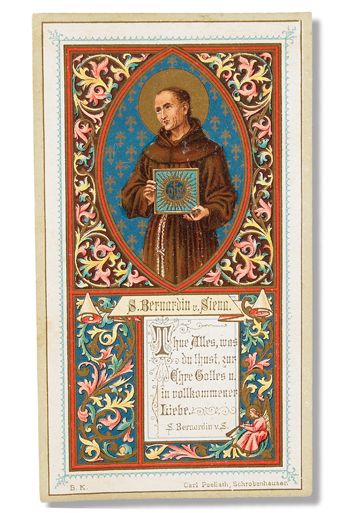
An immensely popular Franciscan preacher, Bernadine vowed to preach in every part of Italy.
Thoroughly entertaining to common people, he would speak in the open air for four hours at a time. Because he often strained his voice, he suffered from hoarseness, like patients with
pulmonary problems. A master communicator, he designed the IHS visual emblem of Christ.

Other patronages: advertisers, pugilists, weavers, wool merchants

Invoked: against hemorrhages, hoarseness, tuberculosis


Judges / Ivo of Kermartin, 1253–1303, Feast Day: May 19

A lawyer from Brittany, Ivo joined the Franciscan tertiaries and became a legal representative for the poor. Appointed to higher legal offices, he was known as an extremely honest and fair judge, especially interested in the fate of orphans. After he was ordained a priest, he gave free legal advice to his parishioners.

Other patronages: Brittany; lawyers, notaries; orphans

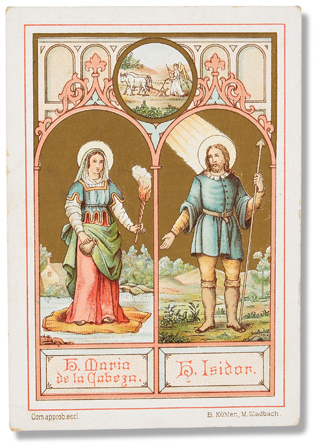
Laborers / Isidore the Farmer, 1070–1130,
Feast Day: May 15

A field hand who spent his entire life working on the same farm outside of Madrid, Isidore and his wife were simple and devout people. When their young son died, they attributed it to God’s will that they have no children, and lived chastely thereafter. They spent so much time praying that their employer suspected them of shirking their duties. When he paid them a surprise visit, he found angels plowing the fields while Isidore prayed.

Other patronages: Madrid; livestock; rural communities; farmers, ranch hands; death of children;

Invoked: for rain


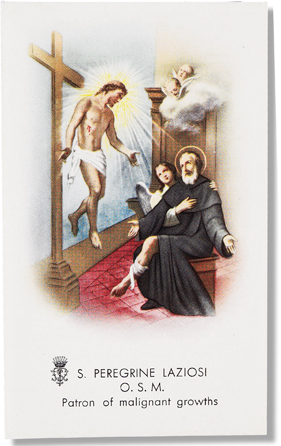
Cancer / Peregrine Laziosi, 1260–1345, Feast Day: May 1

An antipapist political leader, Peregrine converted to Catholicism after his violence against the papal legate was rebuffed with kindness. He eventually became a popular preacher, dedicating himself to working with the hopelessly ill. He himself was diagnosed with cancer. The night before he was to have his leg amputated, Christ came to him and healed him in his cell.

Other patronages: incurable illnesses, running sores

Invoked: for medical breakthroughs

The above patron saints are excerpted from the book Patron Saints: A Feast of Holy Cards by Barbara Calamari & Sandra DiPasqua

All images are from the collection of Father Eugene Carrella

Dining With the Saints

Saint Rita of Cascia

 Saint Rita of Cascia was born in the 14th century in the beautiful, hilly countryside of Umbria in Central Italy. Some years ago when I visited the neighboring town of Norcia, I noticed a lovely statue dedicated to her in the town square. In Cascia itself, a huge shrine to the Saint was built in the early 20th century, and you can still visit the house where she was born. Her feast day is celebrated on May 22.

 Saint Rita came to be associated with roses and with fresh figs, both of which are placed on altars to celebrate her Saint’s day. Evidently near the end of her life, when Saint Rita was bedridden in the convent, a cousin visited her and asked if she desired anything from her old home. Saint Rita said she would like to have a rose and a fresh fig from the garden. Since it was January her cousin didn’t expect to find either. However when her cousin went to the house she discovered, in the little snow covered garden, a single blooming rose as well as a fully ripened, edible fig, both of which she brought back to Saint Rita.

 Coincidently fresh figs come into the market right around May 22 (and in California their season extends into January, so possibly this story is not unfeasible). I thought a great way to celebrate St. Rita’s feast day would be by preparing this salad which incorporates some of May’s most fragrant and beautiful produce; fresh figs, chives, mint, and watercress.

 Green Fig Salad with Watercress, Chives, and Mint

  (Serves two)

 1 large bunch of watercress, thick stems removed

5 fresh green figs (or use the black skinned variety if you wish), cut in half

About 10 chives, chopped (with blossoms if available)

1 small shallot, very thinly sliced

A dozen fresh mint leaves

The grated zest and juice from ½ a lemon

A pinch of sugar

Salt

2 tablespoons extra virgin olive oil

Freshly ground black pepper

A small chunk of Parmigiano Regggiano

Place the watercress in a medium salad bowl. Add the figs, the chives (and blossoms if you have them), shallot, and mint leaves.

 In a small bowl whisk together the lemon juice and zest, sugar, a little salt, and the olive oil.

 Grind some black pepper over the salad and the pour on the dressing. Toss gently. Shave some thin slices of Parmigiano over the top and serve.

 Dining with the Saints is written by Erica De Mane. Her food blog can be found at http://www.ericademane.com

 

Patron Saints for April

Italy / Catherine of Siena, 1347–1380,
Feast Day: April 29

As a young girl, she defied her parents and took up the religious life. A tertiary in the Order of St. Dominic, she tended the incurably ill. Catherine received the stigmata, and she developed a following of young people. Her series of dictated letters are classics of Italian literature. She convinced the Pope to return the Holy See from Avignon, France, to Rome, and this made her the patron of Italy.

Other patronages: Europe; fire prevention, nursing services; firefighters, laundresses; sick people

Invoked: against burns, miscarriage, temptation

Novena to Saint Catherine of Siena


England / George, d. 304, Feast Day: April 23

A soldier from Palestine fighting for the Roman army in Libya, George killed a dragon that was eating two townspeople a day. He then rescued the king’s daughter and was given a white banner with a red cross on it, which he used to convert the town. George’s cult was brought back to England during the Crusades, when soldiers reported seeing him on horseback. His banner was adapted for soldier’s uniforms and official seals in England.

Other patronages: Aragon (Spain), Catalonia (Spain), Genoa, Georgia, Germany, Greece, Istanbul, Lithuania, Moscow, the Netherlands, Palestine, Portugal, Venice; horses; the Crusades; equestrians, farmers, scouts

Invoked: against herpes, leprosy, snakebite, syphilis

Poland / Adalbert of Prague, 957–997,
Feast Day: April 23

Born into a noble family in Bohemia, Adalbert took his name from his teacher. By the age of thirty, he was named bishop of Prague. His insistence on distributing his wealth to the poor and his disdain for slavery made him the enemy of the ruling class. He left Prague and lived in Rome until being called back. On his second attempt to live there, he was driven out. He evangelized in Russia and Poland and was murdered in Prussia by pagan priests. His persistence in the face of failure served as an inspiration for future missionaries in that area.

Other patronages: Bohemia, Czech Republic, Prussia

Doormen / Conrad of Parzham, 1818–1894,
Feast Day: April 21

A farmer from Bavaria, Conrad did not become a Capuchin monk until he was in his early thirties. For the next forty years, he was the porter for the shrine of Our Lady of Altotting. He received thousands of pilgrims with charity and kindness, devoting much of his time to teaching local children. It is said he had the gift of prophecy and the ability to read hearts.

Other patronages: Capuchin-Franciscan Province of Mid-America

Homeless People / Benedict Joseph Labre, 1748–1783, Feast Day: April 16

Born into a prosperous middle-class family in Boulogne, France, Benedict Joseph attempted to enter three different religious orders: the Trappists, the Carthusians, and the Cistercians. Denied entrance because of his health, he went on a barefoot pilgrimage to all the Christian shrines in Europe. Intending to live as a hermit out in the world, he depended on divine providence for his meals and slept in the streets. He died seven years later on the steps of a Roman church.

Other Patronages: mental illness; beggars, pilgrims; bachelors, people rejected by religious orders