Saint Fidelis of Sigmaringen  1577–1622.
Feast Day: April 24.

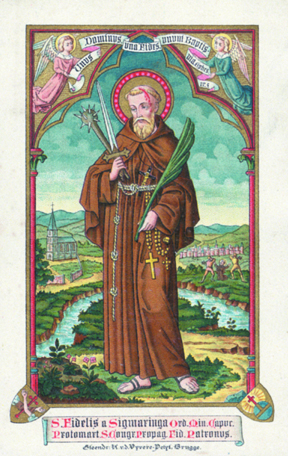
A lawyer disgusted with the corruption in the justice system, Fidelis gave away his worldly wealth and became a Franciscan monk. He led a group of Capuchin friars on a mission to the Protestant area of Switzerland and was martyred for his preaching. His card has the shield of the propagation of the Faith, he has a cut in his head, and he holds the sword and whirl bat with which he was martyred in one hand, martyrs’ palms in the other

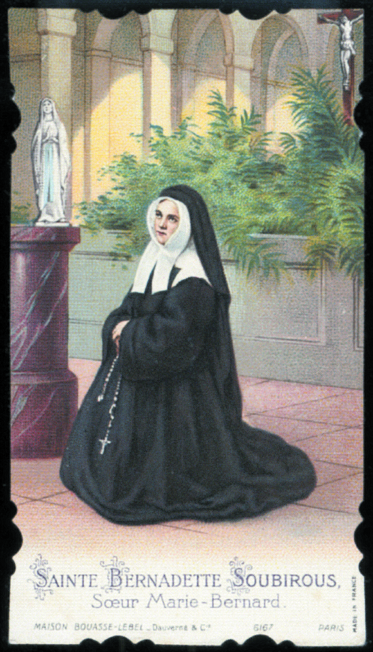
Saint Bernadette Soubirous  1844–1879. Feast Day: April 16.

A poor peasant girl from Lourdes, France, it was her vision of Mary and subsequent communications with her that began the pilgrimage to Lourdes. At Mary’s request, she uncovered a hidden spring of water which was provento have healing powers. Lourdes now attracts over four million pilgrims a year. Bernadette is shown praying with a rosary before a statue of Mary. She wears the habit of the Notre Dame order, the nuns she joined soon after the Marian visitations ended.

Saint Bénézet  1163–1184. Feast Day: April 14.
Patron of: Avignon. Bachelors.

A shepherd watching his mother’s sheep, Bénézet had a vision during an eclipse. A voice told him to build a bridge overa dangerous part of the Rhone River at Avignon. Thinking it impossible, the church and civil officials ridiculed him and refused to help. He lifted a huge stone in place and announced this would be the foundation. The citizens of Avignon were so inspired by this act, they rushed to help him. The bridge was easily constructed. Bénézet died upon its completion and was buried in the bridge. His incorrupt body was removed in 1669 and reinterred in a church. He is shown in shepherd’s robes with the bridge at the bottom of the card.

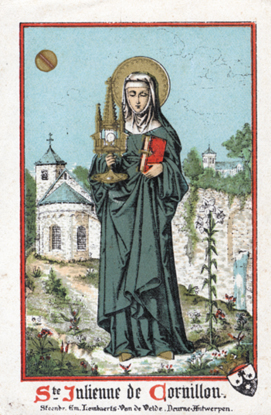
Saint Julienne de Cornillon  1192–1258. Feast Day: April 5.

An Augustinian nun, who with Eve of Liege began the proceeding for the Feast of Corpus Christi. For many years Julienne had a vision of the sun with a black band around it. This symbolized that something was missing from the Church calendar. She is shown with the banded sun, the monstrance holding the body of Christ, her convent in the background, and a closed book of mysterious teaching. A lily is at her side and the Augustinian shield is in the lower corner.


The above saints for April have been taken from the book “Holy Cards” by Barbara Calamari and Sandra DiPasqua. All images are courtesy of Father Eugene Carrella.


Dining With the Saints

The Feast of San Giuseppe

Feast Day: March 19

Husband of Mary and patron saint of the family, St. Joseph is one of the most revered Saints in the Catholic world. His feast day on March 19th is just about the biggest feast holiday in Italy. Almost every town celebrates by preparing fritelle, sometimes called zeppole (he is also the patron Saint of pastry cooks), and there are myriad versions of these fried puffs, most of them stuffed with a sweet filling that can be ricotta based or a flavored pastry cream. My next door neighbor, whose family is from Sorrento on the Amalfi Coast, makes one that’s loaded with a velvety lemon custard. As excellent as these pastries are, this is not the only food made for this huge feast day.

Altars are decorated with labor intensive, highly decorated breads (some shaped into crowns of thorns and crucifixes). St. Joseph’s day is celebrated at the spring solstice and the offering of bread, the ritual of mixing pounded grain and water, symbolizes the powers of fertility and the riches of the earth.

Pasta with sardines or calamari, baccala in many incarnations, arancini, prosciutto and salumi, seasonal vegetables, such as artichokes, wild asparagus and fennel, appear in many dishes. Each area of Italy offers up the best of its local produce and creations, in some regions up to one hundred dishes are typical outpourings of food centered devotion. Too much is never enough for the adoration of this most beloved Saint and it’s a welcome break coming in the middle of Lent. In Molise there’s a ritual lunch of a relatively modest thirteen courses, most of which are based on fish and pasta. Pasta with anchovies in various incarnations is one of the traditional dishes always served. Here’s a version of this great dish that I’ve always loved.

Bucatini with Anchovies, Tomatoes, and Walnuts

(Serves five as a first course)


Salt

Extra virgin olive oil

1 pound bucatini

3 pints cherry tomatoes, cut in half

2 large garlic clove, very thinly sliced

8 salt packed anchovies, filleted, briefly soaked to remove excess salt, and chopped

Freshly ground black pepper

3/4 cup walnut halves, lightly toasted and roughly chopped

A few large marjoram sprigs, leaves chopped

A large handful of flat leaf parsley, leaves lightly chopped

A chunk of Pecorino Toscano


Set up a large pot of pasta cooking water and bring it to a boil. Add a generous amount of salt and add the bucatini.


In a large skillet, heat 1/4 cup of olive oil over medium-high flame. When very hot add the tomatoes and the garlic and cook quickly, just until the tomatoes start giving off some juice, about 5 minutes. Add the anchovies, seasoning with a little salt and more liberally with black pepper, and sauté a minute longer. Turn off the heat and add the walnuts and the marjoram.


When al dente, drain the bucatini, saving about ½ cup of the cooking water, and transfer it into a warmed serving bowl. Add the bucatini, the parsley, about a tablespoon of grated pecorino, a drizzle of fresh olive oil, and give it a toss, adding a little of the pasta cooking water if needed to loosen the sauce. Bring the chunk of pecorino to the table. Serve hot.


Painting: ‘San Giuseppe’   by Guido Reni 1635

Saint Joseph’s Day Altar from New Orleans, Louisiana

More on Saint Joseph

Novena to Saint Joseph

“Dining With the Saints” is a monthly column by Writer and Chef Erica DeMane. Visit her website at: EricaDeMane.com



Novena for March

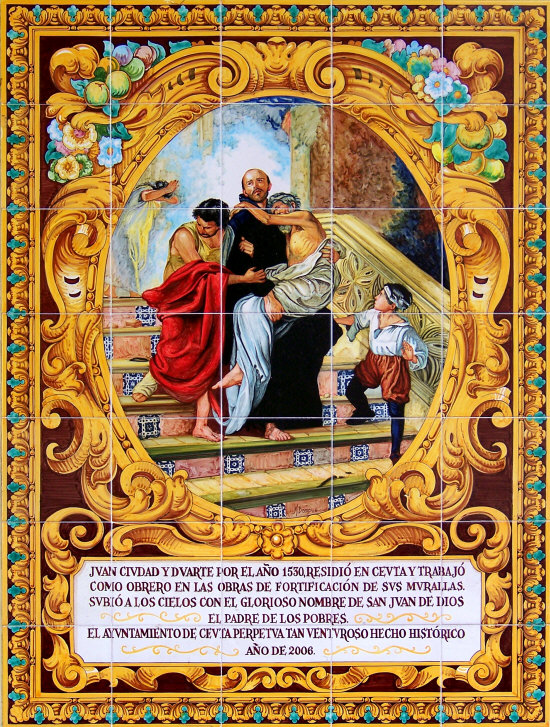
Saint John of God

1495 – 1550

Feast Day: March 8

A Portuguese mercenary who fought in several wars, sold slaves, and lived hard, John was known to “think with his heart” by acting impulsively. At the age of 40, while a bookdealer in Granada, he heard a sermon that changed his life. The thought of all the wrongs he committed in his life drove him to madness. Incarcerated in a filthy hospital, he suffered the mistreatment of the insane first hand.  As he recovered his sanity, he began helping the nursing staff. Upon his release, he devoted the rest of his life to the sick and destitute. He founded the Order of the Brother Hospitallers and opened a hospital, funding it by befgging in the streets. When his hospital was burning down, he ran in and carried each patient out one by one. He is frewquently depicted carrying a hospital patient. Because of this he is also considered a patron of firefighters.

While recovering from an illness, he leapt into a river in anunsuccessful attempt at rescuing a drowning boy. He died on his 55th birthday from an overexhausted heart.

Patron of: those suffeering with Heart Ailments, the Dying, the Sick, Hospitals,, Booksellers, Firefighters, Nurses, Printers.

Invoked against: alcoholism


NOVENA PRAYER TO SAINT JOHN OF GOD FOR A CURESaint John of God, heavenly Patron of the Sick, I come to you in prayer to seek your help in my present sickness. Through the love which Jesus had for you in choosing you for the sublime vocation of serving the sick, and through the tender affection with which the Blessed Virgin Mary placed upon your head a crown of thorns as a symbol of the sufferings you would undergo in the service of the sick to attain to your crown of glory, I beg you to intercede for me to Jesus and Mary that They may grant me a cure, if this should be according to the Will of God.

How patiently you bore the sufferings of your own disease! Teach me to carry with cheerful resignation the cross that God has given me. Let me never complain or lose courage. Help me to understand that suffering is a very important means of sanctifying my soul, of atoning for my many sins, and of reaping a plentiful harvest of merit for Heaven. I trust in your great love for the sick and in the power of your intercession to help them. Help me, good St. John, and beg the God whose name you bear to touch me as He touched the sick while on earth, that through His almighty power health may return to my body. And as you derived strength in your own sufferings from the crucifix, so may I be able to say what you did to Jesus Crucified: “Lord, Thy thorns are my roses and Thy sufferings my paradise.”

Good Saint John, lover of those who suffer and special Patron of the Sick, I confidently place before you my earnest petition.

(Mention your request.)

I beg you to recommend my request to Mary, the Mother of Sorrows and Health of the Sick, that both Mary and you may present it to Jesus, the Divine Physician.

Saint John of God, patron of the Sick and beloved of Jesus and Mary, pray to Them for me and obtain my request. (Three times.)

In honor of Saint John of God:

Our Father, Hail Mary, Glory Be.

Saint John of God, Patron of the Sick, pray for us.


Say this novena nine times in a row for nine days in a row.

Dining With the Saints

File:Fra Angelico 074.jpg

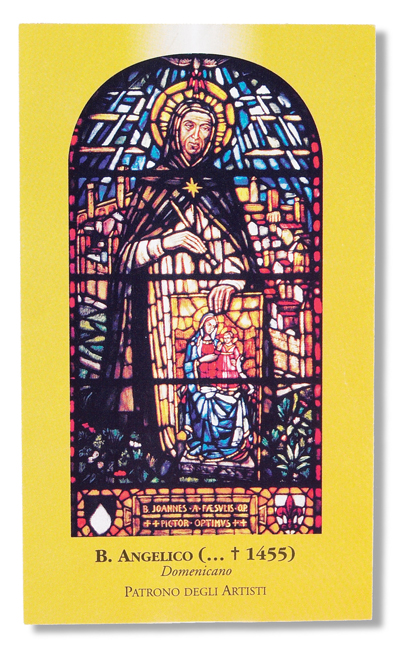
Blessed Fra Angelico

The early Italian Renaissance painter Fra Angelico (1395-1455) was a priest and a master in creating lush, gorgeously colored religious scenes. In his book ‘The Life of the Artists’, Vasari describes him as having “a rare and perfect talent”. As a result of his artistry and piety, Pope John Paul 11 beautified him in 1982.

His namesake Liqueur is a work of art in its own right. The hazelnut flavored drink dates back about three hundred years to early Christian monks living in the hills of Northern Italy. Even though Fra Angelico was a Dominican, it’s widely believed the liqueur was named after him.

This year to celebrate the work of this amazing artist, I’ve created a winter salad using the lovely Fra Angelico liqueur as a base for a vinaigrette.  I hope you will have an opportunity to gaze at some of his art (The Metropolitan Museum in Manhattan owns ‘The Crucifixion’) and possibly make this salad on February 18th, his feast day.

Orange and Hazelnut Salad with Fra Angelico Vinaigrette


(Serves two)


1 medium head of frisee, torn into pieces

A few sprigs of fresh tarragon, leaves lightly chopped

2 small oranges, peeled and sliced into thin rounds

A handful of peeled and very fresh hazelnuts

1 small shallot, very thinly sliced


For the vinaigrette:


1 tablespoon Fra Angelico liqueur

The grated zest from 1 orange

1 teaspoon Spanish wine vinegar

A pinch of salt

Freshly ground black pepper

3 tablespoons hazelnut oil


Place all the ingredients for the salad in a large bowl.


In a small bowl, add the Fra Angelico, the orange zest, and the vinegar. Season it with salt and black pepper. Whisk in the hazelnut oil, pour this over the salad and toss. Divide it up onto two salad plates and serve right away.


Top Image: Detail from “The Deposition of Christ” by Fra Angelico, thought to be a self portrait painted between 1437 and 1446.

“Dining With the Saints” is a monthly column by writer and chef, Erica DeMane. Check out her website: EricaDeMane.com.

Saints for February

Artists / Blessed Fra Angelico, 1387–1455,
Feast Day: February 18

Born Guido di Pietro in Tuscany, Italy, Fra Angelico became a Dominican monk in Florence. Believing that one must be Christlike to visually depict Christ, he lived a truly Christian life, living humbly and nursing the sick. He meditated and prayed before beginning his paintings, which are considered among the greatest works in art history. He earned the title “Blessed Brother Angel” because of the beauty of his work and the beauty of his soul.

Bulgaria / Cyril and Methodius, 827–869 / 826–885,
Feast Day: February 14

Known as “the Apostles to the Slavs,” these two brothers gave up the comfortable lives into which they were born to become priests. They were summoned to work in Moravia, where they began to teach in the native language, instead of the traditional Greek or Latin. They are credited with inventing the Cyrillic alphabet and are also considered the fathers of Slavonic literature. After their deaths, their methods of teaching were spread to Bulgaria, Serbia, and Russia.

Other patronages: Europe; professors, teachers

Childless People / Julian the Hospitaller, dates unknown, Feast Day: February 12

A noble layman, Julian was out hunting when a stag warned him that one day he would kill his own parents. To avoid this fate, he moved far away and married. After years of searching, his parents located him and went to surprise him. Returning to his house, he saw two figures in bed. Thinking his wife was with another man, he killed them. Turning back the covers, he saw it was his parents. He and his wife then gave up everything and went on a pilgrimage. Julian did penance, helping the poor and opening a sanctuary for lepers, until he earned divine forgiveness.

Other patronages: hospitality; boatmen, circus workers, clowns, fiddlers, innkeepers, jugglers, murderers, pilgrims, shepherds

Invoked: to find lodging while traveling