Previous Post

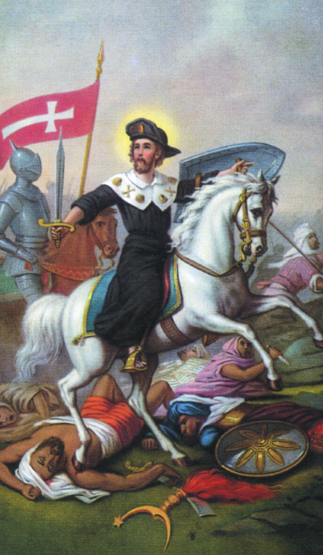
Saint James
First century.
Feast Day: July 25.
Patron of: Spain. Pilgrims. Equestrians. Druggists.
James the Greater was one of the original apostles. According to tradition he preached the gospel as far as Spain. He returned to Judea and was put to death. His body was set out in a boat which washed up on the coast of northern Spain. The great Cathedral of Santiago de Compostela was built to house his relics. This became a great pilgrimage center. Saint James was the patron of the Christians fighting off the Moorish invaders. He is shown in pilgrimage garb on a white charger leading the battle.                                                                                                                                                                                                                                                                                                                                                                                                                                                                                                                                 

Saint Bridget of Sweden 1303–1373.
Feast Day: July 23.
Patron of: Healers.
The daughter of a nobleman, Bridget married a prince. She was widowed and left with eight children after 28 years of marriage. Living at the Swedish Royal Court, she began to experience visions and prophecies directing her to form her own holy order. She began the Bridgettines, a mixed order of monks and nuns. She is wearing the habit that she envisioned and carrying the book of her order. Lilies of purity surround her.
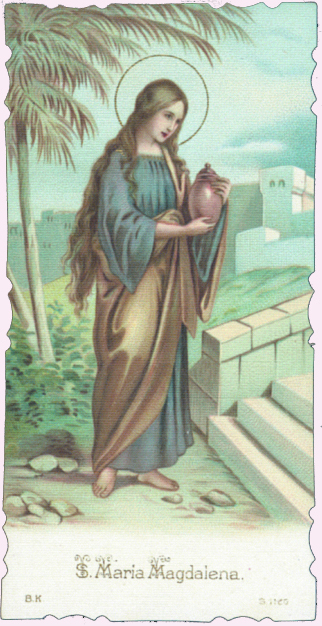
Saint Mary Magdalen
First century. Feast Day: July 22.
Patron of: Penitents. Reformed Prostitutes. Glovemakers. Hairdressers.
An infamous prostitute converted by Christ, Mary Magdalen became His follower and friend. She is always shown with long hair and a jar of oils. In gratitude of His social acceptance of her, she washed His feet, dried them with her hair, and anointed them with oil. She was the first person to whom the risen Christ appeared. After His Ascension, she was set adrift in

a boat and landed in Marseilles, where she lived an ascetic and penitent life.
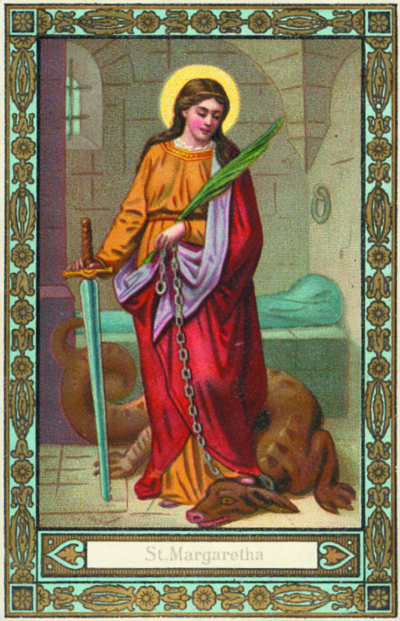
Saint Margaret of Antioch
Died 303. Feast Day: July 20.
Patron of: Childbirth. Exiles.
Margaret was the Christian daughter of a pagan priest. When her father discovered her conversion he cast her out. She lived as a simple shepherdess. When she rejected the advances of a prelate, she was denounced for her Christianity and incarcerated. In her cell the devil appeared to her as a dragon and swallowed her. A cross she carried grew so large it split the dragon in two. She was then beheaded. She holds the sword that killed her and the dragon in chains at her feet.

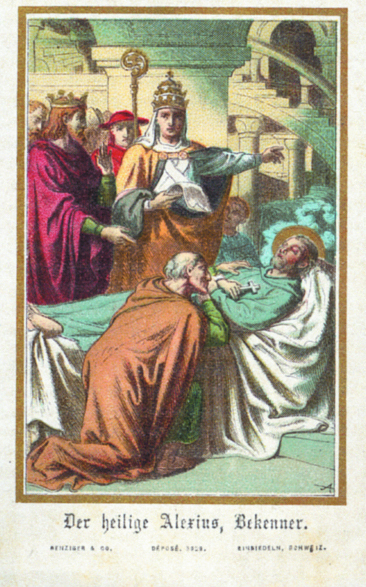
Saint Alexis of Rome  Early Fifth century. Feast Day: July 17.
Alexis, the son of a Roman senator, fled his wedding to become a beggar. After living in Edessa and earning the reputation for great sanctity, he returned to his home in Rome. His family did not recognize him in his ragged state and allowed him to live under their staircase. By the time of his death, the King (with crown), the Cardinal (in red), and the Pope (with the triple tiara) all recognized his holiness and came to pay him tribute. 

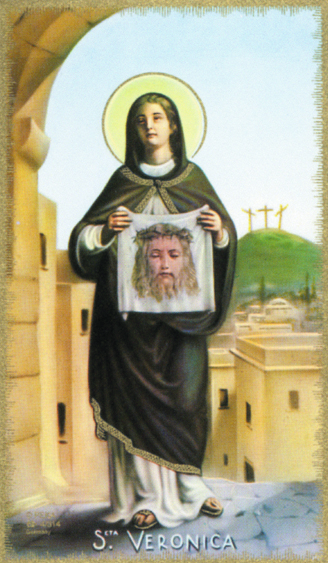
Saint Veronica  First century. Feast Day: July 12.
Patron of: Laundresses. Photographers.
As Christ was being led to his crucifixion, a woman named Seraphia wiped his face with her handkerchief and his image remained on the cloth. Vera icon means “true image,” giving the saint her new name. She is shown holding the image she obtained, with the crucifixion in the background.

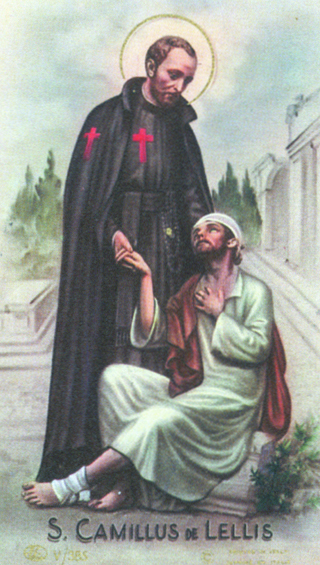
Saint Camillus de Lellis  1550–1614. Feast Day: July 14.
Patron of: Nurses.Those with bodily ills.
A soldier with a gambling habit, Camillus was forced to work in construction to pay off debts. He was converted by the Capuchins for whom he was working. After spending time in a hospital for an incurable war injury, Camillus was inspired to devote his life to caring for the sick. He founded the Congregation of the Servants of the Sick, a nursing order which was later named for him. The red cross is his attribute.

Saint Benedict  480–547. Feast Day: July 11.
Patron of: Monks. Founder of the Benedictines.
He is the father of Western Monasticism, most monks still follow his rule. Living as a hermit when he founded his order, a raven with bread offers him sustenance. He holds the Abbot’s staff. Jealous monks once tried to poison his wine; the snake of Satan is lurking in the chalice. The closed book is for mysterious teachings. Benedict was known for his supernatural gift of prophecy.


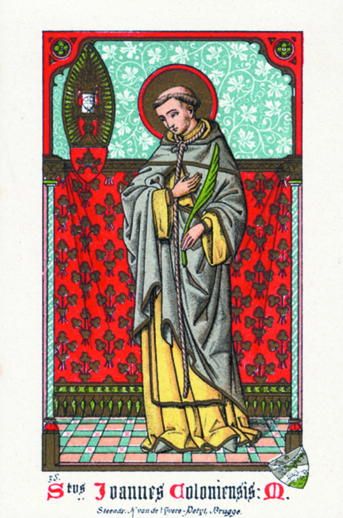
Saint John of Cologne Died 1572. Feast Day: July 9.
John was a Dominican priest who could not wear his habit because of the persecution against the church. He was caught smuggling communion to Catholic prisoners in Gorkum, Netherlands. He wears the rope he was hung with, while holding martyrs’ palms. The monstrance with the host glows near him. The shield of his order is at the bottom of the card.

The above saints have been excerpted from the book “Holy Cards” by Barbara Calamari and Sandra DiPasqua. All images are from the collection of Father Eugene Carrella.

Dining With the Saints

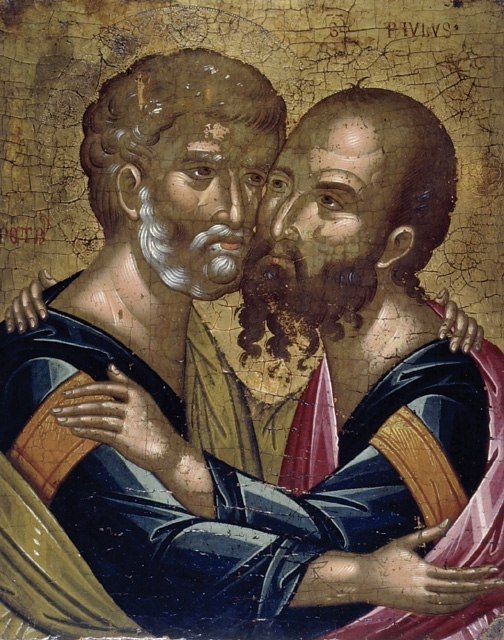
The Feast of Saint Peter and Paul

Many people have experienced eating prosciutto with ripe summer cantaloupe. It’s an Italian flavor combination made in heaven. Even when prosciutto is scarce, Italians, even my father and grandfather, would just sprinkle a bit of salt on cantaloupe knowing it would bring out the fruits’ sweetness.

One of the most ancient feasts observed by Christians is the Feast of San Pietro e Paolo (Saints Peter and Paul) on June 28th and 29th, honoring the martyrdom of these two influential Apostles. Celebrations vary from region to region, but the town ofViadanainLombardyholds a very special sagra of prosciutto, cantaloupe, and their slightly sweet and fizzy Lambrusco wine, highlighting some of the areas most prized food products. The dense, orange fleshed melon got its name form Cantalupo in the Savine region, where it was grown in the papal gardens. The beautiful fruit then spread to other areas ofItaly, traveling from one papal property to another. Inside Viadana’s 17th century church hangs a painting of the town patron surrounded by cantaloupes.

In honor of this very special feast, I’ve turned toLombardyfor inspiration and created a summer salad using cantaloupe, prosciutto, and Lambrusco, all three of the fine products this region celebrates for its festival.


Cantaloupe Salad with Prosciutto, Mozzarella, and Lambrusco Vinaigrette

(Serves four as a first course or as a lunch dish)

For the vinaigrette:

¼ cup Lambrusco wine

1 tablespoon Spanish sherry vinegar

3 tablespoons extra virgin olive oil

Salt

Black pepper

1 small ripe cantaloupe, scooped out with a melon baller (about 2 cups)

1 pint grape tomatoes

About a dozen bocconicini mozzarella

¼ lb. prosciutto, cut into thin strips

1 large bunch of frisee, ripped into pieces

1 shallot, thinly sliced

A handful of small basil leaves, left whole

To make the vinaigrette, pour the Lambrusco into a small saucepot and boil it over high heat until you have about a tablespoon (you can use another semi-sweet wine instead if you like). Let this cool for a few minutes. Now whisk in the sherry vinegar and the olive oil and season it with salt and black pepper.

Place all the ingredients for the salad in a large salad bowl. Pour on the viniagrette and toss gently. Serve right away.

(Dining with the Saints is a monthly column written by Erica De Mane, cookbook writer and teacher. You can find her food blog at www.ericademane.com)