Feast of St. Clare of Assisi, August 11

St.ClareSt. Clare of Assisi
1193-1254
Abbess and Founder of the Poor Clares
Patron of: Television Workers
Quote: “Totally love Him, Who gave Himself totally for your love.”
Keywords: clarity, blindness, embroiderers, eye diseases, gilders, goldsmiths, laundry workers, telephones, telegraphs, television
Symbols: monstrance, lamp, lily

Together with her mentor and friend, Francis of Assisi, St. Clare shook the foundations of Medieval society by revolutionizing religious expression. Her given name, Chiara means clarity and we call on St. Clare whenever we need to shine a light on a situation or to find a way to communicate more clearly. She is also invoked to protect the blind and to help those with eye trouble.
Chiara Offreduccio, as the beautiful daughter of minor royalty was offered every worldly advantage available to one in her social class. When she heard St. Francis preach the Lenten service at her church in 1212, his simple message of living with complete trust in God inspired her to abandon going through with her arranged marriage in order to join the Franciscan movement. The first followers of Saint Francis were the wealthy sons of his town of Assisi. Their act of turning their backs on the material world to live at the mercy of the elements and on whatever alms they could beg was disturbing and controversial to both their families as well as to the church authorities. Attracted by the joyous way in which they comported themselves, as well as the enthusiasm they brought to religious worship, Clare was the first woman to join their order.
Fervently believing in a life devoted to the precepts of the gospel, the Franciscans did not believe in personal property. When Clare escaped her family to join them on Palm Sunday, Francis himself cut off her long blond hair and handed her the simple woolen robe worn by his followers. He then left her in the local Benedictine convent as there were no facilities in his order for women. It was not long before her entire family attempted an intervention type rescue of the girl. Revealing her shorn hair to her horrified father made them realize that she would never return to their world. Her younger sister, as well as other wellborn young women from the town soon followed her. In 1215, Saint Francis installed Clare as the Abbess of the Order of Poor Ladies. True to the Rule of St. Francis, they accepted no dowries from their families as other religious orders did. When they were left inheritances, the money was distributed to the poor. Highly intelligent, and known for the efficacy of her prayers, popes, cardinals, royalty and St. Francis himself came to her for spiritual advice. Her own correspondence shows her to be a clever, happy person.
Devoted to the eucharist and frequently immersed in prayer, the stories of miraculous occurrences around Clare abound. The most famous is that while she was ill, her convent which was outside of the walls of Assisi was attacked by the Saracen mercenaries of Frederick II . As the invaders stormed the walls with ladders, Clare calmly held up a monstrance containing the host. A child’s voice emanated from inside the monstrance, “I will always guard and defend you.” A feeling of dread overtook the invaders and they ran away from the town.
St. Clare was named the patron saint of television writers and workers due to a vision she had while too ill to attend Christmas Eve mass. She was able to view and hear the entire mass on the wall of her room. She spent much time embroidering linens for use in mass, so she is the patron of embroiderers. Because that trade is hard on the eyes and because of her name, she is the patron of those with eye problems and the blind.
CARD SYMBOLS
Monstrance: Devoted to the Eucharist, Clare protected her convent by holding up a monstrance, which holds the host. Sometimes in art, this monstrance is re-interpreted as a lamp. Since Chiara means clarity, it is Clare shining the light of clarity.

NOVENA TO SAINT CLARE
O Glorious St. Clare! God has given you the power of working miracles continually, and the favor of answering the prayers of those who invoke your assistance in misfortune, anxiety, and distress. We beseech you, obtain from Jesus through Mary His Blessed Mother, what we beg of you so fervently and hopefully, (mention your petition) if it be for the greater honor and glory of God and for the good of our souls. Amen.
Novena to Saint Philomena

Aside

FullSizeCard_1


Saint Philomena

 291 – 304

 Feast Day: August 11

 Patron of: the Poor

 Keywords: the poor, children, babies, priests, lost causes, youth

 Symbols: palms, arrows, anchor, crown

 Quote:  “For the love of God!  It might well be that her name is not Philomena, but this Saint has performed many miracles and it is not the name that did them.”   Padre Pio

 Never official canonized, and listed in the local Calendar of Saints for only 130 years before being removed, Saint Philomena enjoys a unique and fervid following among common people, popes and saints. Her remains discovered seventeen centuries after her death, Saint Philomena is known as one of the great Wonder Workers of the nineteenth century and is the only person declared a saint based solely on their intercessionary powers. Recognized for her miraculous influence by six popes and ten different saints who have claimed personal experiences through her intervention, she is called upon when things look most hopeless. Discovered by a priest who hailed from a poverty-stricken parish near Naples, she is said to be particularly in tune with the needs of the poor.

 In 1802, the bones of a girl between the ages of 13 and 15 were discovered in the Catacombs of Priscilia in Rome, Italy. Three tiles closing off her space hollowed into the rock read, “Peace be with thee, Philomena”. Entombed with the girl was a vial thought to contain blood as well as drawings of a palm, two anchors and three arrows. Because these images were well known symbols used by early Christians to convey martyrdom, it was established that the girl was one of the many virgin martyrs in the early, underground church. In 1805 a young priest from the diocese of Nola (a district near Naples) requested the Vatican to allow him to obtain a relic for the new altar in the Church of Our Lady of Grace in Mugnano. Because he felt a spiritual affinity when he was near her remains, he was allowed to take the relics of the recently discovered virgin martyr back with him. Before her remains were translated to the church, they were put on display in Naples. Almost immediately, there were reports of miraculous healing. When her relics arrived in Mugnano on August 11, 1805, a cult rapidly grew, attributing many miracles to the intercession of the little martyr.

 In 1833 a Neapolitan nun, Sister Maria Luisa de Gesu, claimed to have a vision of Philomena who relayed her life story. According to her vision, Philomena was the daughter of the king of Corfu in Greece. When the Emperor Diocletian of Rome threatened her father’s kingdom with war, he traveled to Rome with his family in order to obtain peace. There Philomena discovered Christianity and vowed her virginity to Christ. When the Emperor saw how beautiful she was, he asked to marry her. When the young girl refused him, she was tortured and then drowned with an anchor tied around her neck. When two angels raised her up out of the sea, she was shot with arrows. After this failed to kill her, she was decapitated. According to the nun’s vision, Philomena declared that August 11th, the day her relics were installed in Mugnano, was also the anniversary of her death.

 In 1835, when Pauline Jaricot, the well-known and respected French reformer was gravely ill with heart disease, she made a pilgrimage to Mugnano and was completely cured by Philomena. News of this event spread throughout France and Spain and Philomena attracted such notable devotees as Saint Anthony Mary Claret from Spain and Saint John Vianney of France who built his own shrine to the little martyr. Several popes, while still cardinals paid visits to Philomena’s shrine. Pope Pius IX credits her with curing him of epilepsy. Saints such as Francis Xavier Cabrini, Padre Pio and Father Damian are numbered among her devotees. When the Calendar of Saints was reassessed to only list saints who had historical proof of their existence, Philomena lost her place. Her cult is still very strong and pilgrims from around the world visit her shrine in Mugnano.

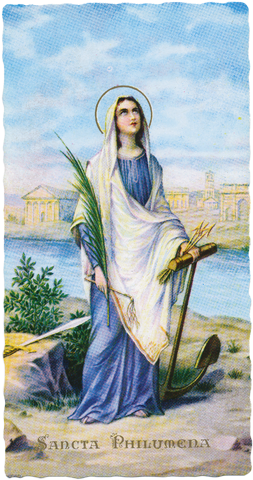
 Symbols:

Crown – of royal birth

Anchor – early Christian symbol of being ‘anchored by Christ’

Palms – martyrdom

Arrows – method of martyrdom


NOVENA PRAYER TO SAINT PHILOMENA


 O Faithful Virgin and glorious martyr, St. Philomena, who works so many miracles on behalf of the poor and sorrowing, have pity on me. Thou knowest the multitude and diversity of my needs. Behold me at thy feet, full of misery, but full of hope. I entreat thy charity, O great Saint! Graciously hear me and obtain from God a favorable answer to the request which I now humbly lay before thee.. (mention your intention).

I am firmly convinced that through thy merits, through the scorn, the sufferings and the death thou didst endure, united to the merits of the Passion and death of Jesus, thy Spouse, I shall obtain what I ask of thee, and in the joy of my heart I will bless God, who is admirable in His Saints. Amen.

 End with:

Saint Philomena, powerful with God, pray for us!
Saint Philomena, powerful with God, hear our prayers!

(Excerpted from The Novena App on itunes: https://itunes.apple.com/us/app/novena/id631346670?mt=8)

Saint Anthony of Padua, 1195 – 1231

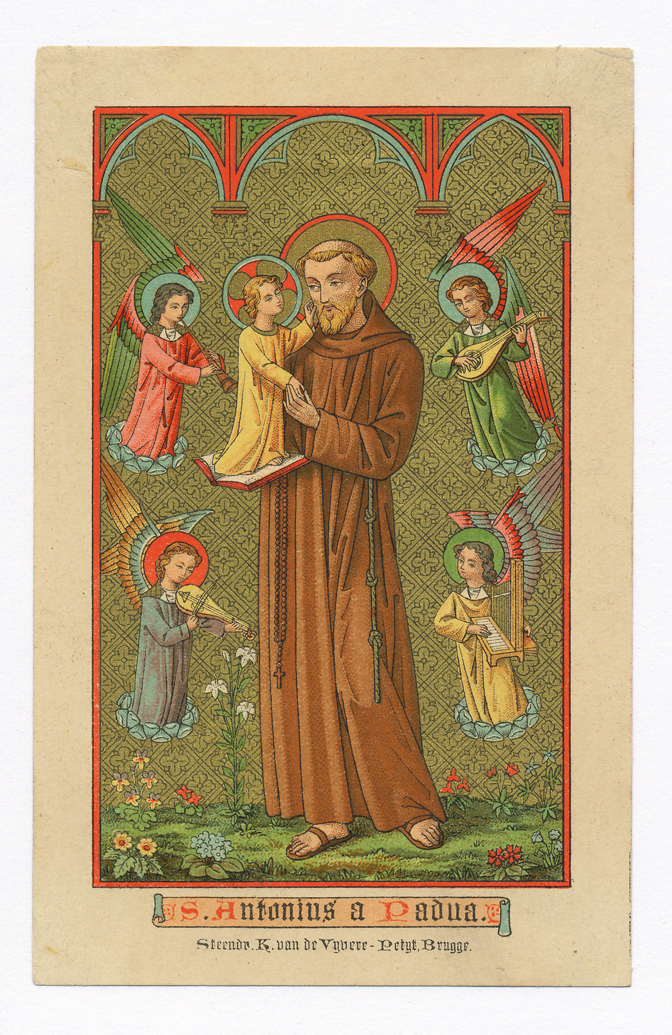
St. Antonius a Paduasmall“Saint Anthony, please come around, there’s something lost that must be found.” Doctor of the Church Feast Day: June 13 Patron of: Lisbon, Portugal, Padua, amputees, barren women, domestic animals, draftees, oppressed people, orphans, paupers, the poor, pregnant women, prisoners, sailors Invoked for: finding a husband, finding lost articles Invoked against: debt, shipwreck, starvation Symbols: baby Jesus, book of Gospels, lily Wonder and miracles are infused with every story of Saint Anthony. Though he has been dead for almost 800 years, he is still the most popular saint in the world and his statue is found in every Catholic Church. Saint Anthony is best known as the patron saint of lost articles but he is invoked for help in all life situations. In his own day he was called the “Wonder Worker’ and credited with the ability to stop the rain, raise the dead and reattach severed limbs. He was such a charismatic preacher that when a crowd of heretics in Rimini refused to listen to his preaching, the fish raised themselves out of the water to hear him. Born Fernando de Bulhes in Lisbon, Portugal, he disappointed his noble family by rejecting his luxurious life and joining the Augustinian religious order. A scholar by nature, he read every book in the monastery, devoting his time to contemplative prayer. Eventually, he befriended a group of itinerant Franciscan monks and became fascinated with this new religious order. Much impressed by their dedication to simplicity, poverty and their belief in returning to the original words of Christ, he joined their ranks, changing his name to Anthony in honor of Saint Anthony of the Desert, the patron of their little church. Returning home from a failed missionary venture in Morocco, his ship was blown off course and he wound up in Messina, Sicily. A group of Franciscan friars insisted he go north with them for a great gathering of all Franciscans, with their founder Francis of Assisi. Anthony remained in Italy and discovered his great gift of preaching when a superior ordered him to speak at an ordination, telling him to say whatever the holy spirit had infused into him. He astonished his audience, not only by his skills as an orator but by the depth of his knowledge. He was sent throughout northern Italy and southern France on evangelical preaching missions which gathered crowds in the tens of thousands. His popularity among the people increased as he used his position to get real changes enacted for their protection. While based in Padua, he observed the crushing power of debt upon the common people. At Anthony’s insistence, the local municipality enacted a law protecting those who could not pay their debts that is still enforced today. Anthony exhausted himself preaching out in fields and in piazzas as there was not cathedral large enough to hold all who came to hear him. At the age of thirty six, his health began to fail him and a local Count donated a woodland retreat for his recovery. One morning the Count heard the sounds of a baby giggling and he looked out to see Anthony surrounded in light, playing with the baby Jesus. That Christ would choose to appear to one of his saints in such a vulnerable state is a testament to the loving and kind nature of Saint Anthony. Because he is depicted holding a baby, women having trouble conceiving invoke his aid. Being of Portuguese descent, Anthony’s feast day is very auspicious for marriages in Portugal and Brazil and in those cultures, he is known to assist women seeking a husband. According to legend, Saint Anthony earned the title patron saint of lost articles when a novice borrowed his psalter and failed to return it. Saint Anthony prayed to get it back and the novice was visited by terrifying visions that sent him running back to Anthony with the book. In iconography, Anthony always holds the baby Jesus and a lily for purity. Many times the returned book of the gospels is included. Novena to Saint Anthony of Padua Holy Saint Anthony, gentle and powerful in your help, Your love for God and charity for His creatures, made you worthy when on earth, to possess miraculous powers. Miracles waited on your word, which you were always ready to request for those in trouble or anxiety. Encouraged by this thought, I implore you to obtain for me (mention your request here). The answer to my prayer may require a miracle. Even so, you are the saint of miracles. Gentle and loving Saint Anthony, whose heart is ever full of human sympathy, take my petition to the Infant Savior for whom you have such a great love, and the gratitude of my heart will be ever yours. Amen It is customary to donate to Saint Anthony’s Bread, a charity started in Saint Anthony’s lifetime, in gratitude to answered novena prayers.