Feast of St. Clare of Assisi, August 11

St.ClareSt. Clare of Assisi
1193-1254
Abbess and Founder of the Poor Clares
Patron of: Television Workers
Quote: “Totally love Him, Who gave Himself totally for your love.”
Keywords: clarity, blindness, embroiderers, eye diseases, gilders, goldsmiths, laundry workers, telephones, telegraphs, television
Symbols: monstrance, lamp, lily

Together with her mentor and friend, Francis of Assisi, St. Clare shook the foundations of Medieval society by revolutionizing religious expression. Her given name, Chiara means clarity and we call on St. Clare whenever we need to shine a light on a situation or to find a way to communicate more clearly. She is also invoked to protect the blind and to help those with eye trouble.
Chiara Offreduccio, as the beautiful daughter of minor royalty was offered every worldly advantage available to one in her social class. When she heard St. Francis preach the Lenten service at her church in 1212, his simple message of living with complete trust in God inspired her to abandon going through with her arranged marriage in order to join the Franciscan movement. The first followers of Saint Francis were the wealthy sons of his town of Assisi. Their act of turning their backs on the material world to live at the mercy of the elements and on whatever alms they could beg was disturbing and controversial to both their families as well as to the church authorities. Attracted by the joyous way in which they comported themselves, as well as the enthusiasm they brought to religious worship, Clare was the first woman to join their order.
Fervently believing in a life devoted to the precepts of the gospel, the Franciscans did not believe in personal property. When Clare escaped her family to join them on Palm Sunday, Francis himself cut off her long blond hair and handed her the simple woolen robe worn by his followers. He then left her in the local Benedictine convent as there were no facilities in his order for women. It was not long before her entire family attempted an intervention type rescue of the girl. Revealing her shorn hair to her horrified father made them realize that she would never return to their world. Her younger sister, as well as other wellborn young women from the town soon followed her. In 1215, Saint Francis installed Clare as the Abbess of the Order of Poor Ladies. True to the Rule of St. Francis, they accepted no dowries from their families as other religious orders did. When they were left inheritances, the money was distributed to the poor. Highly intelligent, and known for the efficacy of her prayers, popes, cardinals, royalty and St. Francis himself came to her for spiritual advice. Her own correspondence shows her to be a clever, happy person.
Devoted to the eucharist and frequently immersed in prayer, the stories of miraculous occurrences around Clare abound. The most famous is that while she was ill, her convent which was outside of the walls of Assisi was attacked by the Saracen mercenaries of Frederick II . As the invaders stormed the walls with ladders, Clare calmly held up a monstrance containing the host. A child’s voice emanated from inside the monstrance, “I will always guard and defend you.” A feeling of dread overtook the invaders and they ran away from the town.
St. Clare was named the patron saint of television writers and workers due to a vision she had while too ill to attend Christmas Eve mass. She was able to view and hear the entire mass on the wall of her room. She spent much time embroidering linens for use in mass, so she is the patron of embroiderers. Because that trade is hard on the eyes and because of her name, she is the patron of those with eye problems and the blind.
CARD SYMBOLS
Monstrance: Devoted to the Eucharist, Clare protected her convent by holding up a monstrance, which holds the host. Sometimes in art, this monstrance is re-interpreted as a lamp. Since Chiara means clarity, it is Clare shining the light of clarity.

NOVENA TO SAINT CLARE
O Glorious St. Clare! God has given you the power of working miracles continually, and the favor of answering the prayers of those who invoke your assistance in misfortune, anxiety, and distress. We beseech you, obtain from Jesus through Mary His Blessed Mother, what we beg of you so fervently and hopefully, (mention your petition) if it be for the greater honor and glory of God and for the good of our souls. Amen.
Novena to Saint Philomena

Aside

FullSizeCard_1


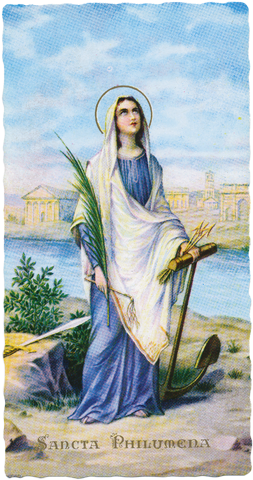
Saint Philomena

 291 – 304

 Feast Day: August 11

 Patron of: the Poor

 Keywords: the poor, children, babies, priests, lost causes, youth

 Symbols: palms, arrows, anchor, crown

 Quote:  “For the love of God!  It might well be that her name is not Philomena, but this Saint has performed many miracles and it is not the name that did them.”   Padre Pio

 Never official canonized, and listed in the local Calendar of Saints for only 130 years before being removed, Saint Philomena enjoys a unique and fervid following among common people, popes and saints. Her remains discovered seventeen centuries after her death, Saint Philomena is known as one of the great Wonder Workers of the nineteenth century and is the only person declared a saint based solely on their intercessionary powers. Recognized for her miraculous influence by six popes and ten different saints who have claimed personal experiences through her intervention, she is called upon when things look most hopeless. Discovered by a priest who hailed from a poverty-stricken parish near Naples, she is said to be particularly in tune with the needs of the poor.

 In 1802, the bones of a girl between the ages of 13 and 15 were discovered in the Catacombs of Priscilia in Rome, Italy. Three tiles closing off her space hollowed into the rock read, “Peace be with thee, Philomena”. Entombed with the girl was a vial thought to contain blood as well as drawings of a palm, two anchors and three arrows. Because these images were well known symbols used by early Christians to convey martyrdom, it was established that the girl was one of the many virgin martyrs in the early, underground church. In 1805 a young priest from the diocese of Nola (a district near Naples) requested the Vatican to allow him to obtain a relic for the new altar in the Church of Our Lady of Grace in Mugnano. Because he felt a spiritual affinity when he was near her remains, he was allowed to take the relics of the recently discovered virgin martyr back with him. Before her remains were translated to the church, they were put on display in Naples. Almost immediately, there were reports of miraculous healing. When her relics arrived in Mugnano on August 11, 1805, a cult rapidly grew, attributing many miracles to the intercession of the little martyr.

 In 1833 a Neapolitan nun, Sister Maria Luisa de Gesu, claimed to have a vision of Philomena who relayed her life story. According to her vision, Philomena was the daughter of the king of Corfu in Greece. When the Emperor Diocletian of Rome threatened her father’s kingdom with war, he traveled to Rome with his family in order to obtain peace. There Philomena discovered Christianity and vowed her virginity to Christ. When the Emperor saw how beautiful she was, he asked to marry her. When the young girl refused him, she was tortured and then drowned with an anchor tied around her neck. When two angels raised her up out of the sea, she was shot with arrows. After this failed to kill her, she was decapitated. According to the nun’s vision, Philomena declared that August 11th, the day her relics were installed in Mugnano, was also the anniversary of her death.

 In 1835, when Pauline Jaricot, the well-known and respected French reformer was gravely ill with heart disease, she made a pilgrimage to Mugnano and was completely cured by Philomena. News of this event spread throughout France and Spain and Philomena attracted such notable devotees as Saint Anthony Mary Claret from Spain and Saint John Vianney of France who built his own shrine to the little martyr. Several popes, while still cardinals paid visits to Philomena’s shrine. Pope Pius IX credits her with curing him of epilepsy. Saints such as Francis Xavier Cabrini, Padre Pio and Father Damian are numbered among her devotees. When the Calendar of Saints was reassessed to only list saints who had historical proof of their existence, Philomena lost her place. Her cult is still very strong and pilgrims from around the world visit her shrine in Mugnano.

 Symbols:

Crown – of royal birth

Anchor – early Christian symbol of being ‘anchored by Christ’

Palms – martyrdom

Arrows – method of martyrdom


NOVENA PRAYER TO SAINT PHILOMENA


 O Faithful Virgin and glorious martyr, St. Philomena, who works so many miracles on behalf of the poor and sorrowing, have pity on me. Thou knowest the multitude and diversity of my needs. Behold me at thy feet, full of misery, but full of hope. I entreat thy charity, O great Saint! Graciously hear me and obtain from God a favorable answer to the request which I now humbly lay before thee.. (mention your intention).

I am firmly convinced that through thy merits, through the scorn, the sufferings and the death thou didst endure, united to the merits of the Passion and death of Jesus, thy Spouse, I shall obtain what I ask of thee, and in the joy of my heart I will bless God, who is admirable in His Saints. Amen.

 End with:

Saint Philomena, powerful with God, pray for us!
Saint Philomena, powerful with God, hear our prayers!

(Excerpted from The Novena App on itunes: https://itunes.apple.com/us/app/novena/id631346670?mt=8)

Novena Saint for August: Health

Sanctus Alphonsus de Ligorio

St. Alphonsus Liguori

 1696 – 1787

Feast Day: August 1 

Doctor of the Church

 Patron: Arthritis sufferers

 Keywords: Confessors, Moral Theologians, Lawyers, Scruples

 Quote: “Your God is ever beside you, indeed He is even within you.”

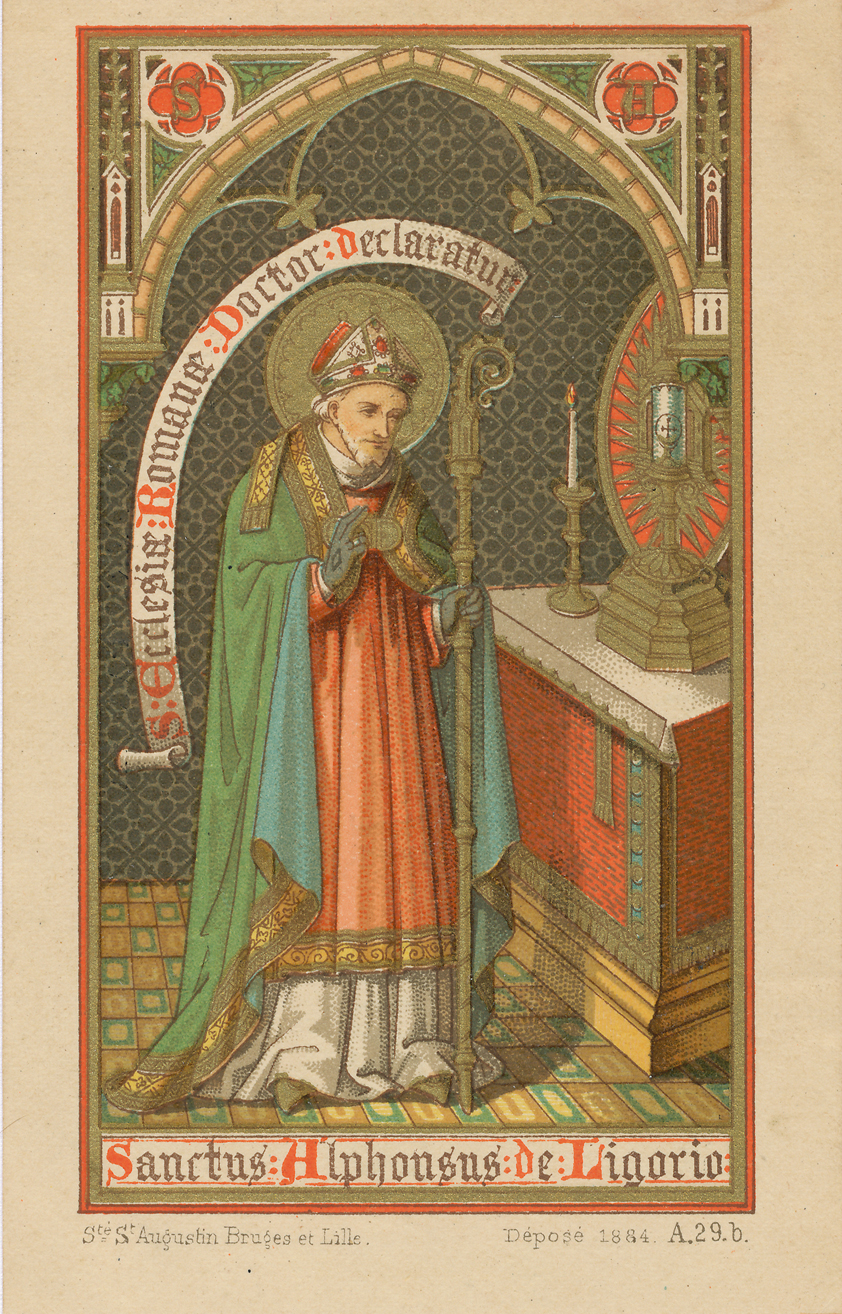
 Symbols: chin in chest, writing pen, book, bishops’ hat and staff


So crippled with arthritis that he could not lift his head off of his chest, St. Alphonsus Liguori looked on his illness as a grace since it made him use his earthly time in the most productive manner possible. In chronic pain and expecting to die at any moment, he went on to publish over 60 books dealing with theological studies, as well as music and poetry. He is invoked by those suffering with arthritis for a cure as well as those seeking a way to live a productive life while stricken with illness.

 Born into a noble but poor family near Naples in 1696, Alphonsus Liguori was the eldest of seven children.  Though he was physically small with poor eyesight, he was incredibly intelligent and musically talented. Because of his poor eyesight he could not follow in his father’s military footsteps, but his intellectual brilliance made him the hope of his family, as he received his law degree at the early age of sixteen.  He quickly became famous in the Neapolitan courts for never losing a case. A devout Catholic, he credited his success with his daily mass going. After eight years of constant triumph, Alphonsus was stunned to lose an extremely important and public case due to his own oversight regarding a signed document. Humiliated, he looked on this personal disaster as sign from God and fasted and prayed for three days. While doing charitable work in the Hospital for the Incurables, he had a vision commanding him to quit the world and give himself to God. His father was outraged when left the law for the priesthood.

 Devoting his work to those on the outskirts of society, he founded the Redemptorist Fathers, an order devoted to doing missionary work among the poor. Though gifted with the ability to argue the most finite facts of law or theology Alphonsus Liguori always preached in the simplest terms, writing many books and pamphlets in the vernacular of the common person. Because of his great popularity as a preacher, his religious order began to attract many young people. Living at a time of great political and religious upheaval and plagued with deteriorating health, Alphonsus Liguori never enjoyed much peace in his life. Instead, he welcomed these obstacles as an opportunity to perfect his soul.

 Explanation of symbols:

Banner: declaring him Doctor of the Church because of the incredible range and amount of his writings.

Bishop hat and staff: he was a Bishop and leader of his order.

Crucifix: Total devotion to Christ and His teachings.


Novena to St. Alphonsus Liguori

 Glorius Saint Alphonsus, loving fathr of the poor and sick, all your life you devoted yourself with a charity really heroic to lightening their spiritual and bodily miseries. Full of confidence in your tender pity for the sick, since you yourself have patiently borne the cross of illness, I come to you for help in my present need.

 (Mention your request).

 Loving father of the suffering, Saint Alphonsus, whom I invoke as the Arthritic Saint, since you suffered from the disease in your lifetime, look with compassion upon me in my suffering. Beg God to give me good health. If it is not God’s will to cure me, then give me strength to bear my cross patiently and to offer my sufferings in union with my crucified Savior and His Mother of Sorrows, for the glory of God and the salvation of souls, in reparation for my sins and those of others, for the needs of this troubled world, and for the souls in purgatory.

 (Recite one Our Father, one Hail Mary, one Glory Be.)

 Saint Alphonsus, patron of the sick, pray for me. Amen

Excerpted from our new App under Saints of Health.
Click Here: https://itunes.apple.com/us/app/novena/id631346670?mt=8

Feast of Saint Ann and Saint Joachim

FullSizeCard_1
Saint Ann and Saint Joachim
First Century B.C.
Feast Day: July 26

Patron of : Grandparents

Keywords: child rearing, childless people, fathers, family crisis, infertility, mothers, pregnancy

Quote: “O blessed couple, all the world is indebted to you, for it is by your means that it can offer to its Creator the most excellent gift possible, her who is worthy to be Mother of His only Son.” – St. John Damascene

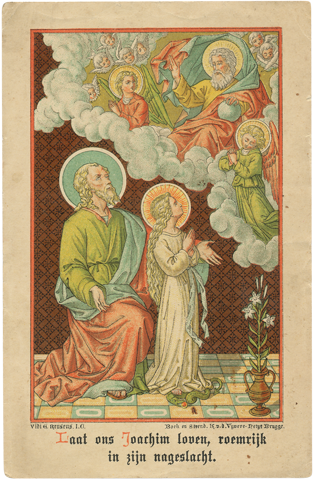
Symbols: two white doves, meeting at the golden gate, teaching the Virgin Mary

Grandparents are the foundation of a family and we invoke Saints Joachim and Ann for strength in every sort of family crisis. As parents of the Virgin Mary and the grandparents of Jesus Christ, they offer a vast array of earthly experiences relatable to every human being. Infertility, late parenthood, an unmarried pregnant daughter, a grandson who was imprisoned and executed, are all parts of their life together which they accepted with grace and dignity.

Joachim and Ann are important as moral examples rather than truthful historical figures. According to legend, Joachim and Ann were married twenty years and still had not conceived a child. Living in Nazareth they were upstanding citizens, always tithing one third of their income to the temple. After many years, their barrenness was considered a form of divine judgment and eventually their contribution to the temple was refused and they were ostracized by their community. In shame, Joachim went off to live with his shepherds. There he was visited by an angel who told him, that Ann was pregnant with a child named Mary who was to be dedicated to the Lord. He was to return home and find his wife, who would be waiting at the golden gate, the entrance to the city. Doing as he was told, his joyful reunion with Ann at the golden gate has become a famous image in art history.

Mary was raised according to the instructions of the angel, she was consecrated to the Lord at infancy and sent off to live in the temple, away from the world, at the age of three. Accepting this great sacrifice of giving up what is most cherished to God, Joachim and Ann acted out an almost impossible act of faith. Though Saint Ann was younger and lived much longer than her husband, she and Joachim are inseparable in sharing the important patronage of grandparents.

Explanation:
A rare image of Joachim as an older father, and his wife, Ann, instructing the Virgin Mary. They are divinely inspired by the wisdom of the Holy Spirit.

Novena to Saints Joachim and Ann

Saints Joachim and Ann, grandparents of Jesus and parents of Mary, we seek your intercession. We beg you to direct all our actions to the greater glory of God and the salvation of souls. Strengthen us when we are tempted, console us during our trials, help us when we are in need, be with us in life and in death.

O divine savior, we thank you for having chosen saint Joachim and Ann to be the parents of our Blessed Mother Mary and so to be your beloved grandparents. We place ourselves under their patronage this day. We recommend to them our families, our children, and our grandchildren. Keep them from all spiritual and physical harm. Grant that they may ever grow in greater love of God and others.

Saints Joachim and Ann, we have many great needs. We beg you to intercede for us before the throne of your divine grandson. All of us here have our special intentions, our own special needs, and we pray that through your intercession our prayers may be granted. Amen.

(Mention your request here)

Novena to Our Lady of Mount Carmel July 16

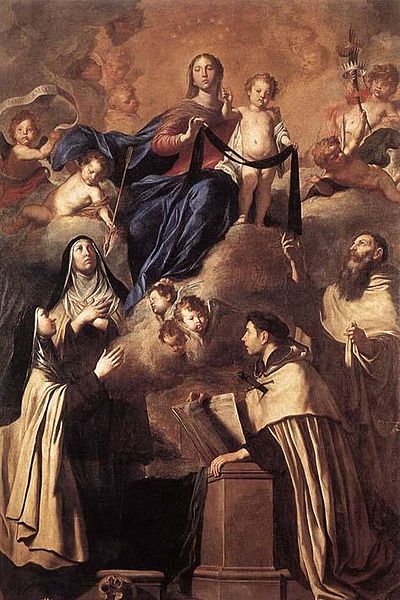
400px-Pietro_Novelli_Our_Lady_of_Carmel_and_Saints

O most holy mother of Mount Carmel, when asked by a saint to grant privileges to the family of Carmel, you gave assurance of your motherly love and help to those faithful to you and to your Son. Behold us, your children. We glory in wearing your holy habit, which makes us members of your family of Carmel, through which we shall have your powerful protection in life, at death, and even after death. Look down with love, O Gate of Heaven, on all those now in their last agony! Look down graciously, O Virgin, Flower of Carmel, on all those in need of help! Look down mercifully, O Mother of Our Saviour, on all those who do not know that they are numbered among your children! Look down tenderly, O Queen of All Saints, on the poor souls!
(Pause and mention your request).
(Recite one Our Father, one Hail Mary, one Glory Be).
Our Lady of Mount Carmel, pray for us.

Excerpted from the book “Novena: The Power of Prayer” by Barbara Calamari and Sandra DiPasqua

Our Lady of Perpetual Help

olph22Feast Day: June 27
Patronage: anything
Keywords: refuge, protection, motherly comfort, icon
Quote: “Why don’t you just ask?”
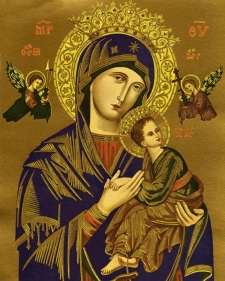
Symbols: lance, sponge, cross, nails, unfastened sandal

An icon is a visual prayer and this image of Mary comforting her young son in a moment of fear, brings consolation to anyone who meditates on it. On either side of Mary are the two Archangels, Michael holding the lance and spear and Gabriel holding nails and the cross Jesus will be crucified on. The child Jesus has been so frightened at the sight of these instruments of his future torment that he has run to his mother in tremendous haste, loosening his sandal. Though she is well aware that this suffering is in his future, Mary has such faith in his ultimate redemption that she calmly holds and reassures her son. If God himself can go to Mary for refuge, than anyone should be able to approach her. Her ultimate belief and faith extends to every one of us, no matter how harshly we may judge ourselves. Our Lady of Perpetual help is said to never refuse a request for help, great or trivial. Despite their reticence to invoke her aid, many have reported hearing Mary’s calm voice saying, “Why don’t you just ask?”

Copies of this miraculous icon can be found in tens of millions of homes all over the world. Though its age is unknown, it first made its appearance in the fifteenth century when it was brought to Rome by a wealthy merchant from Crete. His family eventually donated it to the Church of Saint Matthew in Rome. When that church was destroyed in the Napoleonic invasion of 1789, it was hidden by a priest. Sixty-four years later, its discovery so moved the Redemptorist Fathers who were building a new church on that site. Because of its great visual power, they made it their mission to disseminate this image all over the world. The original icon can be found today hanging in the Church of Saint Alphonse Liguori in Rome.

Meaning:
Lance and sponge: Held by St. Michael the Archangel instruments of torture in the crucifixion
Crucifix: Held by St. Gabriel the Archangel, cross of crucifixion
Unfastened sandal: Jesus was so frightened his sandal came off

Novena to Our Lady Of Perpetual Help.

See at Your feet, O Mother of Perpetual Help, a poor sinner who has recourse to you and confides in you.

O Mother of Mercy, have pity on me! I hear you called the refuge and the hope of sinners; be my refuge and my hope.

Help me, for the love of Jesus Christ; stretch forth your hand to a poor fallen creature recommends myself to you, and I devote myself to your service forever.

I bless and thank Almighty God, who in His mercy had given me this confidence in you, which I hold to be a pledge of my eternal salvation.

Mary, tender Mother, help me. Mother of Perpetual Help, never allow me to lose my God.
Amen.

Recite the following prayers 3 times each…
Our Father…
Hail Mary…
Glory Be…

Novena App Review

A review from RORATE CAELI

“A wonderful new, low-cost app has been made available to Catholics, enabling them to take their novenas on the go with no need to lug along books or printouts.

In a time of mass communications and very little of it good and holy, we’re very happy to pass this wonderful tool along to our readers.

The novena app has a plethora of great novenas, arranged to easily navigate based on need: health, occupations, situations, states of life, etc. You can also say novenas based on who you want to pray to, if not what to pray for. You can search for those by: angels, evangelists, holy people, martyrs and mystics.”

http://rorate-caeli.blogspot.com/2013/05/novenas-on-go.html

Sacred Heart of Jesus

FullSizeCard_1Feast Day: June 7
Movable – the Friday after the Second Sunday after Pentecost

Patronage: Family Peace, Anything

Keywords: Love, Family Peace, Consolation, Mercy, Reparations

Quote: “Behold the heart which has so much loved men that it has spared nothing, even exhausting and consuming itself in testimony of its love….”

The iconography of the Sacred Heart speaks to us on such a basic level that its image can be found everywhere in everyday life – from tattoos on bikers to stained glass windows in cathedrals. Traditionally, many Catholic homes display the Sacred Heart of Jesus to insure domestic peace and a loving atmosphere. This ancient concept depicting Christ’s heart in flames was first meditated on in privacy by the 4th century hermits in the desert and taken up by mystics in religious communities in the 11th and 12th centuries; it did not become a popular devotion until the 17th century.

On December 27, 1673, a young Visitation nun in Burgundy, France, named Margaret Mary Alacoque was praying in the convent chapel when she heard a strong inner voice identifying itself as Jesus Christ. In later visits the voice requested that she begin a devotion to an image of Christ’s heart in flames, bleeding and encircled by thorns. The flames were for His ardent love for mankind, the thorns were to remind us of His sacrifice on the cross and the blood was because He was God made man. There is no indication that Margaret Mary Alacoque had ever seen this image before. Indeed, she was puzzled by it and greatly mistrusted herself as being qualified to relay any spiritual messages no matter who they purportedly came from. When she reported her communications to her Mother Superior she was scoffed at as delusional and forbidden to perform any of the devotions she was instructed to carry out. It was only after her Confessor, Claude de La Columbiere heard her describe her visions that she was taken seriously. Unlike the Mother Superior or Margaret Mary, he was well aware of the private devotions of Bernard of Clairvaux and Mechtilde of Helfta, religious mystics who lived centuries before, inspired by same image. La Columbiere did much to publicize devotion to the Sacred Heart based on the messages Christ gave to Margaret Mary. According to her, Christ was greatly troubled by the indifference and sacrilege He was being treated with by the average person. As a reward for contemplating this image He promised:
1. I will give them all the graces necessary for their state of life.
2. I will give peace in their families.
3. I will console them in all their troubles.
4. I will be their refuge in life and especially in death.
5. I will abundantly bless all their undertakings.
6. Sinners shall find in my Heart the source and infinite ocean of mercy.
7. Tepid souls shall become fervent.
8. Fervent souls shall rise speedily to great perfection.
9. I will bless those places wherein the image of My Sacred Heart shall be exposed and venerated.
10. I will give to priests the power to touch the most hardened hearts.
11. Persons who propagate this devotion shall have their names eternally written in my Heart.
12. In the excess of the mercy of my Heart, I promise you that my all powerful love will grant to all those who will receive Communion on the First Fridays, for nine consecutive months, the grace of final repentance: they will not die in my displeasure, nor without receiving the sacraments; and my Heart will be their secure refuge in that last hour.
Since there is no way to physically depict the soul, it is thought that the image of the Sacred Heart comes closest. The heart is the seat of love in the body and the wounded heart represents Christ’s sacrifice at the crucifixion as well as His ongoing pain at the state of mankind.

Novena to the Sacred Heart of Jesus
O Lord, Jesus Christ, to your most Sacred Heart I confide this intention. Only look upon me, then do what your love inspires. Let your Sacred Heart decide. I count on you. I trust in you. I throw myself on your mercy. Lord Jesus, you will not fail me.
(Mention your request.)
Sacred Heart of Jesus I trust in you.
Sacred Heart of Jesus I believe in your love for me.
Sacred Heart of Jesus, your kingdom come.
Sacred Heart of Jesus, I have asked you for many favors, but I earnestly implore this one. Take it, place it in your open heart. When the Eternal Father looks upon it, he will see it covered with your Precious Blood. It will no longer be my prayer, but yours, Jesus. Sacred Heart of Jesus, I place all my trust in you. Let me not be disappointed. Amen.

Feast of St. Dymphna

St. Dymphna
St. Dymphna
605 – 620
Feast Day: May 15
Patron of: Mental Illness
Invoked for: epilepsy, incest victims, runaways, demonic possession, schizophrenia, family peace, calm, consolation

“Saint Dymphna, renowned for many miracles, please hear my plea.”

As a victim of a mentally ill father, Saint Dymphna offers much solace to those suffering from psychological problems as well as their families. She is invoked to bring peace to the unbalanced as well as create an aura of calm and consolation for those who live in the midst of instability.

Having lived such a short life so long ago, there is very little factual information available about Saint Dymphna. According to a written report commissioned by the Bishop of Cambrai seven hundred years after her death, Dymphna was born an Irish princess. Her mother was a devout Christian married to Damon, a pagan king. Dymphna’s mother made sure her daughter was brought up as a Christian, having installed her own confessor, Gerebran into her household. At the age of fourteen Dymphna lost her mother and her father went mad with grief. After a period of mourning, he searched all of Ireland for a new companion but could not find a woman who even remotely resembled his first wife. Because Dymphna was almost the exact image of her mother, Damon decided to marry her and make her his queen, disregarding the fact that she was his own daughter. In order to thwart this plan, Gerebran and Dymphna escaped the castle and went abroad to Antwerp. Eventually settling in Gheel in Belgium, they lived as religious hermits. Dymphna studied to be an anchoress which was a woman who lived in a room connected to a church with a window open to the street. Towns in the middle ages usually supported these people who offered their knowledge to those in need of advice. It took Damon and his men a year to find Dymphna and Gerebran. The priest was executed immediately and Dymphna was offered her father’s kingdom in exchange for returning home with him. When she refused, he decapitated her in a rage. Both bodies were immediately buried. Since epilepsy and mental illness were all thought to be caused by demonic possession, those suffering from mental afflictions were never welcomed to live in one place and were doomed to wander from town to town. Soon after Dymphna’s death, a group of five of these social pariahs slept at the site of her murder and were instantly healed by the blood in the earth.

In the 13th century, the remains of an unknown man and woman were accidentally disinterred at Gheel. The name DYMPNA was written on a brick over the woman’s remains. As the remains were reinterred in a tomb, miraculous healings of the mentally ill and epileptics in the region were recorded. Gheel became a pilgrimage site for anyone suffering from any form of mental illness. By the end of the thirteenth century a major hospital and treatment center was built there for those suffering from nervous disorders. To this day, Gheel offers the most advanced and humane treatment for the mentally ill in the world. Saint Dymphna’s remains, in the church named for her there continues to be a place of pilgrimage.

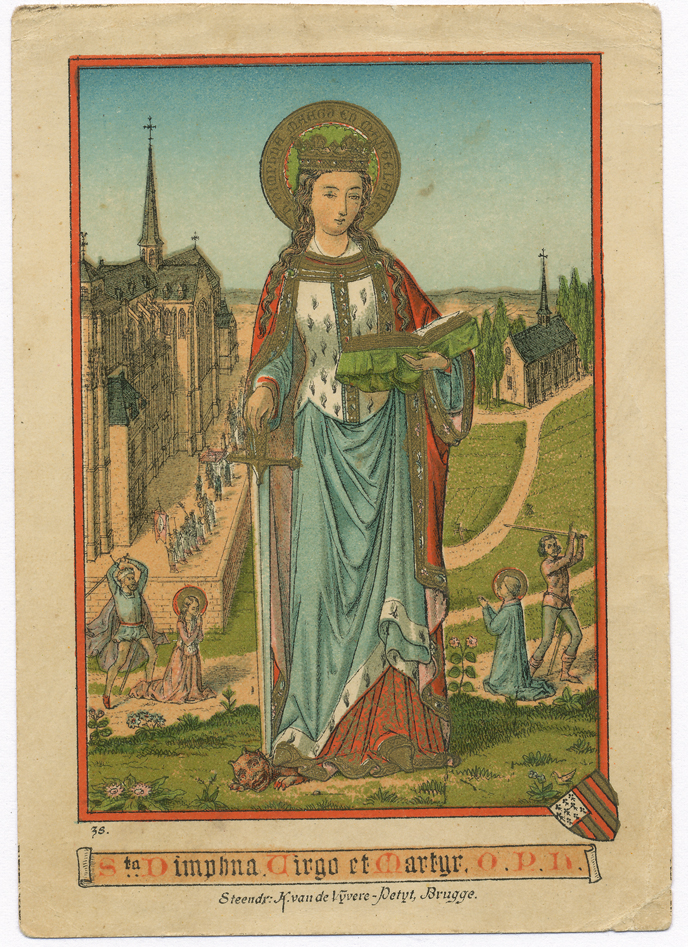
Symbols: crown because of royal birth, shackled serpent representing the devil who was thought to be responsible for the mentally ill due to demonic possession, book because she was an anchoress and religious scholar, lily for purity, martyrs palm

Novena to Saint Dymphna

O God, we humbly beseech you through your servant Saint Dymphna, who sealed with her blood the love she bore you, to grant relief to those who suffer from mental afflictions and nervous disorders, especially (mention the afflicted person).

Saint Dymphna, helper of the mentally afflicted, pray for us.

Saint Dymphna, comforter of the despondent, pray for us.

Saint Dymphna, renowned for many miracles, please hear my plea.

Amen.

(Recite one Glory Be).

Saint Rita of Cascia

St. Rita of Cascia
1386-1457
Patron of: Impossible Causes

Keywords: Impossible, Desperation, bad marriages, spousal abuse, widows, bodily ills, loneliness, smallpox, sterility

Symbols: roses, thorns, bees, wounded head

An abused wife, a mother who’s children died, a widow of a murdered husband, and finally, a nun, Saint Rita experienced many lives in her time on earth. Knowing the powerlessness and despair of those in bad marriages she is invoked for help in desperate times. In her own lifetime she was famous for the power of her prayers to change any situation and it was said that she could accomplish the impossible. Canonized almost 500 years after her birth, she is the first declared female saint of the 20th Century.

Margarita Lotti was born to an older farming couple in Roccaporena, Italy. She was called Rita because of a vision of an angel her mother had who named the baby while declaring, “You will give birth to a daughter marked with the seal of sanctity, gifted with every virtue, a helper to the helpless and an advocate of the afflicted.” As proof of this prophecy, bees, a sign of divine presence, always hovered over her crib as she slept, never harming or waking her.

Though she had always wanted to be a nun, Rita’s parents feared for her future security as there was a schism in the church and many religious orders were closing their doors. Instead, she had to accept a marriage they contracted for her with a man named Paolo Mancini. Though he was a good provider, he soon proved to be an abusive, promiscuous husband. Settling his personal disputes with violence, Mancini created a tense family environment for Rita and the two sons she had with him. Never wavering in her devotion to God, Rita prayed that her husband would change his ways. After 18 years of marriage, Paolo had a vision of himself as others saw him and begged for his wife’s forgiveness. A lifetime of enemies caught up with Paolo and he was murdered, his mutilated body dumped on his family’s doorstep. Rita begged her two teenaged sons not to pursue a vendetta against his killers, but they refused. She prayed to God to prevent her sons from murdering anyone. Both of them came down with serious illnesses and died before they could act on their vendetta.

Alone in the world, Rita petitioned to join the Augustinian convent. Because several of the nuns there had family members who were involved in Paolo’s murder, the convent refused her, not wanting tensions to carry over from the outside world. Rita prayed and entreated Paolo’s family to forgive his killers. Much to everyone’s surprise, they acquiesced and Rita was admitted to the convent on her third try. While there she spent her days nursing the older nuns and concentrating on Christ’s suffering. When she begged to feel what Christ felt on the cross, a thorn from the crown of thorns on a crucifix struck her on the head and became embedded there. It left a deep wound that never healed. Because this wound became infected and foul smelling Rita was shunned by the other nuns and remained in her cell praying and meditating. The January before she died, a cousin asked her if there was anything she needed and she asked for a rose from her childhood garden. The cousin was shocked to see that there was indeed two roses growing in that garden in the middle of January. Upon her death, her cell was filled with the smell of roses. Rita is always depicted with the thorn in her head, in her Augustinian habit, meditating on the crucified Christ.

Thorns: she took on the suffering of Christ
Wound in the head: Divine light, grace and spiritual power.
Roses: love. Also proof of Rita’s miraculous powers as her roses grew in the winter.

St. Rita
Novena to Saint Rita
O holy protectress of those who art in greatest need, O you who shine as a star of hope in the midst of darkness, blessed Saint Rita, bright mirror of God’s grace, in patience and fortitude you are a model of all states in life. I unite my will with the will of God through the merits of my Savior, Jesus Christ, and in particular through his patient wearing of the crown of thorns, which with tender devotion you daily contemplated. Through the merits of the holy Virgin Mary and your own graces and virtues, I ask you to obtain my earnest petition, provided it be for the greater glory of God and my own sanctification. Guide and purify my intention, O holy protectress and advocate, so that I may obtain the pardon of all my sins and the grace to persevere daily, as you did in walking with courage, generosity, and fidelity down the path of life.
(Mention your request).
Saint Rita, advocate for the impossible, pray for us.

Saint Rita, advocate of the helpless, pray for us.

(Recite Our Father, Hail Mary and the Glory Be three