Dining With the Saints

A  SAINT VALENTINE’S DAY DINNER

Saint Valentine, the Saint associated with marriage and love, has a very special place in the hearts of the people of Roquemaure, and small town in the Vaucluse region of Provence, France. In 1868 the town welcomed the Saint’s relics into their town in an effort to cure their terribly blight infested vineyards. Every year since the arrival of the holy relics, the town holds a huge festival, starting on the Saint’s feast day of February 14 and lasting three days. Couples promenade through the town square in 19th century attire, and there is much period dancing and live music, all dedicated to the theme of love. Kids play traditional 19th century games, and basket makers set up their stalls to demonstrate their craft. Barrel organs are on every street corner, and horse drawn carriages carry residents and tourists,dressed head to toe in the fashions of St. Valentine’s Day, through the town. This area now produces some of Provence’s best red wine and much of it is consumed during this cold weather, outdoor festival.

The St. Valentine’s festival also coincides with the black truffle season in the Vaucluse, where truffle hunters spend hours in the chilly Provence woods with their truffle hunting pigs or dogs, searching for these expensive prized tubers. Truffles have always been a culinary symbol of romance and an offering of love.

Black truffles are prepared simply so their beautiful perfume is not masked by competing flavors. In the Vaucluse shaving truffles over boiled potatoes drizzled with olive oil is a standard treatment, so is shaving them onto creamy scrambled eggs. But my favorite is a dish of egg pasta, tossed simply with butter and fine Provencal olive oil and topped with thin shavings of the Vaucluse truffle. If you really want to woo your lover, Provence style, try this simple but extravagant recipe.

Tagliatelle with Black Truffles, Vaucluse Style

(Serves two)

½ pound fresh tagliatelle pasta

Salt

3 tablespoons unsalted butter

2 tablespoons extra virgin olive oil, from Provence, if possible

A few sprigs flat leaf parsley, leaves lightly chopped

1 ½ to 2 ounces fresh black truffle

Freshly ground black pepper

Put up a pot of pasta cooking water and bring it to a boil. Season it with a generous amount of salt.

Warm a pasta serving bowl and have it close at hand.

Drop the tagliatelle into the water and cook until just tender. The fresher the pasta the shorter the cooking time. Just made egg pasta can take as little as a minute. Store bought, fresh pasta tends to be slightly firmer and might take about 3 minutes. When tender, drain the pasta, leaving a little water clinging to it, and pour it into the serving bowl. Add the butter and olive oil, the parsley, a few big grindings of black pepper, and a pinch of salt, and toss until the pasta is well coated. With a vegetable scraper or a truffle shaver, shave the black truffle over the top. Serve right away.

By Erica De Mane, chef and cookbook writer

www.ericademane.com

More about Saint Valentine.

Dining With the Saints

The Feast of Sant’ Antonio Abate


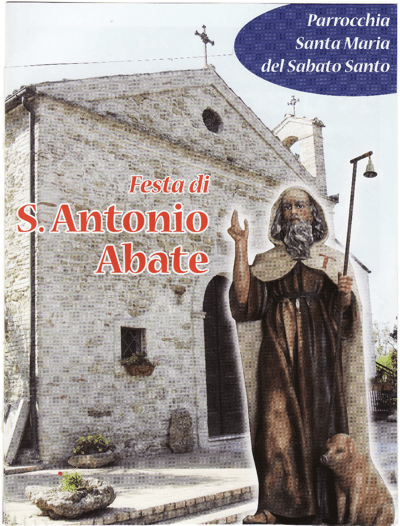
 Sant’Antonio Abate (Saint Anthony the Abbot, born 251 in Egypt) is the protector of domestic animals, so in Italy on his feast day, January 17, all kinds of pets and farm animals go to be blessed in church. Donkeys, geese, cats, monkeys, goats, parrots, all arrive at the door of the church carried or escorted by their owners and often decorated in ribbons, bells, and bows.

 As the protector of animals, Sant’Antonio Abate is usually depicted accompanied by a large domestic pig. This part of his iconography is said to stem from his success in healing inflammatory skin diseases. The traditional treatment for these ailments were pork fat. However, his feast day in Italy also serves as the bittersweet slaughter day for the family pig, one that has been fattened all year just for the occasion. It’s a huge ritual throughout rural Italy, and the pig provides food for an entire family for the whole year.

 January 17 is always celebrated with pork dishes. In Piemonte they prepare sausages with red wine and lentils, or a pork loin piccata. No part of the pig is wasted. The lungs, brains, and liver are made into a fritto misto. Fennel-flavored sausages are made in Tuscany, and in the South, in Puglia and Calabria, they always serve their famous coppa, a cured pork loin seasoned with either hot peppers or sweet spices. Pork ragú, served with pasta or polenta, is often another highlight of the huge pork-focused feast, as is sanguinaccio, a sweet blood pudding. Sanguinaccio sounds peculiar, but it’s quite delicious. It can be flavored, depending on the region, with cinnamon, chocolate, nutmeg, Marsala, raisins, pine nuts, pistachios, or red wine.

 Here’s a pork braciole recipe inspired by the cooking of the Abruzzi region. Try it if you’d like to celebrate your own feast of Saint Anthony.

Pork Braciole with Provolone, Parsley, and Capers


(Serves 4)

    1 garlic clove

    A large bunch of flat-leaf parsley, stemmed (about a cup of packed leaves), plus a small handful of whole leaves reserved for garnish

    A large handful of salt-packed capers, soaked for about 20 minutes in several changes of water and rinsed

    3/4 cup grated provolone cheese (try to find a imported Southern Italian cheese, not a domestic brand, which can be salty and lacking in finesse)

    Salt

    A few pinches of ground cayenne pepper

    Extra-virgin olive oil

    About 3 pounds of pork, cut for braciole (into thinly sliced rectangular pieces. The shoulder cut is best.

    3 medium shallots, cut into small dice

    2 cloves, ground to a powder in a mortar and pestle

    A bay leaf

    A wineglass of dry white wine

    A 35-ounce can of plum tomatoes, well chopped, with the juice

    Kitchen string for tieing the braciole

 Place the garlic, parsley, and capers in the bowl of a food processor and pulse briefly until roughly chopped (you don’t want a paste). Transfer the mixture into a small bowl and add the grated provolone, a pinch of salt (not much, since the cheese and capers will be slightly salty), the cayenne pepper, and a drizzle of olive oil. Mix everything together.

 Lay the pork slices out on a work surface. Spoon a heaping tablespoon of filling onto each slice and spread it out to about 1/4 inch from the end all around. Roll up the braciole lengthwise and tie each in about 3 or 4 places with string. They’ll look like they’re a lot of meat, but they’ll shrink down considerably during cooking.

 Choose a casserole fitted with a lid and big enough to hold all the braciole and the sauce. Heat a few tablespoons of olive oil in it over medium heat. Season the braciole with salt and a pinch of cayenne and place them in the casserole. Take your time to brown them well all over (the browning will add great flavor to the sauce). Scatter on the shallots and season the meat with the ground cloves. Sauté a few minutes longer, just until the shallots have softened and given off flavor.

 Add the white wine and let it boil for a couple of minutes, scraping up any cooked-on juices from the bottom of the casserole. Add the tomatoes and a pinch more salt. The braciole should be almost completely covered by the liquid (just poking out a little); if they’re not, add a bit of warm water. Cover the casserole, lower the heat, and simmer, turning the braciole occasionally, until they are very tender, about 2 hours. You’ll need to skim the surface once or twice during cooking. Uncover the casserole for the last half hour of cooking so the sauce can reduce.

 When you’re ready to serve the braciole, lift them from the casserole onto a cutting surface. The sauce should be reduced to a medium thickness (it is not meant to be a dense tomato sauce). If it seems a little too liquid, boil it over high heat for a few minutes. You also may need to give the surface a quick skim. Taste for seasoning, adding another little pinch of cayenne pepper if you like and a little salt if needed. Remove the string from the braciole, and cut them into approximately 1/4-inch slices on a slight angle. Place them on a warmed serving plate and spoon a little of the sauce over the top (you can pour the remaining sauce into a small serving bowl and bring it to the table). Garnish the plate with the whole parsley leaves.

 It’s customary to serve pasta dressed with the braciole sauce as a first course and then serve the meat second. You can certainly do this if you like, but I prefer to forgo the pasta and instead offer a dish of roasted potatoes or rice, bringing the extra sauce to the table so guests can use it to pour on the rice or to sop it up with bread.

 ‘Dining With the Saints’ is a monthly column written by Writer and Chef Erica DeMane. EricaDeMane.com

Images: Top, a poster for one of the thousands of local festivals celebrating Saint Anthony the Abbott from Italy.  Bottom: Italian Holy Card

 

Dining With the Saints


La Vigilia

 Christmas Eve, La Vigilia (the vigil), as it’s called in Italy, is traditionally a meatless meal, eaten late in the evening. But just because it lacks a big lamb or pork centerpiece doesn’t mean it skimps on quality or quantity. To the contrary. This is a meal of many fish dishes and usually takes hours to eat, each dish brought to the table separately, in ceremonial fashion. For Italian-Americans seven fish dishes are usually the amount prepared, but this seems to be more an American than a purely Italian tradition.  People debate what the number symbolizes, except that it most likely refers to the seven sacraments. In Italy, especially in the South, nine, eleven, or thirteen fish dishes are more the norm and they have specific religious symbolism. Nine represents the Holy Trinity times three. The number thirteen stands for the twelve Apostles plus Jesus, but the preparation of eleven seafood dishes seem to stand for the twelve Apostles minus Judas (very popular in Sicily for some reason).

 My New York Italian family usually prepared three, I believe because it was relatively easy to prepare and get them out to the table without too much kitchen hysteria. Usually we started off with some type of cold seafood salad that could include calamari or scungilli, then on to linguine with clam sauce, and after that often we’d eat a big platter of giant broiled shrimp with garlic and lemon. Other traditional dishes can involve octopus, sea urchin, oysters, baccala, eel, and whole sea bass.

 My mother’s father always prepared this beautiful pasta with lobster. I never tasted his version since he died young, but I’ve recreated it from my mother’s description. It’s really lovely.

 Merry Christmas to you.

Spaghetti with Lobster, Tomato, and Cognac


(Serves 4 as a main course)


3 small lobsters (about 1 1/2 pounds each)

 Extra-virgin olive oil

 2 tablespoons unsalted butter

 2 shallots, cut into small dice

 3 large thyme sprigs, the leaves chopped

 1 small inner celery stalk, cut into small dice, plus the leaves, chopped

 Salt

 A generous pinch of sugar

 About 8 big scrapings of nutmeg

 A generous pinch of Aleppo pepper (or a smaller pinch of cayenne)

 1/3 cup cognac or brandy

 1 35-ounce can high quality, Italian plum tomatoes, with the juice, well chopped

 1 pound spaghetti (Latini is the brand I always use)

 A dozen basil leaves, lightly chopped, plus a few whole sprigs for garnish

For the best flavor and texture, the lobster for this dish  should be sautéed raw. This means either hacking the things up alive (something I no longer have the stomach for) or, my new solution, having your fish seller kill them for you. You just have to make sure to cook them the same day. Once you get your lobsters home, you’ll need to cut them into pieces. Get a sharp, heavy knife or a cleaver and start by cutting the lobsters in half horizontally through the top of the shell. Remove the head sac, located on either side of the top of the shell. Now separate the tail sections from the head sections. Remove the claws and front legs in one piece, and give the claws a swift whack with the back of your knife or cleaver to crack them. You’ll notice a long, dark intestinal tract running along the top of one of the tail sections; pull that out. Remove the tomalley, and the roe if you find any, and place in a small bowl, mashing it up a bit.

 If you don’t want to bother with all this, just have your  fish seller cut up your lobsters for you.

 Set up a large pot of pasta cooking water over high heat.

 In a medium saucepan, heat 2 tablespoons of olive oil and the butter over medium heat. Add the shallots, celery and leaves, thyme, a pinch of sugar, salt, Aleppo or cayenne, and nutmeg,  and sauté until soft and fragrant, about 5 minutes. Add half of the cognac and let it bubble until almost dry. Add the tomatoes and a splash of water and simmer, uncovered, for about 8 minutes.

 In a very large sauté skillet (or two smaller ones), heat two tablespoons of olive oil over medium-high heat (a little more if you’re using two skillets). When hot, add the lobster pieces, shell side down, and sauté until they turn pink, about 4 minutes. Turn the pieces over and sauté for a minute on the other side. Now add the remaining cognac and let it bubble away. Add the tomato sauce and the tomalley and roe if you have it, and let everything simmer, uncovered, until the  lobster is just tender, about 5 minutes. The sauce will be a bit loose. Taste for seasoning, adding more salt and a pinch of Aleppo or cayenne, if desired (this is not meant to be a full-on Fra Diavolo hot sauce. You really want to a hint of heat). Add the basil.

 While the lobster is simmering, add a generous amount of salt to the boiling pasta water and drop the spaghetti into the pot. Cook until al dente. Drain the spaghetti, leaving a little water clinging to it, and pour it onto a very large serving platter. Drizzle with a generous amount of olive oil and give it a toss. Pour the lobster sauce over the top and garish with the basil sprigs. Serve right away.

Dining With the Saints is written by chef Erica DeMane.  EricaDeMane.com

Image: Detail from a fresco of The Nativity (1303-1305) by Giotto di Bondone located in the Scrovegni Chapel in Padua, Italy.

Dining With The Saints

day of the dead

All Souls Day

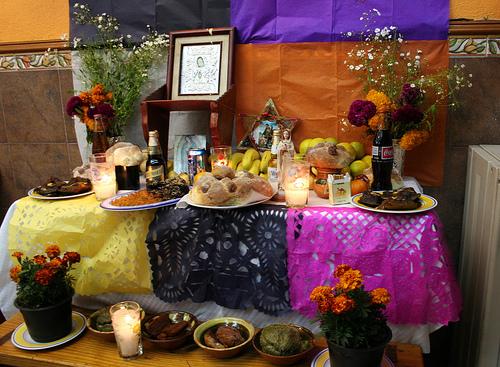
 November 2nd is All Souls Day, or Day of the Dead as it’s commonly called in Mexico, where it’s one of the most important religious events of the year. Mexicans travel miles to take food and flowers to the graves of their departed relatives. As morbid as this sounds, it’s usually a day of great celebration, as families reunite, catch up on gossip, and eat and drink together. Altars are set up in private homes, elaborately decorated with candles, photos of their dead relatives, skulls, crosses, huge bouquets of flowers, fresh fruit of all kinds, and Pan de Muertos, breads flavored with orange flower water and shaped into skulls and bones. Tomales, chicken mole, chunks of Mexican chocolate, even cans of soda, beer, and cigarettes are left at the altar in honor of the departed.


To celebrate your own All Souls Day, Mexican style, you might like to try this elegant chicken dish made with almonds, raisins, and hot and sweet spices. It’s a lot simpler than many of the Mexican mole sauces often cooked with chicken, but it’s hauntingly delicious with a great depth of flavor. I’ve adapted the recipe from one in The Art of Mexican Cooking, by Diana Kennedy.


Braised Chicken with Almonds, Raisins, and Jalapenos


(Serves four)


¼ cup extra virgin olive oil

1 large chicken (about 3 ½ pounds), cut into serving pieces

Salt

1 medium onion, diced

3 garlic cloves, thinly sliced

2 carrots, peeled and thinly sliced

A few large thyme sprigs, leaves chopped, plus extra leaves for garnish

A few large marjoram sprigs, leaves chopped, plus extra leaves for garnish

1 fresh bay leaf

3 cloves, ground to a powder

3 allspice, ground to a powder

½ cup white wine

1 tablespoon white wine vinegar

1 cup chicken broth

½ cup raisins

½ cup sliced almonds, lightly toasted

8 small new potatoes, peeled and cut in half

2 or 3 canned jalapeno chilies, sliced


Choose a large casserole, fitted with a lid. Pour in the olive oil and get it nice and hot over medium heat. Add the chicken pieces and brown them on both sides. Season with salt and add the onion, garlic, carrots, thyme, marjoram, cloves, and allspice. Sauté a minute or so longer, just to blend these flavors and soften the vegetables. Add the white wine and the vinegar and let it bubble for about a minute or so to burn off the alcohol. Add the chicken broth and bring it to a boil. Turn the heat to low, cover the casserole, and simmer for about 30 minutes. Now add the raisins, almonds, potatoes, and the sliced jalapenos. Continue simmering, covered, until the chicken and the vegetables are very tender, about 30 minutes longer. Garnish with the extra marjoram and thyme leaves. Serve hot.

by Erica De Mane

w.ericademane.com


Dining With The Saints

saint therese

Roses for St. Therese of Lisieux


“Love proves itself by deeds, so how am I to show my love? Great deeds are forbidden me. The only way I can prove my love is by scattering flowers and these flowers are every little sacrifice, every glance and word, and the doing of the least actions for love.”

 This is a quote from St. Therese of Lisieux. St. Therese loved flowers and saw herself as the ‘little flower of Jesus’. She became associated especially with roses.  To celebrate the feast day of St. Therese on October 1st, devout Catholics often scatter rose petals. Here’s a more potent way to celebrate this much loved Saint.


Rose Liqueur


1 packed cup cleaned, organic red rose petals

3 cups unflavored vodka

¼ cup kirsch

1 3/4 cups sugar

1 tablespoon rose syrup (available at Middle Eastern food shops and at some supermarkets)

 Place the rose petals in a quart jar. Add 1 cup of the sugar and then pour in the vodka and the brandy or cognac. Seal the jar tightly and place it in a dark place for about 2 weeks.

 Now strain the liqueur through a fine strainer or a layer of cheesecloth. Pour it into a clean quart jar and add the remaining sugar and the rose syrup. Seal it up and let it sit until the sugar is dissolved, about 2 days.

Now you can store the liqueur in wine or brandy bottles sealed with a cork, but let the rose liqueur age for 2 months before drinking it.

 “Dining With The Saints” is a monthly column written by chef and foodwriter Erica DeMane who can be found at EricaDemane.com


Dining With the Saints

 assumption - poussin

The Feast of the Assumption


August 15th is the Feast of the Assumption of the Virgin, a national holiday celebrated throughout Italy. This is a joyous occasion that celebrates the taking of the Virgin Mary, body and soul, into heaven. It also marks the start of the summer vacation season for all Italians. Weary, irritated families start leaving big cities in droves, making their way, often in horrendous traffic jams, to every shore and mountain resort of Italy. It’s also a time when baskets are packed with traditional Italian picnic food. Anything that can be sliced, assembled, and served at room temperature, either bought or homemade, is loaded up for the journey. Frittatas cooked with summer vegetables, rice and bean salads, cheeses, fruit, bread, cured meats such as prosciutto and mortadella, and savory and sweet tortas using summer produce are all great things to bring along or prepare at a summer house. Here’s an easy torta using ripe August tomatoes and a light, easy to work with olive oil crust. Let this torta cool for at least an hour before slicing.


Tomato Tart with Pecorino and Rosemary

 (Serves four as a lunch or light dinner, or eight as an appetizer)


For the crust:

2 cups all purpose flour

2 sprigs of rosemary, leaves well chopped

Salt

¼ cup extra virgin olive oil

¼ cup water

A 9 inch tart pan with a removable bottom, preferably one with smooth not fluted sides (you can also use a tart ring, if you like)


For the filling:

 Approximately 2 doz. cherry tomatoes cut in half

1 tablespoon Dijon mustard

1 large garlic clove, peeled and smashed with the side of a knife

2 tablespoons extra virgin olive oil

2 sprigs of rosemary, leaves well chopped

1 teaspoon sugar

Salt

Freshly ground black pepper

½ cup grated young pecorino Toscano

¼ cup heavy cream

1 large egg

 In a large bowl, mix the flour with the rosemary and a little salt.  In a small bowl, stir the egg, olive oil, and water together and pour it over the flour. Stir to blend everything, and then dump the dough out onto a work surface and knead it very briefly, just until it holds together in a more or less smooth ball.  Wrap the dough in plastic wrap and let it rest, unrefrigerated, for about an hour.

 Place the tomatoes in a bowl. Add the mustard, olive oil, garlic, rosemary, and sugar. Season with salt and black pepper, and toss well. Let the tomatoes sit at room temperature, tossing them around a few times, while the dough is resting.

 Preheat the oven to 375 degrees.  Coat your tart pan with a little olive oil. Roll out the dough and drape it into the tart pan, cutting off the overhang. Sprinkle half the cheese into the tart shell. Line the tart with the tomatoes, in slightly overlapping circles. Save the juice left from the tomato marinade. Sprinkle the tomatoes with a little extra salt and black pepper.

 Whisk together the remaining cheese, cream, egg, and about a tablespoon of the tomato marinade liquid. Season with a little salt and black pepper and pour this evenly over the tomatoes. Bake until browned and set, about 35 to 40 minutes.


“Dining With the Saints” is a monthly column written by the chef and foodwriter Eric DeMane. Her website is: EricaDeMane.com

Dining With the Saints

madonna-fiumarola

Festa dei Noantri

 July 16th, the feast day of La Madonna del Carmine, is celebrated throughout Italy, but in the Trastevere district of Rome the day has a special significance. Since around 1920, the festival there has been called Festa dei Noantri or La Madonna de Noantri, our own Madonna, because, legend has it that in 1535 a group of Roman fishermen pulled a wooden case from the Tiber that contained a statue of the Madonna. This revered Madonna became the protector of all Trasteverini. Today that same statue resides in the Church of St. Agatha. Every summer on the Saturday before July 16th, La Madonna dei Noantri is carried, in an elaborate procession, from her home in St. Agatha’s through the streets of the Trastevere to the church of St. Crisogono, several blocks away, where she spends the eight days while the festival is in full swing. At the conclusion of the festival, the Madonna is placed on a boat for a short ride on the Tiber to Ponte S. Angelo. Crowds line up on bridges to watch and cheer as she takes her symbolic sail. The procession then continues on land, taking the Madonna through the streets once more, back to her home at St. Agatha.

 During the eight days of this jubilant festival, restaurants and shops set up food stands on the streets of the Trastevere. Wine from the Castelli Romani area, just south of Rome, is drunk in large quantities. Stalls selling thick slices of porchetta, a slow cooked pork loin seasoned with garlic and rosemary, are everywhere. You can buy skewers of grilled lamb or chicken, or plates of bucatini carbonara or spaghetti tossed with spicy tomato sauce and pecorino Romano. Sweet Ricotta cakes are also a tradition. Everyone strolls around the piazza under strings of lights, drinking, dancing, and singing. And since it’s high summer many places offer bruschetta, toasted Roman bread, topped with summer vegetables of all types. Here are two you might want to try for your own celebration.


(Both recipes serve eight)


Bruschetta with Broccoli Rabe, Summer Garlic, and Pecorino Romano


2 bunches of broccoli rabe, well stemmed

Salt

Extra virgin olive oil

3 cloves of fresh summer garlic, thinly sliced

1 small fresh red chili, minced (seeded if you like less heat)

A generous pinch of ground fennel seed

A squeeze of fresh lemon juice

8 good sized sliced of crusty Italian bread

A chunk of pecorino Romano


Set up a big pot of water and bring it to a boil. Add a generous amount of salt. Add the broccoli rabe and blanch it for 3 minutes. Drain it into a colander and run cold water over it to stop the cooking and to bring up its green color. Squeeze as much water as possible from the broccoli rabe. Now give it a rough chop.

 In a large skillet, heat about 3 tablespoons of olive oil over medium-high heat. Add the garlic and the fresh chili and sauté a minute just to release their flavors. Add the broccoli rabe, seasoning it with salt and the ground fennel seed. Sauté until it’s well coated with flavor and tender, about 3 minutes. Add a squeeze of fresh lemon juice.

 Grill or broil the bread slices on both sides. Brush them on one side with olive oil. Spoon some of the broccoli rabe onto each slice and then shave a few big slices of pecorino Romano over each brushcetta. Serve hot.


Bruschetta with Grape Tomatoes, Mint, and Capers

Extra virgin olive oil

2 scallions, thinly sliced, using some of the tender green

2 summer garlic cloves, thinly sliced

3 anchovy fillets, minced

2 pints grape tomatoes

Salt

Freshly ground black pepper

A splash of dry white wine

A palmful of capers, rinsed and dried

About 10 large sprigs of mint, leaves lightly chopped

8 good sized slices of crusty Italian bread


In a large skillet, heat about 2 tablespoons of olive oil over medium-high heat. When hot, add the scallions, garlic, anchovies, and the tomatoes. Season with salt and black pepper and sauté until the tomatoes start to burst and give off some juice, about 4 to 5 minutes. Add a splash of white wine and let it boil for a few seconds. Add the capers. Turn off the heat and add the mint.

 Broil or grill the bread slices on both sides. Spoon some of the tomato mixture with some of its skillet juices onto each bruschetta. Give each one a drizzle of fresh olive oil. Serve hot.

 Erica De Mane is a cookbook writer and chef specializing in Italian cooking. She has an Italian food blog at http://www.ericademane.com


DINING WITH THE SAINTS

13_n_StJohnTheBaptist

The Feast of John the Baptist, June 24th


Lumache di Vigna di San Giovanni

 Snails Braised in Tomatoes, Anchovies, Herbs, and Chilies


In many parts of Italy snails are gathered—usually from the vineyards—and eaten on St. John’s Day,  probably because snails’ horns make them resemble the devil, and eating them will ward away the witches, devils, and vampires that are believed to congregate on the night of the Summer solstice. This recipe is how they’re prepared in Rome.

 I find imported French snails in 7-ounce cans in my market. They are medium-size and perfect for this dish. If you can find only the really large ones, the kind served in ramekins with butter and garlic, cut them in half. Canned snails are already cooked, so they need only a short simmering over low heat to warm through and soak up all the flavorings from the sauce.

 A white from the Castelli Romani region outside of Rome is the classic wine to serve with this dish. The region encompasses Castel Gandolfo, where the Pope has his summer residence.

 Extra-virgin olive oil

2 summer garlic cloves, thinly sliced

1 fresh red peperoncino, seeded and thinly sliced

3 anchovy fillets, minced

A generous pinch of sugar

A pinch of salt

2 7-ounce cans of snails, drained. See note

A splash of brandy

1/4 cup dry white wine

1 35-ounce can of Italian plum tomatoes, well chopped, with juice

1 large sprig rosemary, the leaves well chopped

4 thyme sprigs, the leaves chopped

A handful of flat-leaf parsley, the leaves lightly chopped


In a skillet large enough to hold all the snails, heat 2 tablespoons of olive oil over medium-low heat. Add the garlic, peperoncino, and anchovies. Sauté until the garlic is very lightly colored and everything is fragrant, about 2 minutes. Add the snails, and season them with the sugar and a little salt (not too much, since the anchovies are salty). Sauté a minute to coat the snails with all the flavors. Add the brandy, and let it boil away. Pour on the white wine, and let it bubble for about a minute. Add the tomatoes with all their juice, the rosemary, and thyme, and turn the heat to low. Let everything cook, uncovered, at a gentle simmer for 20 minutes. By this time the sauce will be very lightly thickened and the snails will be tender. Serve hot in soup bowls, with plenty of good Italian bread to soak up all the sauce.


Fregola di Bosca

 Wild Strawberries with Honey and Mascarpone


The Virgin Mary is said to accompany children who pick strawberries on St. John’s Day, so I had to include a recipe for the little wild variety in this menu. I’ve dressed them with honey, a nod to St. John’s diet, which is said to have consisted of honey and locusts. (I thought the honey part sounded more appealing.)

 If you can gather your own wild strawberries, that will be ideal, but it may be impractical. In June and July I find small, sweet strawberries called Tri Star at my city farmers’ market. They’re cultivated from a wild variety and taste much like the little fregole di bosca (wood strawberries) found in Italy in early summer, but any fragrant summer strawberry will be delicious for this. If you can only find large ones, cut them in half.

 2 pints summer strawberries, hulled

1/4 cup wildflower honey (acacia honey is nice with this)

3/4 cup mascarpone, at room temperature

Basil sprigs for garnish

 Spoon the strawberries into four bowls.

 Pour the honey into a small saucepan, and warm it very gently over a low heat. Spoon the mascarpone into a small bowl, and drizzle in the honey, whisking until it’s well blended. Spoon a large dollop on each serving of strawberries, and garnish with a basil sprig.


Dining With the Saints’ is written by chef Erica Demane visit her website at EricaDemane.com

Some Novenas for May

StRita

SAINT RITA OF CASCIA

1377 – 1447

Abused wife, mother, widow, and nun, Saint Rita experienced her earthly life on many different levels. Because of this, she is invoked more frequently than the Virgin Mary in many regions of the world. Her novena is said to work miracles in impossible situations. Because of her own terrible marriage, it is particularly effective in the case of marital difficulties.


Novena Prayer to Saint Rita


O holy protectress of those who art in greatest need,

O you who shine as a star of hope in the midst of darkness,

blessed Saint Rita, bright mirror of God’s grace,

in patience and in fortitude you are a model of all the states in life.

I unite my will with the will of God through the merits of my

Savior, Jesus Christ, and in particular through his patient

wearing of the crown of thorns, which with tender devotion

you daily contemplated. Through the merits of the holy

Virgin Mary and your own graces and virtues,

I ask you to obtain my earnest petition,

provided it be for the greater glory of God

and my own sanctification. Guide and purify my intention,

O holy protectress and advocate, so that I may obtain

The pardon of all my sins and the grace to preserve daily,

as you did in walking with courage,

generosity, and fidelity down the path of life.

(Mention your request).


Saint Rita, advocate of the impossible, pray for us.

Saint Rita, advocate of the helpless, pray for us.


Recite Our Father, Hail Mary and Glory Be three times each


Say this novena nine times in a row for nine days in a row.


 Saint Rita is the Patron Saint of Impossible Causes.

She is invoked to heal Marital Problems.

 Feast Day: May 22

Dining with the Saints


titian_st_mark_enthroned_with_saints_c1510


The Feast of San Marco, April 25th


Risi e Bisi


Risi e Bisi (rice with fresh peas) is a very old Venetian dish, dating from the Renaissance when green peas where as expensive and luxurious as truffles. It was served to the Doge annually on April 25th for La Festa di San Marco, in honor of St. Mark, the Patron Saint of Venice, Italy. This beautiful and delicate spring dish is still made every April 25th to celebrate the city’s saint.

Dining with the Saints is a monthly feature written by Erica De  Mane, author of several books and columns on Italian cooking as well as a blog called Skinny Guinea at http://www.ericademane.com


(Serves four)


1 1/2 lbs. fresh peas in their pods

2 quarts light chicken broth

Salt

Freshly ground black pepper

2 tablespoons extra virgin olive oil

2 tablespoons unsalted butter

1/4 cup diced pancetta

2 shallots, cut into small dice

2 cups carnaroli or vialone nano rice

A pinch of ground cinnamon

A slightly bigger pinch of ground nutmeg

½ cup freshly grated Parmigiano Reggiano, plus a little more for serving.

A handful of flat leaf parsley, leaves lightly chopped


Shell the peas and reserve the pods. Put the pods in a saucepot. Pour in the chicken broth and add a generous pinch of salt. Bring to a boil. Turn the heat to low and let this simmer, uncovered, for about ½ hour. Strain and keep warm.


Choose a wide, shallow pan. Get it hot over medium heat. Add the olive oil and the butter. Add the pancetta and sauté until it crisps. Add the shallots and sauté until they’re softened. Add the rice and the peas, seasoning with salt, black pepper, the cinnamon, and the nutmeg. Sauté the rice and peas for about a minute, coating everything well with oil. Start adding the pea broth, a ladleful at a time while you stir the rice. Continue stirring and adding broth as it evaporates until the rice and peas are both tender, about 16 to 17 minutes. Pull the rice from the heat and add the Parmigiano, the parsley, and enough additional broth (or warm water, if you’ve run out) to achieve a loose consistency (this dish is served a little looser than a traditional risotto). Check the seasoning, adding more salt or freshly ground black pepper if needed. Serve right away with additional grated Parmigiano Reggiano to sprinkle over the top.