
Merry Christmas from Dining With the Saints

Christmas Eve in Provence

Gros souper is the traditional Provencal family meal held before midnight mass on Christmas Eve. The seven meatless courses are meant to symbolize Mary’s labor pains. The dishes are all simply prepared and most are made ahead of time so the family can relax and enjoy the evening together. Marinated olives, dishes of white beans dressed in Provencal olive oil, Swiss chard gratin, fish broths with croutons, whole fish roasted with dried fennel, and various salt cod preparations typically show up on the table throughout the evening.

Brandade de Morue, salt cod whipped with garlic and the excellent, golden Provencal olive oil is one of my favorite Gros souper dishes. It has a creamy texture and is surprisingly gently flavored since the cod is long soaked to remove most of the salt. It’s often served gratin style, baked in the oven with a breadcrumb topping, then scattered with the tiny, sweet black olives that are famous in the region.

Brandade de Morue

(Serves 5 or 6 as an antipasto)

1 ½ pounds salt cod (try to find the thicker middle section, which has less bones to deal with)

1 fresh bay leaf

½ cup dry white wine

1 baking potato, cooked soft, peeled and roughly mashed

1 large garlic clove, minced

Extra virgin olive oil

The grated zest from 1 small lemon

A few big gratings of nutmeg

5 or 6 thyme sprigs, leaves lightly chopped

Freshly ground black pepper

A few tablespoons of milk

¾ cup home-made, not too finely ground breadcrumbs

A handful of black olives

Toasted bread made from slices of baguette, brushed with a little olive oil


You’ll need to soak the salt cod in a big pot of cold water for about a day and a half, changing the water a bunch of times (and putting the pot in the refrigerator overnight). After this, taste a bit to see if a sufficient amount of salt has leeched out of it. If not, soak it a little longer. Now drain it.

In a large skillet, place the salt cod (cut into pieces if necessary). Add the bay leaf and pour on the white wine. Add enough cool water to just cover the cod. Bring to a boil and then turn the heat down to very low. Cover the skillet and gently simmer the cod until it just begins to flake. This should only take about 15 minutes, maybe even less if you’ve got thin cuts. If it cooks any longer, it might become dry. Take the cod from the skillet and when it’s cool enough to handle, pull off the bones and the skin.

Put the cod in a food processor and give it a couple of pulses. Add the potato, the garlic, about ¼ cup of your best olive oil, the lemon zest, thyme, nutmeg, and some black pepper. Give it a few more pulses. You want a texture that’s creamy but not completely smooth. Add about 2 tablespoons of milk and pulse again. You shouldn’t need any salt.

Scrape the brandade from the food processor and spoon it into a shallow baking dish. Top with the breadcrumbs and drizzle the top with olive oil.

When you’re ready to serve it, preheat the oven to 425 degrees and heat it through, about 10 minutes. If the breadcrumbs don’t turn golden, run it under a broiler for a minute. Scatter on the olives and serve it with the toasts.

Dining With the Saints is written by Chef and Food Writer Erica DeMane.  Visit her at her website : http://www.ericademane.com

Painting: “Nativity” by Robert Campin  1420-1425

La Vigilia –  Another Christmas Eve Dinner

Dining With The Saints


The Feast of St. Andrew

 St. Andrew is the patron Saint of Scotland. His feast day on November 30th is celebrated with a huge festival, not only in Scotland, but also by Scots who live abroad. There is, for instance, a St. Andrew’s Society in Boston that was set up in 1657 and it’s still very active in organizing his feast day activities.

 It was the custom for farm workers and laborers in Scotland to go ‘St. Andra’ing’, where they would go out and shoot rabbits, spend all day cleaning and preparing them, and then have a huge meal of roast rabbit and Scotch whisky. Eating a singed sheep’s head also used to be traditional. Today the occasion is more likely celebrated with an assortment of famous Scottish dishes such as Scotch broth, salted herring, beef in whisky sauce, finnan hadie, haggis, Dundee cake, Crannachan, a kind of sweet dumpling, Angus Toffee and, of course, lots of whisky.

 One of my favorite Scottish dishes and something that’s always present at any St. Andrew day feast is Scotch Eggs, hard cooked eggs that have been encased in herbed sausage and deep-fried. They’re very easy to make and are delicious. Great with Scotch whisky or beer.

Scotch Eggs

 (Serves four)


A mild vegetable oil for deep-frying

1 ¼ pounds country style sausage, removed from it’s casing (or buy bulk sausage)

6 fresh sage leaves, finely chopped

8 sprigs of fresh thyme, leaves chopped

Salt

A generous pinch of cayenne pepper

4 large, hard-boiled eggs

About ½ cup off all-purpose flour

2 raw eggs, lightly beaten

1 cup home-made, dry breadcrumbs


Over high heat about 4 inches of oil in a large pot.


In a large bowl combine the sausage, sage, thyme, a little salt, and the cayenne. Divide the mixture into four parts and flatten each portion out into a thin round. Wrap a sausage round around each hard-boiled egg, sealing it well with your fingers.

When the oil reaches approximately 360 degrees, it’s hot enough for frying.

 Dredge the sausage covered eggs in flour, then dip them in the raw egg, letting the excess drip off, and then coat them in the breadcrumbs.

 Fry the eggs, turning them gently a few times, until they’re golden all over, about 5 minutes. Lift them from the oil with a slotted spoon and let them drain on paper towels. Serve hot or warm.

Painting: “Saint Andrew and Saint Francis” by El Greco

Dining with the Saints is a monthly column written by chef and author Erica DeMane. Erica DeMane.com


Dining With the Saints


The Feast Day of San Crispino


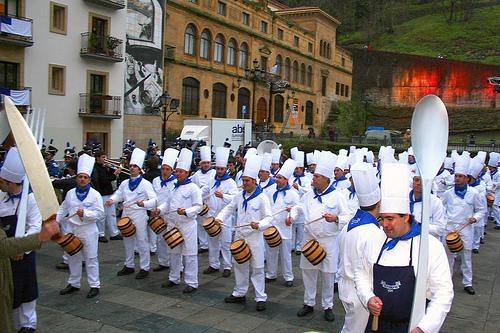
Every year on October 25, in the Puglian town of Acquaviva delle Fonte, the Feast of San Crispino is celebrated with a Sagra del Calzone, a huge calzone festival. The star of the day is a particular calzone filled with ricotta, sauteed red onion, a local, sweet variety called Tropea, roasted tomatoes, and black olives, all cooked in wood burning ovens.


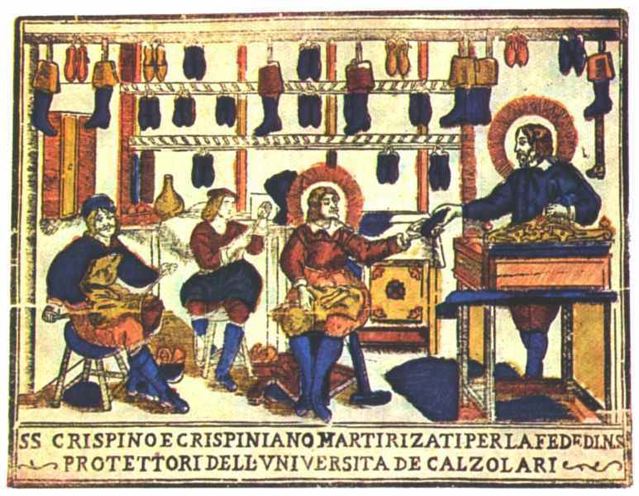
San Crispino was born in the 3rd century of noble Roman birth, but became a cobble so he could relate to the common people. He is often depicted holding or making shoes. He is the patron Saint of cobblers, tanners, and all leather workers and as a result has been adopted by groups as diverse as equestrians and people who just like to wear leather, such as the Hell’s Angels. What this all has to do with calzones is somewhat of a mystery, but the calzone has been a feast day symbol in Italy for decades. It’s a delicious and convenient street food, perfect to eat while strolling and shopping, since many faithful buy a new pair of shoes each year on San Crispino’s feast day.

Since it’s hard to find Tropea onions in the U.S., I made a version of this calzone using leeks, which are in season now at many greenmarkets.

Calzone with Spiced Leeks, Ricotta, and Roasted Tomatoes

 (Makes two large calzones)

For the dough:

1 cup warm water (approximately 110 degrees)

1 tablespoon extra virgin olive oil

1 package active dry yeast

A generous pinch of salt

2 ½ cups of all-purpose flour


 For the filling:

2 pints of grape tomatoes

Extra virgin olive oil

Salt

5 medium leeks, using only the tender white and very light green parts

A pinch of sugar

¼ teaspoon ground cloves

1 bay leaf

Freshly ground black pepper

A splash of dry Marsala

1/2 cups whole milk ricotta, drained if watery

1/2 cup grated grana padano cheese

A handful of flat leaf parsley, leaves lightly chopped


Plus, about ½ cup of corn meal


For the dough:

Pour the warm water and olive oil into a large bowl. Sprinkle the yeast and the salt over the water and give it a stir. Let stand for about 5 minutes to give the yeast a chance to develop. Add 1 cup of the flour and stir well. Mix in 1 more cup of the flour to form a sticky ball.

Transfer the dough to a well floured surface, leaving behind any crumbly bits that have not been incorporated. Knead the dough until smooth and elastic, about 5 minutes, adding a bit more flour if needed to prevent sticking. Transfer the dough to a lightly oiled bowl, turn to coat the dough in oil, and cover the bowl with a damp kitchen towel. Let it rise in a warm place until doubled in size, about an hour or so.

Punch the dough down and divide it into 2 equal pieces. Form each into a ball. Transfer the dough balls onto a floured work surface and let them rise again for about 15 minutes.

 While the dough is going through it’s first rising, preheat the oven to 425 degrees. Place the tomatoes on a sheet pan. Drizzle them with olive oil and season with a little salt. Mix them around with your hands until they’re well coated. Roast until lightly browned and just starting to burst, about 12 minutes. Take them from the oven and let them cool a bit.

 I a large skillet, heat 2 tablespoons of olive oil over medium heat. Add the leeks, sugar, cloves, bay leaf, salt, and some black pepper. Sauté until the leeks are just starting to turn very lightly golden, about 10 minutes. Add the splash of Marsala and let it bubble away. Remove from the heat and let it cool for a few minutes.

 In a medium bowl combine the ricotta, the grana padano, and the parsley, seasoning it with a little salt and black pepper.

Place a pizza stone in the oven and turn the heat up to 500 degrees.

On a floured work surface, roll one of the dough balls out to an approximately 11 inch round. Sprinkle a pizza peel or baking sheet with a little cornmeal and slide the dough onto it. Spoon half of the ricotta mixture on one half of the dough, heaving a 1 inch margin. Top with half of the leeks and half of the tomatoes. Fold the dough over to form a half moon shape and pinch the edges together, making little tucks to close it well. Poke a few holes in the top to let out stem. Brush the top lightly with olive oil.

 Slide the calzone onto the pizza stone and bake for about 18 minutes, or until golden. Serve hot or warm. Make another calzone exactly the same way.

Dining with the Saints is a monthly column written by Erica De Mane. To see more of her recipes, please go to http://www.ericademane.com, her own food blog.


Dining With the Saints

In Honor of San Gennaro

San Gennaro (Saint Januarius in English) is the patron saint of Naples, and the city celebrates his feast day on September 19. The Christian Bishop of Naples during Roman times, Gennaro was martyred by decapitation.  His followers secretly stored his blood in glass ampules and a church was built around his relics. These ampules are held up three times a year, and they miraculously liquify. It is thought to be a sign that Mount Vesuvius will erupt if this miracle does not occur. Neapolitan communities all over the world, await the word if their city has earned the saint’s protection or not. There are elaborate religious processions through the streets in Naples, but the real focus, as far as I’m concerned, is the celebration of the city’s beautiful street food.. The celebration of San Gennaro gives New York City’s its most famous Italian Feast and with it, a huge array of street food.

If you like things fried, as I do, Naples does them better than anywhere else. At the feast you can get batter-fried zucchini flowers, calamari, artichokes, eggplant, even fried cow’s brains. Or a slice of Naples’s famous pizza margherita. Or you might require calzone stuffed with escarole or ricotta, or pizza fritta (basically a deep-fried calzone), crocche (potato croquettes), zeppole, or a sweet, flaky sfogliatelle. While the kids eat spumoni, the old men walk the streets munching on roasted chickpeas from little bags and drinking red wine out of plastic cups. That ritual seems very austere compared with everything else going on at the feast, which makes it very appealing and romantic. You can still get roasted chickpeas at the Little Italy feast in New York, but they are as hard as pebbles and, in my opinion, almost too dangerous to eat. Like most things, if you really want them right you’ve got to make them yourself. So here is my recipe for roasted chickpeas. They’re crisp and brown outside, but with a creamy center. Not only are they delicious and crunchy, but they’re almost fat-free, and they’re a great carb choice, low on the glycemic index. With all the red wine you’ll need to ease them down, they are a health meal made in Naples. For the wine, try a glass of Campanian red, such as a Lacryma Christi Del Vesuvio. Terredora is a good producer.


Roasted Chickpeas with Rosemary and Garlic

2 cups home-cooked chickpeas, drained (use good-quality canned ones if you prefer, but rinse them)
2 tablespoons extra-virgin olive oil
5 garlic cloves, unskinned and crushed with the side of a knife
Sea salt
A generous pinch of ground hot red pepper
A pinch of sugar
3 sprigs rosemary, the leaves well chopped

Preheat the oven to 450 degrees. Lay the chickpeas out on a sheet pan. Drizzle them with the olive oil. Scatter on the garlic cloves, and season everything with salt and the ground hot pepper. Toss the chickpeas with your fingers so they’re well coated with the seasoning. Spread them out again in one layer.

Roast the chickpeas until they’re fragrant and starting to brown, about 20 minutes. Pull the sheet pan from the oven, and scatter on the rosemary, and sprinkle on the pinch of sugar. Toss quickly, and put back in the oven for another 5 minutes or until the chickpeas are browned and crunchy-skinned but still have soft centers. Let them cool on the sheet pan. Serve warm or at room temperature.

Erica DeMane is a chef and writer. She the popular food blog:  EricaDemane.com 

Image: 2007 Poster from the New York City Feast of San Gennaro

Dining With the Saints

Saint Augustine

 Saint Augustine, our most philosophical and prolific Saint, was born in 354 AD in Thagaste, a provincial Roman city in North Africa, what is now a part of Algeria. The Roman inhabitants of this territory were thoroughly Romanized citizen but very likely linked biologically to the North African Berbers. There are many African saints who exerted a great influence in the early church. Saint Augustine’s mother, Saint Monica, was a North African  Christian, his father was a minor Roman official.  The food of North Africa has always been sophisticated in its use of spices and fresh ingredients. Indeed, when the Romans conquered that part of the world, they introduced many North African ingredients into their own cuisine. Below is a carrot recipe using the same flavors available to those who lived in the time of Saint Augustine.

I’ve been finding the most amazing carrots this summer at my local greenmarket, not only the standard orange ones, but ones in deep crimson, yellow, and dark burgundy. Seeing these carrots reminded my of a beautiful North African carrot salad that I hadn’t made in a long time. It’s traditionally seasoned with cumin, cinnamon, spicy paprika, a touch of sugar and fresh mint. You can add black olives or dates, depending on whether you want to sway it in the sweet or savory direction. It seemed like the perfect recipe to celebrate August 28th, Augustine’s Saint day. If you can find any of these heirloom carrot varieties, try making this fragrant salad with a mix of colors, but it’s also quite beautiful and delicious made with all orange carrots. This salad goes very nicely with grilled lamb and a side of cous cous.

 Carrot Salad with Cinnamon, Cumin, and Fresh Mint


2 tablespoons extra virgin olive oil

1 tablespoon unsalted butter

1 pound carrots, peeled and cut into rounds, on an angle

2 summer garlic cloves, peeled

1 1/2 teaspoons sugar

1/4 teaspoon ground cumin

1/4 teaspoon ground cinnamon

1/2 teaspoon medium spicy paprika

Salt

Extra virgin olive oil

A handful of black Moroccan olives

A handful of fresh mint leaves


In a large skillet, heat the olive oil and the butter over medium heat. When hot add the carrots and the garlic cloves and sauté a minute to release the garlic’s flavor. Add the sugar, cumin, cinnamon, paprika, and a little salt and sauté a minute longer to deepen the flavors of all the spices. Add a splash of warm water to the skillet and cover it, letting the carrots steam cook until just tender but not falling about, about 6 minutes or so. Give them a stir from time to time and add a little more water if the skillet becomes completely dry. When done, they should have a nice glaze on them. Transfer to a serving bowl. Add the olives and scatter on the mint leaves. Serve hot or warm.

 By chef and food writer Erica De Mane. Please check out her food blog at http://www.ericademane.com

Dining With the Saints in Honor of Santiago de Compostela

The Feast of Santiago

The feast day of Santiago, or St. James the Greater, the patron Saint of Spain is celebrated on July 25th with a pilgrimage to Santiago de Compostela, the holy sight in Galicia, Spain where the Saint’s remains are said to be buried.

One of the original twelve apostles,  St. James was sent to Iberia as an evangelist. Upon his return to Jeruslaem, he was killed by Herod Agrippa the First. His disciples then carried his body by sea to back Iberia, where they landed at Padron, on the coast of Galicia, and then took his remains inland for burial at Santiago de Compostela. Due to his return to Spain by sea, his symbol has always been the cockle or scallop shell and pilgrims often wear this symbol on their hats or clothes.

Coquille St. Jacques, ‘cockle of Saint James’ is a popular French dish in honor of the Saint. It’s a dish of broiled scallops served in their shell, often topped with a béchamel sauce and a little Gruyere. It’s very popular in bistros throughout France, but since Santiago’s holy sight is in Galicia I thought a dish from that region would be a more fitting tribute to this popular Saint. In Galicia the local scallop is called vierias, the pilgrim’s scallop, in honor of Saint James. They’re eaten broiled in their large shells with garlic, parsley and sherry or white Albarino wine. Since scallops with their shells still intact are hard to find in the U.S., I’ve chosen a cockle recipe instead. The tiny New Zealand cockles you find in many American fish shops are perfect for this.

Cockles with Spanish Sherry and Almonds

(Serves four as a first course)

Extra virgin olive oil, preferably a Spanish brand

3 fresh summer garlic cloves, thinly sliced

2 pounds cockles, well washed (discard any that are opened)

¼ teaspoon Piementon de la Vera (Spanish smoked paprika)

Salt

½ cup Spanish Fino sherry

1 fresh bay leaf

The leaves from 8 thyme sprigs

¼ cup sliced, blanched almonds, lightly toasted

A handful of flat leaf parsley leaves

In a large pot, heat about 2 tablespoons of olive oil over medium flame. Add the garlic and let it turn very lightly golden. Add the cockles, the paprika, and a little salt. Give the cockles a quick stir and then add the sherry and the bay leaf. Cook, uncovered, stirring frequently until the cockles have opened, about 4 minutes or so. Add the thyme and stir it in.

Pour the cockles, with all their cooking juices into a large serving bowl. Give them a generous drizzle of fresh olive oil and garnish with the toasted almonds and the parsley leaves.

Serve with crusty bread and glasses of white Spanish wine such as an Albarino from Galicia.

Dining with the Saints, written by Erica De Mane, is a monthly feature on novena.co. If you like, you can also check out http://www.ericademane.com, her blog on Southern Italian cooking.

Dining With the Saints

In Honor of St. Anthony of Padua

St. Anthony of Padua is the Saint people pray to to find lost objects, and where would a person who has lost a sentimental piece of jewelry in a meadow or woods in June look for it? A likely spot would be under the leaves of wild strawberry plants, which cover the ground in many parts of the world on his Saint’s day, June 13th, and throughout the month of June. Because of this connection, over the years, Saint Anthony has become associated with wild strawberries. I’ve created this fresh strawberry salad in his honor.
If you’re luck enough to know a beautiful meadow where you can forage for your own wild strawberries, those would be the best choice for this salad. In Italy these tiny, incredibly sweet strawberries are called fregola di bosca (strawberries of the woods). Everyone celebrates when the first ones arrive and they’re usually eaten just drizzled with a thread of aged balsamic vinegar. I can sometimes find a hybrid strawberry, partly cultivated from a wild strain, at my greenmarket starting around now. Tri-Star is one of these varieties. Ask at your local market to see if any of your area farmers are growing them. They’re small, sweet, and deep red, like little ruby earrings.

Frisee Salad with Strawberries, Basil, and Warm Goat Cheese

(Serves 2)
1 medium head of frisée lettuce, torn into pieces
¼ cup pine nuts, lightly toasted
20 wild strawberries, hulled, or about 10 regular sized ones, hulled and cut in half
1 small shallot, very thinly sliced
A handful of small basil leaves
½ teaspoon balsamic vinegar
½ teaspoon lemon juice
2 tablespoons extra-virgin olive oil, plus a little extra to drizzle
Salt
Freshly ground black pepper
A pinch of allspice
4 ½-inch-thick rounds fresh goat cheese
4 ½-inch-thick slices from a baguette, cut on an angle so they’re longer
Place the frisée in a salad bowl. Add the pine nuts, strawberries, the shallot, and the basil leaves.
Set out two salad plates.
In a small bowl, whisk together the balsamic vinegar, lemon juice, and olive oil, seasoning it well with salt, black pepper, and the pinch of allspice.
Place the baguette slices on a small cookie sheet, and set it under a broiler. When the slices are golden, flip them over, and then place a slice of goat cheese on each one, seasoning them with salt and a few grindings of black pepper. Broil until the cheese is just starting to melt and the edges of the bread are toasted.
Pour the dressing over the salad, and toss gently. Divide the salad onto the plates, and place two goat cheese toasts around each one. Drizzle a thread of olive oil over each toast. Serve right away.
Dining with the Saints is a month feature on Novena.com. It is written by Erica De Mane. Check out her food blog at http://www.ericademane.com

Dining With the Saints

Saint Rita of Cascia

 Saint Rita of Cascia was born in the 14th century in the beautiful, hilly countryside of Umbria in Central Italy. Some years ago when I visited the neighboring town of Norcia, I noticed a lovely statue dedicated to her in the town square. In Cascia itself, a huge shrine to the Saint was built in the early 20th century, and you can still visit the house where she was born. Her feast day is celebrated on May 22.

 Saint Rita came to be associated with roses and with fresh figs, both of which are placed on altars to celebrate her Saint’s day. Evidently near the end of her life, when Saint Rita was bedridden in the convent, a cousin visited her and asked if she desired anything from her old home. Saint Rita said she would like to have a rose and a fresh fig from the garden. Since it was January her cousin didn’t expect to find either. However when her cousin went to the house she discovered, in the little snow covered garden, a single blooming rose as well as a fully ripened, edible fig, both of which she brought back to Saint Rita.

 Coincidently fresh figs come into the market right around May 22 (and in California their season extends into January, so possibly this story is not unfeasible). I thought a great way to celebrate St. Rita’s feast day would be by preparing this salad which incorporates some of May’s most fragrant and beautiful produce; fresh figs, chives, mint, and watercress.

 Green Fig Salad with Watercress, Chives, and Mint

  (Serves two)

 1 large bunch of watercress, thick stems removed

5 fresh green figs (or use the black skinned variety if you wish), cut in half

About 10 chives, chopped (with blossoms if available)

1 small shallot, very thinly sliced

A dozen fresh mint leaves

The grated zest and juice from ½ a lemon

A pinch of sugar

Salt

2 tablespoons extra virgin olive oil

Freshly ground black pepper

A small chunk of Parmigiano Regggiano

Place the watercress in a medium salad bowl. Add the figs, the chives (and blossoms if you have them), shallot, and mint leaves.

 In a small bowl whisk together the lemon juice and zest, sugar, a little salt, and the olive oil.

 Grind some black pepper over the salad and the pour on the dressing. Toss gently. Shave some thin slices of Parmigiano over the top and serve.

 Dining with the Saints is written by Erica De Mane. Her food blog can be found at http://www.ericademane.com


Happy Easter from Dining With the Saints

A Roman Easter Dinner

Roman Easter food has always had a big allure for me. It’s creative, seasonal Italian cooking at its best. Lamb, ricotta, eggs, artichokes, asparagus, shell peas, favas, and wheat all play a part in the Easter feast and Roman springtime celebrations. These are rich tastes, but their youth and greenness makes them renewing to the spirit, which is just what I want around this time of year.

Here’s a Roman dish that I absolutely love since it highlights the beauty of spring asparagus, and I can’t imagine Easter without asparagus (even though they’re not quite in season here yet, but California imports are pretty decent). Here you’re bringing together a few simple ingredients, asparagus, eggs, pecorino, guanciale, a handful of herbs, to create a very opulent dish. Since you leave the egg yolks soft they run all over the asparagus and the guanciale, creating a cheesy, eggy sauce. Really nice. I think it’s a great first course before another classic Roman Easter dish, braised lamb with fresh green peas. Here’s my recipe for that if you’d like to give it a try: http://ericademane.com/2002/05/05/agnello-alla-cacciatore/.

Easter Eggs with Asparagus, Guanciale, and Pecorino

 (Serves four as a first course)

1 large bunch of medium thick asparagus, trimmed and peeled

Extra virgin olive oil

1/3 cup well chopped guanciale (you can use pancetta instead)

2 garlic cloves, peeled and lightly crushed

Salt

Freshly ground black pepper

The juice from ½ a large lemon

4 extra large eggs

1/2 cup grated Pecorino Romano (get the best you can find, something that’s not overly salty)

A few chives, chopped

A few large sprigs of fresh mint, leaves left whole

Set up a pot of water and bring it to a boil. Drop in the asparagus and blanch for about 4 minutes. Drain the asparagus in a colander and then run them under cold water to stop the cooking and set their green color. Drain well.

Lay the asparagus out in a shallow baking dish.

In a large skillet heat a tablespoon of olive oil over medium heat. Add the guanciale and let it get crisp and give up its fat. Add the garlic and sauté a minute longer, just to release its flavor.

Remove the crisp guanciale bits from the skillet with a slotted spoon and scatter them over the asparagus. Discard the garlic. Season the asparagus with salt, black pepper, and the lemon juice. Reserve the guanciale cooking fat.

Poach the eggs in just simmering, lightly salted water until the whites are set but the yolks are still runny. Scoop them from the water with a slotted spoon, resting them on paper towels for a moment to blot excess water, and arrange them on the asparagus. Spoon a little of the guanciale cooking fat over the eggs (an important step for flavor) and season them with salt and black pepper.

Sprinkle on the pecorino and run the dish under a broiler until the cheese just starts to melt, about a minute or so. Garnish with the chives and the mint. Serve right away.

Dining With the Saints is a monthly column written by chef and writer Erica DeMane.

Erica DeMane.com

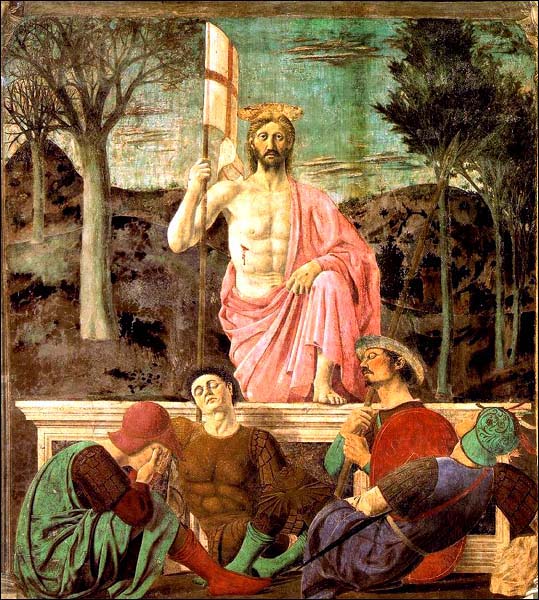
Image: “Resurrection” mural by Piero Della Francesca  1463 – 65

Dining With The Saints

St. Patrick’s Day


The Irish have observed St. Patrick’s feast day of March 17th for over 1,000 years and even though it falls during lent, the church for this celebration has long waved the prohibitions against meat. This is a huge national holiday throughout the country and people traditionally celebrate with a meal of Irish bacon cooked with cabbage, lots of beer, and lots of dancing.
Fresh salmon, one of Ireland’s finest food offerings and a springtime treat, is fast becoming a contender for the centerpiece of the St. Patrick’s Day meal. Especially popular is salmon poached or baked and then finished with a cream sauce. Sounds rich, and it is. I’ve lightened this dish a bit by adding white wine, lemon zest, and capers to the cream. I think this salmon would be perfect with a side of steamed asparagus and boiled new potatoes tossed with butter and parsley.

Baked Salmon with White Wine, Cream, and Capers

(Serves four)
A 2 1/2 pound piece of wild salmon fillet (a thick center cut), skinned
Unsalted butter
½ cup dry white wine
1 large shallot, very thinly sliced
Salt
Freshly ground black pepper
A few big scrapings of freshly ground nutmeg
½ cup of heavy cream
The grated zest from 1 small lemon
A palmful of small capers, rinsed
A few large dill sprigs, chopped
Preheat the oven to 350 degrees.
Lightly butter the bottom of a large baking dish (one that gives the salmon a little room to breath, about 2 inches on all sides is perfect). Place the salmon in the dish and pour on the white wine. Season it with salt, black pepper, and the nutmeg. Scatter on the shallots and dot the top with small pieces of butter. Cover with foil and bake until the salmon is just tender and still a little pink at the center, about 15 minutes or so (it should flake at the thinner ends but still be a bit pink at the thickest point).
Take the salmon from the oven and gently, with a large, long spatula, transfer it to a warmed serving platter. Cover it with aluminum foil to keep it hot.
Place the baking dish with the salmon cooking juices over a high flame and boil the juices down until you have about 3 tablespoons. Add the cream and the lemon zest and boil that down until it’s reduced by about ½, adding a little salt and fresh black pepper. Strain the cream sauce and pour it over the salmon. Scatter on the capers and the dill. Serve right away.
 
Written by Erica De Mane, chef and food writer. Check out her blog at www.ericademane.com