St_PadrePio

SAINT PIO OF PIETRELCINA

 “Padre Pio”


1887 – 1969

Feast Day: September 23

Patronage: none official

Invoked For: forgiveness,  healing of all kind

Symbols: stigmata, crucifix

  “Pray, hope and don’t worry”

            Padre Pio


            With these words Padre Pio was able to make people who never thought of spiritual matters, religious. He is known as the saint of the common people, always consoling, always accessible to those who visited or wrote to him  A mystic who could bilocate and read hearts, he had assured his fellow monks that he would become even more prevalent a force after his death. Today, millions of people a year flock to the little monastery he never left in order to be in his spiritual presence.

            Named for Saint Francis of Assisi, Francesco Forgione was born in Pietrelcina, a small town north of Naples. As a child he experienced many spiritual visions of Christ and the Virgin Mary but never mentioned them to anyone as he thought all people had them. Coming from a devout Catholic family, he entered the novitiate of the Capuchin Friars, an austere division of the Franciscans. He took the name Pio (Pious) and was ordained in 1910. Diagnosed with a form of tuberculosis, he was sent back to live with his family. Since he could not fulfill his duties as a priest he decided to offer himself as a conduit of suffering in the exchange of the salvation of others. While praying in his family’s home, wounds appeared on his hands, feet and side, similar to those inflicted on Christ. Embarrassed, he begged God to take these marks away. His prayers were answered and he was later conscripted into the army in 1916. While there, he fell ill with a fever that rose higher everyday. It is recorded that it broke the thermometer,  rising to 118 degrees, far higher than what would be considered fatal. Sent home to die, he recovered and his Father Superior ordered him to the remote monastery of Our Lady of Grace in San Giovanni Rotondo, Puglia, a province of Southern Italy. 

            While praying alone in the intense stillness of the church on September 20, 1918, he went into a trance like state of “waking sleep”.  He saw Christ standing before him, bleeding from his wounds. Pio was intensely moved and thought his own chest would burst in sympathy, but as he came out of this altered state he experienced excruciating pain. He was inflicted with the same stigmata as Christ and a fellow brother had to lead him away and bandage him up. Though he did what he could to heal his wounds, they never closed up until his death 50 years later. There are other mystical saints who have experienced the stigmata, starting with Saint Francis himself, but Padre Pio became the first ordained priest to have this condition.

            Since San Giovanni Rotondo is very near the Gargano shrine to Michael the Archangel, religious pilgrims began flocking to the monastery to hear Pio say mass. Wanting only to stay in the background and remain an anonymous friar, Pio suffered not only physical agony but psychological and spiritual pain as well. His life of constant prayer was greatly disturbed by the influx of curiosity seekers as well as those who considered him holy. Forced by his wounds to wear half gloves, many reported “the odor of sanctity” on his hands. His mysticism extended  to the confessional where penitents swore that Pio could read hearts. Many were sternly rebuked by him as he recited for them sins that they themselves had withheld or forgotten. After going to him for confession these same people reported feeling overwhelming joy and relief.

            All great mystics write about a period in their lives when they feel spiritually abandoned and God seems distant and unavailable. Saint John of the Cross has called this time in one’s life “the dark night of the soul”. Pio’s trials began in 1920 when Pope Benedict XV opened an investigation into the causes of his stigmata. Concerned about Pio’s cult following, doctors and archbishops were dispatched to interview him. Accusations of fraud and clerical misconduct would follow Padre Pio for the rest of his life as the Vatican launched over 12 future investigations into his conduct. In 1922, under Pope Pius XI, a specialist on stigmatic causes declared Padre Pio to be an hysteric who kept his wounds open with carbolic acid.. Padre Pio was ordered into seclusion and forbidden to say mass in public. A massive demonstration of 5000 people erupted in the village when it was rumored that their beloved friar was going to be moved. The Vatican agreed to leave him in Our Lady of the Angels but issued a decree warning against devotion to the priest as Padre Pio’s gifts were not to be considered of supernatural character. 

            While in seclusion, Pio calmly accepted his situation, he would spend hours of the day engulfed in prayer. Padre Pio has said that at this time he realized his true vocation was to suffer for the souls in purgatory so that they may win early release.  Though it deeply pained him to be under such intense suspicion, he obeyed the church authorities with humility and considered this time in his life a necessity for purging further imperfection from his soul.

             He never left his monastery at the same time people reported seeing him at the sick beds of hospital patrons hearing final confessions or comforting the fatally ill hundreds of miles away.  A fellow monk has written that he saw Pio shivering and murmuring in the middle of an intense heat wave. When he finally seemed to return to consciousness, the monk asked him where he was, “I was giving the last rites in the Alps,” he was told. “It’s very cold there.”

            In 1933 he was granted the privilege of saying mass in public again, but only at 5:30 in the morning. The little church would be filled to overflowing at this hour, people would begin lining up in the middle of the night to attend. Pio ate little and slept only three hours a night. Over his lifetime he heard over a million confessions. Though he could be gruff and angry with penitents he had a devout following. He began a small local prayer group which has since spread worldwide with 400,000 members. 

            During World War II, he promised the citizens of San Giovanni Rotondo that he would see to it that their town would be safe. The Germans had stored a depot of ammunition near the town which the Allies attempted to bomb, more than one officer reported seeing a monk in the sky with uplifted hands. Their bombs had fallen out of the planes into the woods and their planes had reversed course by themselves.  American soldiers, hearing about this “living saint” made the difficult trip up into the mountains to see Padre Pio. They too experienced his abilities, many thought he knew English when they went to his confessions, he was so successful at impressing his advice on their minds. On their return home, they spread his cult to every part of the United States. By 1947 Padre Pio was receiving more than 200 letters a day requesting advice and prayers from the United States, Europe and Australia.

            He used his growing popularity to found the House for the Relief of Suffering, a hospital for the hopelessly ill using only donations of the faithful. Today, it serves over 60,000 patients a year and is solely supported by charitable donations. Successful though he was, doubts about his real sanctity continued throughout his lifetime. Microphones were secretly planted in his confessional by Vatican investigators in attempts to find human flaws in his character. Though he never encouraged it, he developed a major cult following which was considered distracting and possibly dangerous by the Church.

            He died as he predicted he would, in 1968. His fellow monks heard him declaring that he saw two mothers at his bedside, then he murmured, “Jesus, Mary” before expiring. Over 100,000 devotees attended his funeral. The suspicions that many in the Church held of Padre Pio were dissolved in 2002 when he was canonized by Pope John Paul II in front of half a million people. This pope knew first hand, the mystical abilities of this obscure monk as he had traveled to San Giovanni Rotondo in 1947 when he was only a seminarian. While in confession with Padre Pio, he was given the astounding prediction that he would someday be pope. Years later, when he was the bishop of Cracow he wrote to Pio requesting prayers for a friend with cancer. Ten days later she was healed.

            . Today, a cathedral which holds 10,000 people at a time stands in the town where Padre Pio spent his life. San Giovanni Rotondo is second only to the shrine of Our Lady of Guadalupe for religious pilgrims. Like Saint Therese of Lisieux and his patron, Francis of Assisi, Padre Pio  does as much after his death as he did in life to bring grace and consolation to those in need.

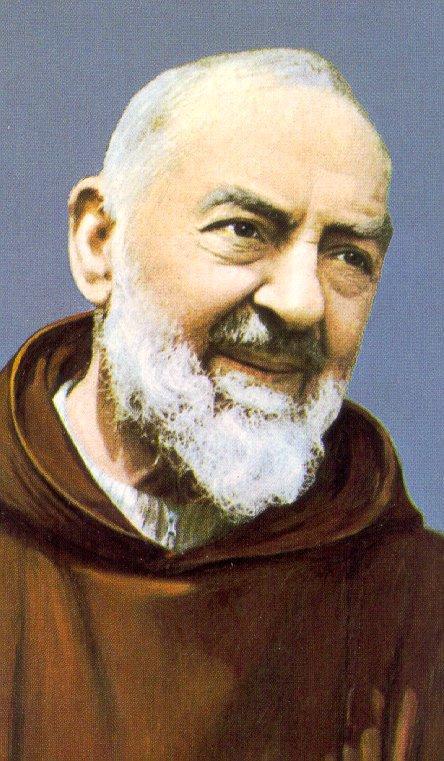
             As a contemporary saint, most images of Padre Pio are standard photographs. Because of his willingness to suffer like Christ, Padre Pio is usually depicted with a crucifix or with his stigmatized hands bandaged.


                                 Prayer Asking the Intercession of Padre Pio


                                       Oh Jesus, full of grace and charity, victim for sinners,

                             So impelled by your love of us that you willed to die on the cross,

                                     I humbly entreat Thee to glorify in heaven and on earth,

                                             the servant of God, Padre Pio of Pietrelcina,

                                          Who generously participated in Your sufferings,

                                     who loved Thee so much and who labored so faithfully

                               for the glory of Your heavenly Father and for the good of souls.

                                            With confidence, I beseech Thee to grant me,

                                 through his intercession, the grace of which I ardently desire.


 Excerpted from the book “Saints: Ancient and Modern” by Barbara Calamari and Sandra DiPasqua

Novena for August

alphonsus-liguori

SAINT ALPHONSUS LIGUORI

1696 – 1787

            Crippled by arthritis and ready to die at age seventy-two, Saint Alphonsus Liguori went on to live another nineteen years, publishing over sixty books and writing poetry and music. His disease made him so conscious of his own mortality that he assumed each day was his last and lived accordingly. He is the patron of those suffering from arthritis and the pains of old age. He sets the example of turning suffering to an advantage. In his case, his ill health made him use his earthly time in the most efficient manner. Saint Alphonsus Liguori is most frequently invoked for a cure to illness, and if that is not possible, for a way to bear illness productively. It is also thought that those who suffer physical torments on earth and offer those pains as reparations for the sins of mankind have more intercessionary power after death than others. Because he spent so many years of his life in chronic pain, unable even to lift his chin off his chest, Saint Alphonsus is thought to be an extremely effective intercessionary force.

             Born near Naples, Italy, in 1696, Alphonsus Liguori started out in life as a brilliant lawyer. A doctor of law by the age of sixteen, he practiced for eight years before losing his first case. He always attributed his success at law to his daily attendance of mass. His first loss in court – the result of an oversight on his part – came as a devastating blow to him. Humiliated, he fasted and prayed for three days. While doing charitable works in the Hospital for Incurables, he found himself surrounded by mysterious light. The building seemed to rock and an interior voice said, “Leave the world and give yourself to me.” This occurred twice. A few years later, in 1726, he was ordained a priest. He devoted himself to working in the poorest areas of Naples and developed a reputation as a popular preacher. Though a highly educated professional, able to argue the smallest nuance in law and theology, Saint Alphonsus said, “I have never preached a sermon that the poorest old woman in the congregation could not understand.”  His confessional was always crowded, and he is credited with healing a great number of hardened sinners. Saint Alphonsus founded the order of Redemptorist fathers, dedicated to going out among the poorest neighborhoods. He wanted his priests to preach practical sermons and act as missionaries, bringing the word of God to the forgotten. At the age of sixty-six, Saint Alphonsus was made the bishop of Saint Agata, a diocese of thirty thousand people. When ill health forced him to be bedridden, the pope refused to accept his resignation because he felt that the power of Alphonsus’ s prayers would help his constituents more than the actual good works of anyone else. Saint Alphonsus died in 1787 at the age of 91.

             In art he is always depicted with his chin on his chest due to his arthritic condition.

 He is the Patron of: Charity

He is Invoked against: Arthritis, the Pains of Old Age

 His Feast Day is August 1


NOVENA TO SAINT ALPHONSUS LIGUORI


Glorious Saint Alphonsus, loving father of the poor and sick, all your life you devoted yourself with a charity really heroic to lightening their spiritual and bodily miseries. Full of confidence in your tender pity for the sick, since you yourself have patiently borne the cross of illness, I come to you for help in my present need.


(Mention your request).


Loving father of the suffering, Saint Alphonsus, whom I invoke as the Arthritis Saint, since you suffered from this disease in your lifetime, look with compassion upon me in my suffering. Beg god to give me good health. If it is not God’s will to cure me, then give me strength to bear my cross patiently and to offer my sufferings in union with my crucified Savior and his Mother of Sorrows, for the glory of God and the salvation of souls, in reparation for my sins and those of others, for the needs of this troubled world, and for the souls in purgatory.


(Recite one Our Father, one Hail Mary and one Glory Be).


Saint Alphonsus, patron of the sick, pray for me. Amen.


Say this novena nine times in a row for nine days in a row.


Excerpted from the book: “Novena: the Power of Prayer” by Barbara Calamari and Sandra DiPasqua.

Dining With the Saints

 assumption - poussin

The Feast of the Assumption


August 15th is the Feast of the Assumption of the Virgin, a national holiday celebrated throughout Italy. This is a joyous occasion that celebrates the taking of the Virgin Mary, body and soul, into heaven. It also marks the start of the summer vacation season for all Italians. Weary, irritated families start leaving big cities in droves, making their way, often in horrendous traffic jams, to every shore and mountain resort of Italy. It’s also a time when baskets are packed with traditional Italian picnic food. Anything that can be sliced, assembled, and served at room temperature, either bought or homemade, is loaded up for the journey. Frittatas cooked with summer vegetables, rice and bean salads, cheeses, fruit, bread, cured meats such as prosciutto and mortadella, and savory and sweet tortas using summer produce are all great things to bring along or prepare at a summer house. Here’s an easy torta using ripe August tomatoes and a light, easy to work with olive oil crust. Let this torta cool for at least an hour before slicing.


Tomato Tart with Pecorino and Rosemary

 (Serves four as a lunch or light dinner, or eight as an appetizer)


For the crust:

2 cups all purpose flour

2 sprigs of rosemary, leaves well chopped

Salt

¼ cup extra virgin olive oil

¼ cup water

A 9 inch tart pan with a removable bottom, preferably one with smooth not fluted sides (you can also use a tart ring, if you like)


For the filling:

 Approximately 2 doz. cherry tomatoes cut in half

1 tablespoon Dijon mustard

1 large garlic clove, peeled and smashed with the side of a knife

2 tablespoons extra virgin olive oil

2 sprigs of rosemary, leaves well chopped

1 teaspoon sugar

Salt

Freshly ground black pepper

½ cup grated young pecorino Toscano

¼ cup heavy cream

1 large egg

 In a large bowl, mix the flour with the rosemary and a little salt.  In a small bowl, stir the egg, olive oil, and water together and pour it over the flour. Stir to blend everything, and then dump the dough out onto a work surface and knead it very briefly, just until it holds together in a more or less smooth ball.  Wrap the dough in plastic wrap and let it rest, unrefrigerated, for about an hour.

 Place the tomatoes in a bowl. Add the mustard, olive oil, garlic, rosemary, and sugar. Season with salt and black pepper, and toss well. Let the tomatoes sit at room temperature, tossing them around a few times, while the dough is resting.

 Preheat the oven to 375 degrees.  Coat your tart pan with a little olive oil. Roll out the dough and drape it into the tart pan, cutting off the overhang. Sprinkle half the cheese into the tart shell. Line the tart with the tomatoes, in slightly overlapping circles. Save the juice left from the tomato marinade. Sprinkle the tomatoes with a little extra salt and black pepper.

 Whisk together the remaining cheese, cream, egg, and about a tablespoon of the tomato marinade liquid. Season with a little salt and black pepper and pour this evenly over the tomatoes. Bake until browned and set, about 35 to 40 minutes.


“Dining With the Saints” is a monthly column written by the chef and foodwriter Eric DeMane. Her website is: EricaDeMane.com

edith stein

SAINT TERESA BENEDICTA OF THE CROSS

Also known as Edith Stein

 1891 – 1942

Feast Day: August 9

Patronage: Europe, World Youth Day, loss of parents, martyrs

Symbols: carmelite habit, cross, concentration camp wire, star of David


I had given up practicing my Jewish religion when I was a 14-year-old girl and did not begin to feel Jewish again until I had returned to God.”

                                        Edith Stein


            Edith Stein was a brilliant scholar of philosophy who was born a Jew, declared herself an atheist, converted to Catholicism and joined the Carmelite Order taking the name Teresa, Blessed of the Cross. From her isolation she wrote meitative studies and prayed for the world. Though cloistered in the neutral country of Holland for her protection during World War II, she was not spared from being gassed by the Nazis at Auschwitz.

             Born in Breslau, Germany on the Jewish Day of Atonement, Edith Stein was the youngest of 11 children in a traditionally Jewish family.  Her father ran the family’s large timber business and when he died suddenly when Edith was two. Her mother, was forced to fend for herself and her children, took control of the floundering company and proved herself to be a brilliant businesswoman. Though opportunities in higher education had only just opened up for women in Prussia, she mother stressed the value of higher education for all of her children, male and female alike. Edith’s sisters became doctors and teachers. Edith, who was a child prodigy, reading Friedrich Schillers since she was six year old, was fascinated by philosophy. Her mother encouraged her to become a lawyer but then acknowledged that Edith probably knew best about her own career.

            As a teenager, Edith became an atheist and stopped practicing her religion. In her own words she was a “radical suffragette” passionately devoted to women’s issues. She immersed herself in the study of philosophy, and in 1913  transferred to Gottingen University where she was accepted as a student by Edmund Husserl, the philosophic genius who developed Phenomenology, an early form of Psychology devoted to the individual’s view of reality. Husserl had a great influence on the intellectual and philosophical circles of his day and many of Germany’s best young minds vied to be near him. He recognized Edith Stein’s keen intelligence  and appointed her as his teaching assistant. Edith was fascinated with find the truth in everything. Phenomenology stresses the importance of returning to “things”. Not viewing the world as the individual perceives it, but as it is without preconceived notions. Between 1916 and 1921 Edith Stein wrote four treatises for Husserl’s journal that are still required reading for students of this philosophy, as many feel she surpassed her mentor in explaining and exploring his theories.    

            During the First World War  she volunteered as a nurse in an Austrian field hospital and was confronted with the spectre of young people dying and suffering on a daily basis. When a good friend – one of Husserl’s assistants – was killed in the war, Edith was paralyzed with grief. Moreover, she dreaded seeing his widow as she felt incapable of offering any solace. To her amazement, it was his widow, a devout Protestant,  who comforted Edith. She writes of this time as “…my first encounter with the Cross and the divine power it imparts to those who bear it…”  Phenomenologists did not share the prejudice against religious beliefs that is common among scientists and intellectuals. Though Husserl himself was an agnostic, a good number of his students were adapting Christian beliefs. While writing her dissertation “The Problem of Empathy”, Edith visited the Frankfurt Cathedral. To her amazement, she saw a woman come straight from the market with her groceries and enter the church to say a brief prayer. Years later she wrote, “This was something totally new to me. In the synagogues and Protestant churches I had visited, people simply went to the services. Here, however, I saw someone coming straight from the busy marketplace into this empty church, as if she was going to have an intimate conversation. It was something I never forgot.”

            Anticipating a day when women would be allowed to become professors, Edith earned her doctorate summa cum laude in 1917. In her pursuit of absolute objectivity of judgement she read religious tracts and wrote articles about the philosophical foundation of psychology. Though still an atheist, Edith tried doing Ignatius Loyola’s Spiritual Exercises, out of curiosity. To her own surprise, she found in herself a thirst for God. While vacationing with friends – recent Protestant converts and students of Husserl’s – Edith happened on the autobiography of Teresa of Avila. She devoured it in a single night and exclaimed, “This is the truth!” She seemed to assimilate and fully identify with the inner spiritual journey of the great Spanish mystic. Since Teresa of Avila was part Jewish herself, Edith felt her to be a kindred spirit in her search for truth. She believed that she belonged to Christ not only spiritually, but through her bloodlines as well. The study of Catholicism became her new passion and she was baptized on January 1, 1922 with the future intention of becoming a Carmelite nun in the footsteps of Teresa of. Avila. Though her mother was devastated by her daughter’s decision, she retained a close relationship with her youngest child.

            Her desire to live in seclusion from the world by becoming a cloistered nun were discouraged by her spiritual directors. They insisted that she employ her true talents as a teacher and scholar. Throughout the 1920’s she worked in the Dominican Sisters’ school as a German and history teacher, positions far beneath her abilities. She also ran a teacher training course at Saint Magdalen’s Convent in Speyer. She was a popular speaker on women’s issues and she returned to her philosophical roots by translating Thomas Aquinas and then writing a study of his central concepts using her background in Phenomenolgy to base her thoughts on. All the while, Edith kept in close contact with the Benedictine Monastery of Beuron, going there to celebrate holy days and to continue her contemplative exercises.

            By 1932, laws against hiring women in academia were relaxed and Edith had assumed a lecture position at the Institute for Educational Studies at the University of Munster. When the National Socialists took over the government in 1933, Edith suffered first hand the persecution that the Jews of Germany were experiencing. New racial laws forbid the hiring of Jewish Professors and Edith’s career ended. Her attempts to gain an audience with Pope Pius XI and her requests that he write an encyclial against the persecution of the Jews were never acknowledged. She turned down an opportunity to work in Argentina, preferring to remain in Germany. “By now it dawned on me that God had laid His hand heavily on His people, and that the destiny of these people would also be mine.”

            Edith was accepted into the Carmelite Convent in Cologne. She went home to say goodbye to her family, attending synagogue for the holy days with her mother. She has said that this was the most difficult thing she had ever had to do. Her mother wept in inconsolable despair. Edith wrote to her mother every week from the convent but never received a response. She was invested in the Carmelite order in April of 1934, taking the name Teresia Benedicta a Cruce, Teresa, Blessed of the Cross. At 42 she was almost 20 years older than the other novices. After so many worldly honors she found doing such chores as cooking and sewing for the first time in her life “a good school for humility”. 

            She discovered that by entering the Carmelite Order she was not escaping the world but using the time spent in isolation and prayer to intercede for the world. She particularly concentrated on the plight of the Jews in Germany, “I keep thinking of Queen Esther who was taken away from her people precisely because God wanted her to plead with the king on behalf of her nation. I am a very poor and powerless little Esther, but the King who has chosen me is infinitely great and merciful. This is great comfort.”

            After her Final Profession in 1938, Edith was again researching and writing full time. Her mother had died in 1936 and one of her older sisters, Rose  had joined her in the convent. When the mass deportations of Jews began, her superiors transferred Edith and Rose to a convent in Echt, in the neutral country of Holland. Edith spent these years writing meditative studies on the cross and its meaning. Her last work was an essay on Saint John of the Cross, the father of the Discalced Carmelite Order. It was his words, “Henceforth, my only vocation is love.” that she had quoted at her induction into the convent.

            In January of 1942 Holland fell under Nazi occupation and both Edith and Rose were forced to wear the star of David on their habits. On July 26, 1942 every Catholic church in Holland read a Pastoral letter from Archbishop Jong condemning the Nazi deportations of the Jews. Reprisals were immediately taken. The SS began arresting all Catholics of Jewish origin and deporting them to death camps. On August 2 two SS officers came to the convent and demanded the Stein sisters accompany them. Edith’s last known words were, “Come, let us go for the sake of our people.” Forced into cattle cars with thousands of others, it took them four days to reach their final destination, Auschwitz. They died in the gas chambers on August 9, 1942.

             Because of her great notoriety as a scholar, there are numerous photographs of Edith Stein throughout her career. In art she is depicted as a nun with the Star of David on her habit. In recent years a debate  has questioned the church’s usage of “martyr” to categorize her since she was not killed for being a Christian but for being born a Jew. But since she was deported and executed as a response to the Church in Holland’s stance against Nazi genocide, the term “martyr” is an apt one.


                   Prayer for the Intercession of Saint Teresa Benedicta


                               Lord, God of our fathers, You brought Saint Teresa Benedicta

                         to the fullness of the science of the cross at the hour of her martyrdom.

                               Fill us with the same knowledge, and, through her intercession,

                                       allow us always to seek after you, the supreme truth,

                                     and to remain faithful until death to the covenant of love

                        ratified in the blood of your Son for the salvation of all men and women.

                                                  We ask this through Christ, our Lord.

                                                                          Amen

Excerpted from the book “Saints: Ancient and Modern” by Barbara Calamari and Sandra DiPasqua


RAF53258

SAINT CLARE OF ASSISI


Abbess and Founder of the Poor Clares


1193-1254

Feast Day: August 11

Patron of: embroiderers, eye disease, gilders, goldsmiths, laundry workers, occulists, telephones, television

Invoked: against fever, against blindness, for good sight

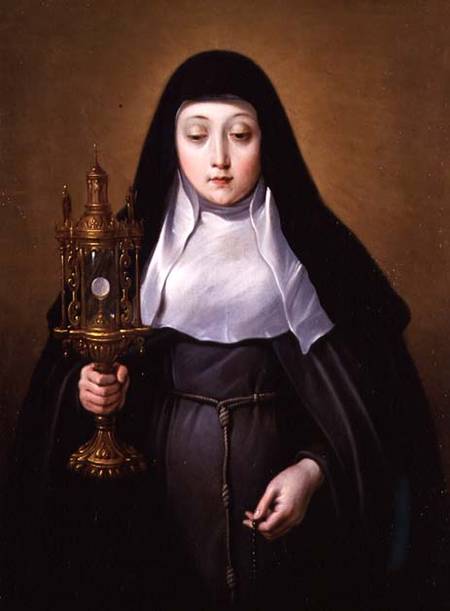
Symbols: monstrance, cross, olive branch, lily, sometimes a lamp


 “Love God, serve God: Everything is in that.”

                                                Clare of Assisi


            Without ever leaving  her convent on the outskirts of Assisi, Saint Clare founded orders of nuns throughout Italy, France, and Germany. Though she maintained a vow of silence, Popes, Cardinals and royalty came to her for spiritual advice. Only twelve years younger than her mentor, Saint Francis of Assisi, she quietly helped him lead a movement of young people that confronted the church hierarchy for their material excesses and  revolutionized religious expression by embracing simplicity and poverty.

            Chiara Offreduccio was the daughter of a wealthy Count and Countess in Assisi, Italy and displayed little interest in the worldly advantages offered by her highborn state. She was eighteen and destined for an arranged, profitable marriage when she heard Saint Francis deliver the Lenten sermon at her church.  Inspired by his simple message of living with complete trust in God, she conspired to run away and live like this new order of mendicant friars, dependent solely on alms received from begging. The turning point for her occurred on Palm Sunday of 1212 . That day, Clare went to the Cathedral of Assisi in her finest clothes for the blessing of the palms. While others went to the altar rail to receive their palms, she sat in her seat, too shy to move. With the entire congregation as witnesses, the bishop stepped down from the altar and delivered the palms to her. She took this as a sign to act on her plan.

            Homes in Assisi were built with two doors, one for regular use and one called the Door of the Dead, opened only to remove a coffin from the house. That night, Clare secretly cleared the debris from the Door of the Dead and stepped through it, renouncing her former life and the material world forever. She slipped through the woods to the chapel of the Portiuncula, where Francis and his small community of men were at prayer. Clare exchanged her finery for a penitential tunic of coarse cloth tied with a rope, and  Francis cut off her luxurious hair in front of the Blessed Virgin’s altar. Having no separate living facility for women, he then took her to the local Benedictine convent.

            Clare’s family embarked  on a rescue mission, sparing no expense. During a violent struggle to drag Clare her from the convent, her clothing was torn off, and her shorn hair revealed. She declared to her shocked father, “The only spouse I will have is Christ, and further attempts to remove me from my chosen life will make me more steadfast!”  Her powerful father had to submit to her will and leave her behind. To his great anguish his younger daughter Agnes joined Clare two weeks later. Thus began a retreat of wealthy young women turning their backs on privilege and society in order to follow a higher spiritual path. Francis of Assisi had offered his peers a way of living that shook the foundations of society in the Middle Ages. Instead of becoming dependent behind the walls of staid, established religious orders, he encouraged his followers to exist in a day-to-day manner, experiencing nature and depending on the good will of others. The joy he and his band of friars exuded was infectious and he developed a following wherever he went. Clare was the first young woman with the courage to join him. 

            In 1215 when Clare was twenty two years old, Saint Francis installed her as the Abbess of the Order of Poor Ladies in a small house across from the Church of San Damiano. These women followed the Franciscan rule, forbidden to own property or material goods and entirely dependent on the alms the Friars Minor could beg for them. Upon the death of her father, Clare did not veer from Saint Francis’s teachings. She gave her vast inheritance to the poor rather than to her own religious community. This act of devotion caused much controversy – church authorities expected women to give their dowries to the religious orders they joined. This was to ensure that the nuns would be supported throughout their lives and would not serve as a burden to their parish communities.

            Despite this disagreement with church hierarchy, convents of “Poor Clares” as the order became known, were started in cities all over Italy, gradually spreading to France and Germany. These first convents attracted many educated and wealthy women who not only walked away from titles and estates but also lived in a state of self imposed austerity that was considered extreme for men and unheard of for women. They went barefoot, wore sackcloth, slept on the ground, ate no meat and maintained a vow of silence, speaking only out of necessity. Agnes, daughter of the King of Bohemia, broke her engagement to become Empress of the Holy Roman Empire to start an order of Poor Clares. The correspondence between Agnes and Clare leaves a lasting portrayal of the intellectual brilliance and good nature of the order’s founder.

            Because of her great mind,  Saint Clare was an invaluable advisor to Saint Francis. When he was wrestling with the choice of becoming a religious hermit or going out in the world to evangelize his movement, she encouraged him to go out to the people. It was Clare who nursed Francis through the last days of his life, and it was under her care that he composed one of his greatest works, “Canticle of the Sun.” After Francis’s death Clare could never be convinced to relax his strict rules of poverty remaining the most loyal adherent of his teachings.

            Though she was Abbess of her own order of nuns, Clare lived as humbly as possible. She served at the table, tended the sick and washed the feet of the lay sisters when they returned from begging. Because of the austere manner in which she lived, Clare’s health suffered, and  like Francis, she had the reputation for mystical powers. When she prayed she exuded a rainbow aura  and enjoyed a silent rapport  with animals. While bedridden, she would embroider altar cloths for neighboring churches and her cat would bring her whatever she needed..

            In 1234 the army of Frederick II was at war with the Papal States, and the convent of Poor Clares came under attack by a band of Saracen mercenaries. Clare rose from her sick bed and took a monstrance containing a host from the chapel. While ladders were being set up for the invaders to scale the walls, Clare calmly prayed, “Does it please Thee, O God, to deliver into the hands of these beasts the defenseless children whom I have nourished with Thy love? I beseech Thee good Lord, protect these whom now I am not able to protect.” She then heard the voice of a child saying, “I will have them always in my care.” In response, she turned to the terrified nuns and told them to have no fear but to trust in Jesus. In that instant, the attackers were seized with an incredible wave of dread and they fled the convent. The citizens of Assisi credit Clare with saving them from a later assault by the same army. Telling her nuns that they needed to support the city which had given them so much charity, she had them pray through a day and night until the attacking army inexplicably gave up and retreated.

            Two days before her death at the age of 59, Pope Innocent IV approved the rule for her order which she had formally written herself. As she lay on her death bed her sister and the early followers of Saint Francis were at her bedside, reciting the same prayers for her as they had said for him.

            In art, Saint Clare is usually depicted holding the monstrance which she held in driving out the Saracens. Those working in embroidery as Clare did, frequently suffer from eye problems, and so she is their patron as well as patron to those who treat the eyes. Because gold work requires intense use of the eyes, gilders are also under her patronage. Because her name ‘Chiara’ means “clear”, she is called upon for clarity of vision.  Since laundresses work at dawn and her name reminds one of the effects of the rising sun, they are also under her protection. Vision and clarity accompanied Clare throughout her life. When she was too ill to attend Christmas midnight mass, she was able to visualize it on her wall, amazing those who did attend by relaying exact information of the events. Because of this miracle she was named the patron of television, telegraph operators and the telephonein 1958.


Prayer of Saint Clare of Assisi


                                    Go forth in peace, for you have followed the good road.

                             Go forth without fear, for he who created you has made you holy,

                                     Has always protected you, and loves you as a mother.

                                          Blessed be you, my God, for having created me.


Excerpted from the book “Saints: Ancient and Modern” by Barbara Calamari and Sandra DiPasqua