
SAINT ANNE
First Century
Feast Day: July 26
Patron of: Canada, Brittany, Broommakers, Cabinetmakers, Childless people, Grandparents, Miners, Lacemakers, Pregnancy, Housewives, Seafarers, Rain
Invoked for: protection in pregnancy and childbirth, help in raising children, for a good death, finding a husband, protection in thunder storms, protection in sea storms
Symbols: Book, throne, golden gate
Saint Anne is beloved for being the mother of the Virgin Mary, and grandmother to Jesus and many of his Apostles. Her story was first told in the second century as part of The Protevangelium of James, a gospel written about the early life of Jesus Christ. Though widely read by early Christians, it was never accepted as part of the New Testament canon. According to that text, Anne and her husband Joachim had a childless marriage for nearly 20 years. During Joachim’s presentation of an offering for the dedication of a new temple, he was shunned by the priest who declared his childlessness a curse from God. In humiliation, Joachim fled to the wilderness for forty days of prayer. When Anne heard the disturbing news, she begged the Lord to allow her to conceive, promising to dedicate any child she might have to the service of the Lord. An angel appeared to Joachim in the hinterland and said, “Delayed conceptions and infertile childbearing are all the more wonderful! Your wife will bear you a daughter and you will call her Mary. As you have vowed, she will be consecrated to the Lord at infancy and filled with the Holy Spirit from her mother’s womb. Return to the city and meet your wife at the golden gate of Jerusalem.” A distraught Anne, with no knowledge of where her husband had gone, was visited by the same angel. “You will meet your husband at the city gate, and this will be a sign that your prayers are answered.”
Anne and Joachim were overjoyed to see each other. Mary was conceived. When their precious only child reached the age of three, they honored their pledge to dedicate her to God. Not without tears, they left Mary at the temple to be raised in religious service.
According to an early account of her life, when Joachim died, Anne married his brother Cleophas with whom she had another daughter named Mary. When he died, she married for a third time and had a third daughter named Mary. The first Mary gave birth to Jesus Christ, the second Mary gave birth to James the Lesser, Joseph the Just, Simon and Jude. The third gave birth to James the Greater and John the Evangelist.
Saint Anne did not live to see the torment and execution of Christ. Because she was spared this sorrow she is invoked for an easy death. Sometime after the resurrection of Christ, Mary Magdalene, her brother Lazarus, and other apostles, were driven from Jerusalem because of their faith. They journeyed by boat carrying the remains of Saint Anne, setting ashore in Marseille, France. Her remains were taken deeper inland to what is now Apt, France, where they were subsequently concealed in a crypt. These events were transcribed in the Martyrology of Apt, dating from the Second Century, which Charlemagne consulted in a vain attempt to locate her remains nearly 700 years later. During a ceremony to re-consecrate the Cathedral of Apt, a 14 year old deaf mute began striking the main altar with his staff, greatly disturbing those in attendance which included the Emperor. Charlemagne was so impressed with the determination of the boy to draw attention to the altar that he gave orders to open its stairs after the mass. An underground door sealed with stones was uncovered. When these were removed an ancient catacomb was revealed. The boy led the group through the underground of the church to a wall which he also struck with his staff. The company eagerly broke through the wall to find a crypt containing a casket of cypress wood. Inscribed on it were the words “Here lies the body of Blessed Anne, mother of the Virgin Mary.” Charlemagne had the recollection of these events recorded, notarized and sent to the pope in Rome. The original papers of this correspondence are still in existence today.
The Cathedral of Apt became an important pilgrimage site. The cult of Saint Anne spread throughout France becoming particularly strong in Brittany. There are many Breton legends claiming Saint Anne as a Breton queen who had to escape a brutal husband, was led by Angels to a ship which landed in Jerusalem where she gave birth to the Virgin Mary. In the East, her feast was celebrated from the beginning of Christianity. As it spread through Western Europe, her patronage of fertility was extended to farm land. In Italy, agricultural workers referred to rain as “Saint Anne’s gift” and in Germany rain was referred to as “Saint Anne’s dowry”. Martin Luther wrote that he became a monk because of a promise he made to Saint Anne while he was caught in a terrifying thunder storm. In 1650 a group of sailors were caught in a storm on the Saint Lawrence River. Soon to perish they invoked Saint Anne for help, promising to build a shrine to her wherever they first landed. They washed ashore on the north bank of the river at Beaupre. Today, the Cathedral of Saint Anne de Beaupre, which now stands on that site, attracts millions of pilgrims from around the world. The chapel is filled with ex-votos donated to the church by people who have received miraculous healings.
Though not a biblical figure, Saint Anne was considered second only to Saint Joseph in importance by the early Eastern Church. Her role as a powerful matriarch and grandmother to Jesus Christ served as a strong example in Western Europe where many communities depended on the wisdom and advice of the aged. Because of her three marriages, young women ask her aid in finding a husband with the prayer, “Saint Anne, find me a man.” Her patronage of the sea and storms stem from the ocean voyage her remains made with Lazarus and Mary Magdalene. Because her womb held Mary she is the patron of miners who unearth secret treasures. Her womb was also revered as a sort of human tabernacle, normally made only of wood, so she is also the patron of carpenters and cabinet makers.
The Hebrew name for Anne is Hannah, which means “grace”. A common saying is, “All Anne’s are beautiful” and because of this the name “Anne” became the most popular girl’s name in Central Europe during the 19th Century. Adding “Anne” after a girl’s name is still common practice, particularly the combination of Mary Anne. Canada and Brittany hold major celebrations in Saint Anne’s honor on her feast day and Canada is still known as the “Land of Saint Anne”.
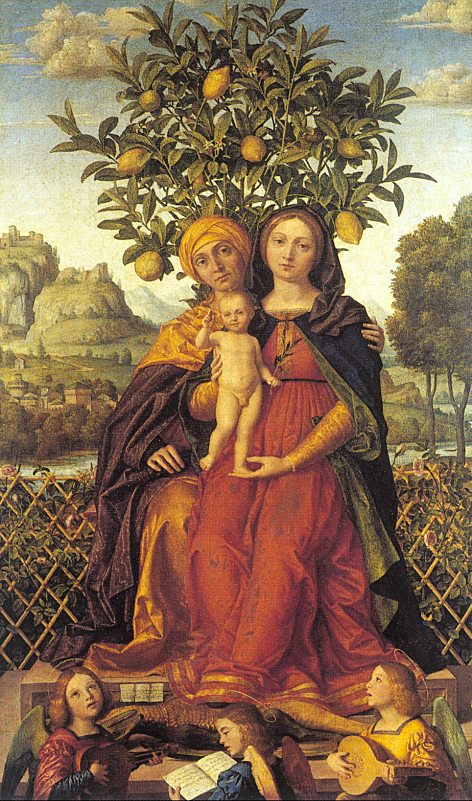
As the grandmother of Jesus and many of his Apostles, Saint Anne was a crucial branch on the family tree of Christ and is often depicted as the largest figure seated on a throne holding a miniature Mary who holds an even smaller young Jesus. As the mother of the Virgin Mary, Saint Anne is frequently depicted with her husband Joachim who shares her feast day, or with an open book, instructing her daughter.
Prayer to Saint Anne
O glorious Saint Anne, you are filled with compassion for
those who invoke you and with love for those who suffer!
Heavily burdened with the weight of my troubles,
I cast myself at your feet and humbly beg of you to take
the present intention which I recommend to you in your
special care (state intention).
Please recommend it to your daughter, the Blessed Virgin Mary,
and place it before the throne of Jesus, so that He may bring it
to a happy issue.
Continue to intercede for me until my request is granted.
But, above all, obtain for me the grace one-day to see my
God face to face, and with you and Mary and all the saints
to praise and bless Him for all eternity. Amen.
O Jesus, Holy Mary, Saint Anne, help me now and at the hour
of my death.
Good Saint Anne, intercede for me.
Excerpted from the book “Saints: Ancient and Modern” by Barbara Calamari and Saandra DiPasqua.

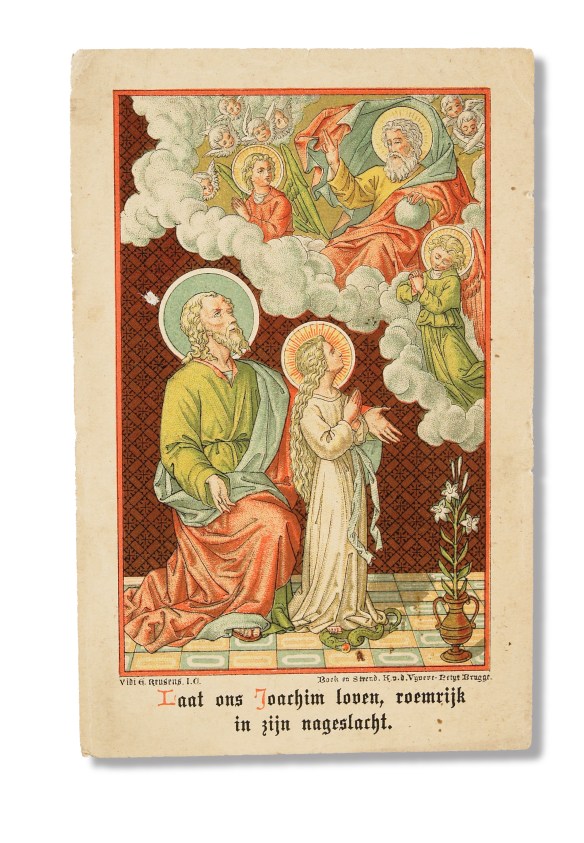 Grandfathers / Joachim, first century b.c., Feast Day: July 26




 novena.com