Austria / Colman of Stockerau, d. 1012,
Feast Day: October 13

A monk from the British Isles, Colman was making a pilgrimage to the Holy Land when he was stopped in Austria under suspicion of spying for their enemy, Moravia. Unable to speak German, he could not defend himself and was tortured and hanged. His body was left to dangle as a warning, and for eighteen months, it did not decompose and no animal touched it. The Austrians recognized this as a sign of his sanctity and made him their patron.

Other patronages: horned cattle, horses; hanged men

Invoked: against hanging, plague

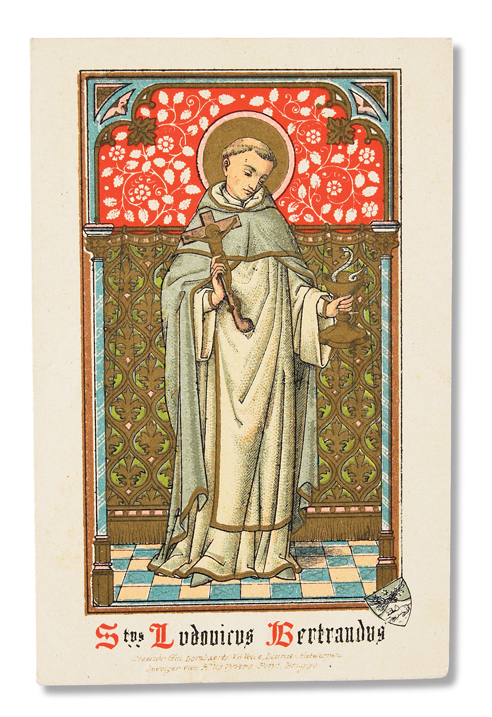
Colombia / Louis Bertran, 1526–1581, Feast Day: October 9

Though he was only in Central America for six years, Louis Bertran baptized tens of thousands of people. A Spanish speaker, he had the gift of tongues, which helped the native population understand him. A warrior tribe made a failed attempt to poison him. On his return to Spain, he trained other preachers and campaigned against the cruelty of the Spanish soldiers in the New World.

Other patronages: Panama

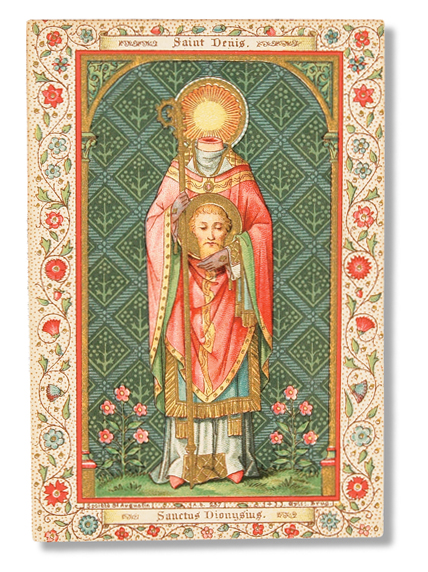
Strife / Denis, d. 258, Feast Day: October 9

An early missionary, Denis was the first bishop of Paris. The Roman governor had him and two companions tortured by flogging and roasting. When Denis would not die, they chopped off his head on what is now called Montmartre (“Hill of Martyrs”). When he picked up his own head and carried it six miles to his present burial place, many were converted.

Other patronages: headaches, rabies; France, Paris; Royal House of France; possessed people

Invoked: against frenzy, syphilis

Actresses / Pelagia the Penitent, dates unknown, Feast Day: October 8

A glamorous and popular actress and dancer in Antioch, Pelagia was known for her pearl jewelry and had the nickname “Margaret,” which means “pearl.” When she overheard the bishop of Edessa cite her as a lesson because “she takes more trouble over her beauty and dancing than we do about our souls and flocks,” she converted. She moved to Jerusalem, disguised as a male monk, and lived for the rest of her life as a hermit in a cave on the Mount of Olives.

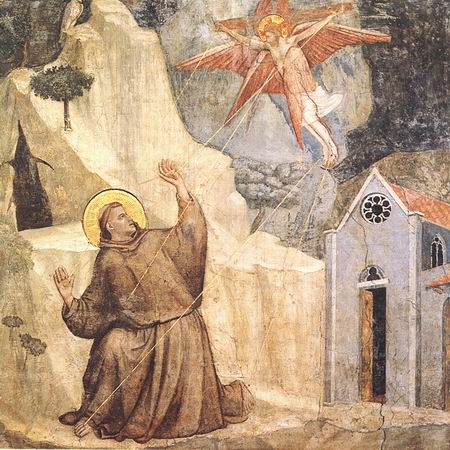
Ecology / Francis of Assisi, 1181–1226, Feast Day: October 4

Perhaps the best-loved saint in the world, Francis was a frivolous, wealthy young man who went off to war and was taken prisoner. On his return to his family, he had a complete change of heart, renouncing the material world in favor of nature and simplicity. He founded the Franciscan religious order devoted to love of God and all his creatures. A mystic, he could communicate with animals and was the first saint to receive the stigmata.

Other patronages: Italy, Assisi, San Francisco, Santa Fe; animals; animal welfare societies, zoos; lace workers, merchants, needle workers, tapestry workers

Invoked: against dying alone, fire

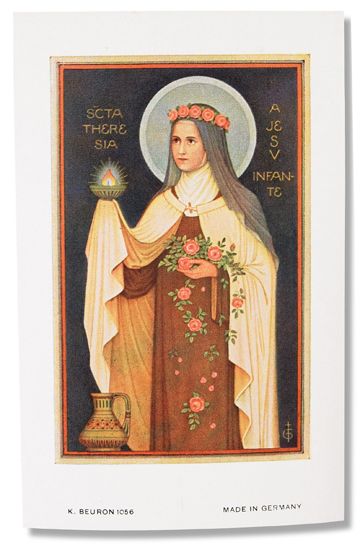
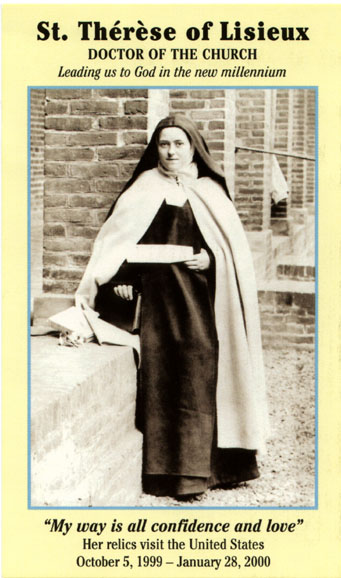
France / Thérèse of Lisieux, 1873–1897,
Feast Day: October 1

A French Carmelite nun who desperately wanted to be a missionary to the Far East, Thérèse was stricken with tuberculosis and never left her convent for the remainder of her short life. Her autobiography, A Story of a Soul, in which she details her lapse from and return to grace by utilizing “the little way,” became a sensational bestseller in France and the rest of the world. She vowed to dedicate herself to love, and today she is one of the most popular saints, especially among the young.

Other patronages: AIDS patients, tuberculosis patients; Russia, Vietnam; foreign missions; florists, pilots

Invoked: for a loving atmosphere

All of the above patron saints are excerpted from the book: “Patron Saints: A Feast of Holy Cards” by Barbara Calamari and Sandra DiPasqua. All images are from the collection of Father Eugene Carrella.


Novenas for October

SAINT FRANCIS OF ASSISI

1182-1226


Ardent love for everything in the universe so consumed Saint Francis of Assisi that he refused to have a full tonsure shaved into his head so that bugs and vermin, his “more simple brethren”, might still have a home in his hair. He called all animals brother and sister and exhorted every creature to honor its creator. It is said that birds became quiet when he preached and that when he walked through their flocks, they never moved unless he asked it of them. A great poet, Saint Francis himself wrote the first part of this novena. Because of the mystical way he experienced the world, in full possession of and living in divine light, he is invoked to change our view of the world and fill our lives with grace.

 He was born Giovanni Bernadone in the town of Assisi in the year 1182. His father was a wealthy cloth merchant and an upstanding member of the local upper classes. Everyone called him Francesco instead of Giovanni because his mother was Provence and he was given to exclaiming in French. Francis lived a pleasure-filled life as a young man, and it was assumed he would inherit his father’s business and social position. When war broke out with neighboring Perugia, Francis went to fight, viewing it all as a great adventure. He was taken prisoner, however, and eventually returned to his family extremely ill. As he recovered, his old way of life seemed to bore him. It was in the neglected Church of San Damiano that he heard the crucifix speak to him: “go and repair my house, which you see is falling down.” He took these instructions literally, enraging his father. Ultimately, h renounced his inheritance, throwing his clothes into the street. The bishop of Assisi provided Francis with his new garments, the brown robe of a monk.

Living alone, Francis rebuilt San Damiano, sometimes begging for the money for supplies. He was eventually joined by a few other young men of his status, and in 1209 he wrote his first holy rule. He embraced poverty and was intent on living as the original apostles of Christ did, traveling, preaching and begging for alms. When he prayed, the bright light in his raptures caused him to cry, but he could not bear to stop. His followers, worried that he would ruin his eyesight, attempted to intervene, but he replied, “We are the same as the flies, attracted to light.” In 1224, while praying alone on the secluded mountain of La Verna, Francis became the first saint to know the suffering of the crucified Christ by receiving the stigmata. These wounds stayed with him for the remaining two years of his life.

Saint Francis of Assisi is one of the greatest saints of the Catholic Church and is the founder of the Franciscan friars. Yet, so true was his embrace of humility that he himself was never ordained a priest, only a deacon. He lived out his life in the order he founded as a humble member with no official status. He was canonized a saint in 1228. Because of his extensive travels in his native country and his love for its natural beauty, Saint Francis is the Patron Saint of Italy.

 Feast Day: October 4

 Patronage: Italy, Animals, Ecologists, Nature

 Prayer by Saint Francis of Assisi with novena


Lord, make me an instrument of your peace.

Where there is hatred, let me sow love;

Where there is injury, pardon;

Where there is doubt, faith;

Where there is despair, hope;

Where there is darkness, light;

And where there is sadness, joy.

O divine master,

Grant that I may not so much seek

To be consoled as to console,

To be understood as to understand,

To be loved as to love.

For it is in giving that we receive,

In pardoning that we are pardoned, and in

Dying that we are born to Eternal Life.

Amen


Saint Francis of Assisi, reflection of Christ

Through your life of poverty and humility,

grant us through your intercession the

graces we so much need for soul and body.

Especially during this novena, we ask for

(mention your request).

We also ask your blessings on all those whom we love.

Amen


Say this novena nine times in a row for nine days in a row.

 (Excerpted from the book: “Novena: The Power of Prayer” by Barbara Calamari and Sandra DiPasqua).

More on Saint Francis of Assisi

Saint Therese of Lisieux

1873-1897

 Also known as Saint Theresa of the Child Jesus and Saint Theresa the Little Flower, Saint Therese’s story offers proof that one need not live a dramatic existence for holiness to be recognized. Cloistered in a Carmelite convent twelve miles from her home, her life was short and she died at the age of twenty four. Pope Pius X called Theresa of Lisieux “The greatest saint of modern times.” Novenas of Saint Therese of Lisieux are particularly effective for dissolving bitter feelings of resentment. Her belief in God was so ardent and loving that a childlike grace and joy extend to all who invoke her. She offers the simplicity, clarity, and innate wisdom of a kindly child. Saint Therese of Lisieux is prayed to by millions every day and her statue stands in thousands of churches. How could this unknown middle-class girl attain such international renown in so short a period of time?

 The youngest of five daughters, Therese Martin was born at Alencon in France. Her mother died when she was four and her father moved the family to Lisieux, where his late wife’s brother and sister-in-law lived. She was a beautiful and pampered child. The household was an extremely devout one, and when her tow older sisters entered the local Carmelite convent, Therese yearned to follow them.

 Upon entering the Carmelite order at the unusually young age of fifteen, Therese Martin declared her intention: “I want to be a saint.” Her life in the order, devoted to prayer, was unremarkable, and she spent her days doing low-level chores and following the regimen of prayer. It was her dream to go to Hanoi as a missionary nun, but this desire was never realized. In 1895 she was instructed to write the story of her childhood by her mother superior. This is a common practice in cloistered convents and monasteries. A year later she became seriously ill with tuberculosis and was bedridden. She finished her book The Story of a Soul, a few weeks before her death. This account of her life presents a very human, moody, middle-class girl with an ardent love for God. Writing with the knowledge that her own death is imminent, she promises that she “wants to spend her time in heaven doing good upon the earth.”

 Published in 1898 with a first printing of two thousand copies, The Story of a Soul became a spectacular success and is one of the best-selling books of the twentieth century, selling millions of copies in twenty eight languages. After the book’s publication, countless miracles were attributed to the heavenly intercession of Therese, and a devout following of this unknown nun sprang up in all parts of the world. Because of this international influence, Saint Therese of Lisieux is patroness of missionaries.

 Her book also presented her cultivating a childlike, loving spirituality, thus making her very sympathetic to the needs and concerns of children. Roses are her symbol and she is always depicted with them. In her book she promises to “let fall from heaven a shower of roses”.  A heavenly sign that novena requests to Saint Therese will be granted is the sight or smell of roses. Saint Therese of Lisiuex was canonized on May 17, 1925, and declared to be the second patron saint of France.

Feast Day: October 1

 Patron Saint of: France, Missionaries, Florists, Concerns of Children

Novena to Saint Therese


Saint Therese of the Child Jesus, during your short life on earth

You became a mirror of angelic purity, of love strong as death,

and of wholehearted abandonment to God. Now that you rejoice

in the reward of your virtue, turn your eyes of mercy upon me,

for I put all my confidence in you.


Obtain for me the need to keep my heart and mind pure and clean

Like your own, and to abhor sincerely whatever may in any way

Tarnish the glorious virtue of purity, so dear to our Lord.


Most gracious Little Rose Queen, remember your promises of

Never letting any request made to you go unanswered, of sending

Down a shower of roses, and of coming down to earth to do good.

Full of confidence in your power with the Sacred Heart, I implore

Your intercession on my behalf and beg of you to obtain the request

I so ardently desire.

(Mention your request.)

Holy little Therese, remember your promise to do good upon the

Earth and shower down your roses on those who invoke you.

Obtain for me from God the graces I hope for from his infinite

Goodness. Let me feel the powers of your prayers in every need.

Give me consolation in all the bitterness of this life, and

especially at the hour of death, that I may be worthy to share

eternal happiness with you in heaven. Amen.


Say this novena nine times in a row for nine days in a row.

(Excerpted from the book: “Novena the Power of Prayer”.)

More on Saint Therese

Dining With the Saints in Honor of Saint Therese


September 29 Feast of the Archangels

Novena to Saint Raphael

Novena to Saint Gabriel

More on Saint Michael

Novena for September

Saint Michael the Archangel


Justice in action and fierce protection are requested when we call on Saint Michael the Archangel. Devotions to him predate Christianity. Three major religions – Judaism, Christianity and Islam – consider him to be the greatest and most powerful of all angels. He is cited in the Book of Revelation as the angel who defeated Lucifer in his uprising against God. Lucifer, God’s most beautiful and favored angel, insisted he was equal or superior to God. He led a band of angels in a revolt against God and his omnipotence. Michael was the standard bearer against them. He defeated Lucifer and his allies and cast them out of heaven. He then took the name Mi-cha-el, meaning “Who is like God?”

 The ancient Jewish people referred to Michael as “the Viceroy of Heaven” and considered him the protector of Israel. In the New Testament he is cited as the angel that will come at the end of the world to slay the Antichrist on Mount Olivet. Saint Michael was one of the three voices directing Saint Joan of Arc in her campaign to unite France. He is said to take an active role in the world and its protection and is called upon when a group, city, or nation is in danger. Also, it is Michael who meets the soul upon its earthly death and guides it to its afterlife. He is frequently shown with a pair of scales to weigh sins and virtues. This is probably why he is the patron saint of grocers.

 From the earliest Christian times, the cults of devotion to Saint Michael were very popular, particularly in the East, where he was invoked to protect against illnesses. A church was dedicated to him in Constantinople to protect the health of the citizens in the fourth century. As his popularity spread, devotions to Saint Michael supplanted those to many of the pagan gods. In Germany, on the banks of the Rhine, he replaced Wotan, and in Roman Gaul he replaced Mercury. Statues depicting an angel with a battle helmet and sword began to appear in such far-flung places as India and Persia. On May 8, 492, he was sighted in a cave on the summit of Mount Gargano in southern Italy, causing it to become one of the first Christian pilgrimage sites. One hundred years later, as a plague raged in Rome, Pope Gregory I saw Michael sheathing a bloody sword over Emperor Hadrian’s tomb. He took this to mean that the city was now under Michael’s protection, and soon thereafter the plague ended. A church dedicated to Saint Michael was built over the tomb. It is now know as Castel Sant’Angelo (Castle of the Holy Angel). The most famous shrine to Michael is Mont-Saint-Michel in Normandy. This Benedictine abbey was found in the tenth century to commemorate an earlier apparition.

 Michael is usually shown holding a banner and a pair of scales and brandishing a sword with his foot on the neck of the devil, who is frequently represented by a dragon. Besides being the patron saint of grocers, Saint Michael is invoked to protect soldiers and policemen as well as to guard against illnesses. Because of the famous visions of Michael, there are local feast days to him on May 8 in Gargano and October 16 in Mont-Saint-Michel. His official feast day, the Feast of the Archangel, is September 29, which he shares with the archangels Gabriel and Raphael.

 Feast Day: September 29

 Patron Saint of: Grocers, Soldiers, Policemen

 Invoked for: Protection against illness

 Novena to Michael the Archangel

 Saint Michael the Archangel, loyal champion of God and his people, I turn to you with confidence and seek your powerful intercession. For the love of God, who made you so glorious in grace and power, and for the love of the Mother of Jesus, the Queen of the Angels, be pleased to hear my prayer. You know the value of my soul in the eyes of God. May no stain of evil ever disfigures its beauty. Help me to conquer the evil spirit who tempts me. I desire to imitate your loyalty to God and Holy Mother Church and your great love for God and men. And since you are God’s messenger for the care of his people, I entrust to you this special request.

(Mention your request.)

Saint Michael, since you are, by the will of the Creator, the powerful intercessor of Christians, I have great confidence in your prayers. I earnestly trust that if it is God’s holy will, my petition will be granted.

Pray for me, Saint Michael, and also for those I love. Protect us in all dangers of body and soul. Help us in our daily needs. Through your powerful intercession, may we live a holy life, die a happy death, and reach heaven, where we may praise and love God with you forever. Amen.

 (Recite one Our Father, one Hail Mary, one Glory Be.)

 Say this novena nine times in arrow for nine days in a row.

Excerpted from the book: “Novena: The Power of Prayer” by Barbara Calamari and Sandra DiPasqua