Unknown's avatar

About sandra dipasqua

graphic designer

Poland / Adalbert of Prague, 957–997,
Feast Day: April 23

Born into a noble family in Bohemia, Adalbert took his name from his teacher. By the age of thirty, he was named bishop of Prague. His insistence on distributing his wealth to the poor and his disdain for slavery made him the enemy of the ruling class. He left Prague and lived in Rome until being called back. On his second attempt to live there, he was driven out. He evangelized in Russia and Poland and was murdered in Prussia by pagan priests. His persistence in the face of failure served as an inspiration for future missionaries in that area.

Other patronages: Bohemia, Czech Republic, Prussia

Doormen / Conrad of Parzham, 1818–1894,
Feast Day: April 21

A farmer from Bavaria, Conrad did not become a Capuchin monk until he was in his early thirties. For the next forty years, he was the porter for the shrine of Our Lady of Altotting. He received thousands of pilgrims with charity and kindness, devoting much of his time to teaching local children. It is said he had the gift of prophecy and the ability to read hearts.

Other patronages: Capuchin-Franciscan Province of Mid-America

Homeless People / Benedict Joseph Labre, 1748–1783, Feast Day: April 16

Born into a prosperous middle-class family in Boulogne, France, Benedict Joseph attempted to enter three different religious orders: the Trappists, the Carthusians, and the Cistercians. Denied entrance because of his health, he went on a barefoot pilgrimage to all the Christian shrines in Europe. Intending to live as a hermit out in the world, he depended on divine providence for his meals and slept in the streets. He died seven years later on the steps of a Roman church.

Other Patronages: mental illness; beggars, pilgrims; bachelors, people rejected by religious orders

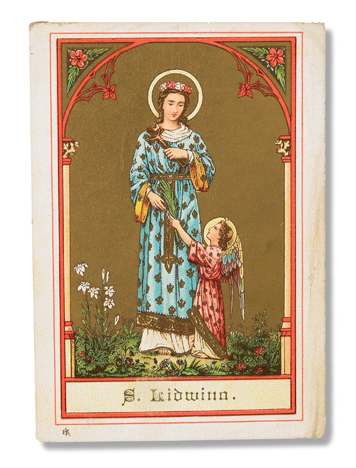
Skaters / Blessed Lydwina of Schiedam, 1380–1433,
Feast Day: April 14

A beautiful girl from the Netherlands, Lydwina became an invalid due to an ice skating accident. For the next thirty years she endured agonizing body pain as well as a series of disfiguring illnesses. She devised a system of meditative prayer, in which she concentrated on Christ’s suffering and offered up her own. Eventually, she fell into mystical experiences and her holiness served as an example to others.

Other patronages: skiers

Handicapped People / Margaret of Castello, 1287–1320, Feast Day: April 13

Blind, lame, and a dwarf, Margaret was hidden away by her parents, landed nobles. Since she liked to pray, she was sent to live in a chapel in the woods. When she was twenty, her parents took her to a Dominican convent to seek a miraculous cure. When none came, they deserted her there. She helped out in the daycare center run by the nuns. Beloved by the townspeople, she is credited with curing a crippled girl upon her death.

Other patronages: right-to-life movement; unwanted people

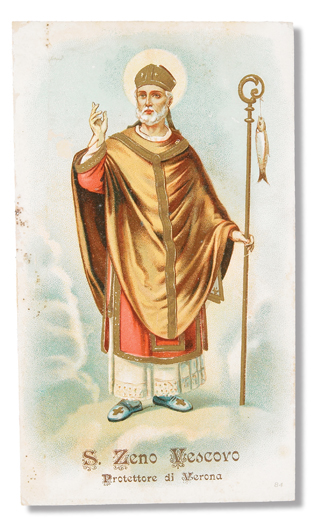
Babies / Zeno of Verona, 300–371, Feast Day: April 12

Born in Africa, Zeno was a bishop of Verona who loved to fish in the Adige river. He was a notable preacher and wrote much about baptism. When he was born, a demon took his place in his crib, and though he was suckled for eighteen years, he never grew. In the meantime, Zeno was raised by monks. When he was coincidentally sent by them to investigate this phenomenon, he forced the demon to spit up all the milk he had consumed into a great vat.

Other patronages: Verona; fishermen; children learning to speak, children learning to walk

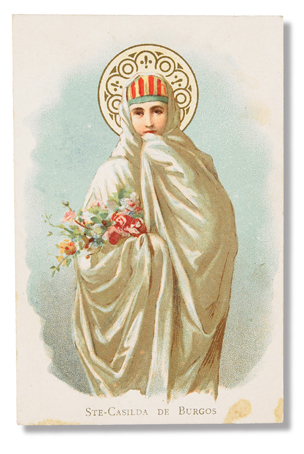
Sterility / Casilda of Toledo, d. 1050, Feast Day: April 9

The Muslim daughter of the Emir of Toledo, Casilda had great compassion for Christian prisoners, frequently sneaking them food. When she fell ill with a uterine hemorrhage, she made a pilgrimage to the sanctuary of Saint Vincent Briviseca in Burgos. She became a Christian after being healed and lived out her life as a hermit near that sanctuary.

Other patronages: Burgos (Spain), Toledo (Spain)

Invoked: against bad luck, uterine hemorrhage

Teachers / John Baptist de La Salle, 1651–1719,
Feast Day: April 7

Giving up a life of ease as canon of Rheims, John Baptist devoted his life to the education of the poor. He donated his personal fortune to create a school to educate teachers. He was the founder of the Christian Brothers, an order devoted to the education of boys. There was much animosity toward his revolutionary teaching methods; he instituted the system of eight grades for primary school that we use today.

Other patronages: school principals

Builders / Vincent Ferrer, 1350–1419,  Feast Day: April 5

A Dominican priest from Valencia, Spain, Vincent Ferrer was a healer and a highly charismatic preacher who generated crowds in the tens of thousands. Demoralized by the Great Schism in the Church, he dreamed that Saints Francis and Dominic implored him to go on apostolic missions. He traveled through Spain, France, Italy, Germany, Belgium, England, Scotland, and Ireland. He is known as patron of builders for his work in strengthening and building up the Church.

Other patronages: fields, vineyards; innkeepers, lead casters, pavement workers, plumbers, roofers, straw-hat makers, tile makers

Invoked: against epilepsy, headaches, drought, earthquakes, lightning strikes

The above patron saints are excerpted from the book: “Patron Saints:
A Feast of Holy Cards” by Barbara Calamari and Sandra DiPasqua

All images are from the holy card collection of Father Eugene Carrella


Happy Easter from Dining With the Saints

A Roman Easter Dinner

Roman Easter food has always had a big allure for me. It’s creative, seasonal Italian cooking at its best. Lamb, ricotta, eggs, artichokes, asparagus, shell peas, favas, and wheat all play a part in the Easter feast and Roman springtime celebrations. These are rich tastes, but their youth and greenness makes them renewing to the spirit, which is just what I want around this time of year.

Here’s a Roman dish that I absolutely love since it highlights the beauty of spring asparagus, and I can’t imagine Easter without asparagus (even though they’re not quite in season here yet, but California imports are pretty decent). Here you’re bringing together a few simple ingredients, asparagus, eggs, pecorino, guanciale, a handful of herbs, to create a very opulent dish. Since you leave the egg yolks soft they run all over the asparagus and the guanciale, creating a cheesy, eggy sauce. Really nice. I think it’s a great first course before another classic Roman Easter dish, braised lamb with fresh green peas. Here’s my recipe for that if you’d like to give it a try: http://ericademane.com/2002/05/05/agnello-alla-cacciatore/.

Easter Eggs with Asparagus, Guanciale, and Pecorino

 (Serves four as a first course)

1 large bunch of medium thick asparagus, trimmed and peeled

Extra virgin olive oil

1/3 cup well chopped guanciale (you can use pancetta instead)

2 garlic cloves, peeled and lightly crushed

Salt

Freshly ground black pepper

The juice from ½ a large lemon

4 extra large eggs

1/2 cup grated Pecorino Romano (get the best you can find, something that’s not overly salty)

A few chives, chopped

A few large sprigs of fresh mint, leaves left whole

Set up a pot of water and bring it to a boil. Drop in the asparagus and blanch for about 4 minutes. Drain the asparagus in a colander and then run them under cold water to stop the cooking and set their green color. Drain well.

Lay the asparagus out in a shallow baking dish.

In a large skillet heat a tablespoon of olive oil over medium heat. Add the guanciale and let it get crisp and give up its fat. Add the garlic and sauté a minute longer, just to release its flavor.

Remove the crisp guanciale bits from the skillet with a slotted spoon and scatter them over the asparagus. Discard the garlic. Season the asparagus with salt, black pepper, and the lemon juice. Reserve the guanciale cooking fat.

Poach the eggs in just simmering, lightly salted water until the whites are set but the yolks are still runny. Scoop them from the water with a slotted spoon, resting them on paper towels for a moment to blot excess water, and arrange them on the asparagus. Spoon a little of the guanciale cooking fat over the eggs (an important step for flavor) and season them with salt and black pepper.

Sprinkle on the pecorino and run the dish under a broiler until the cheese just starts to melt, about a minute or so. Garnish with the chives and the mint. Serve right away.

Dining With the Saints is a monthly column written by chef and writer Erica DeMane.

Erica DeMane.com

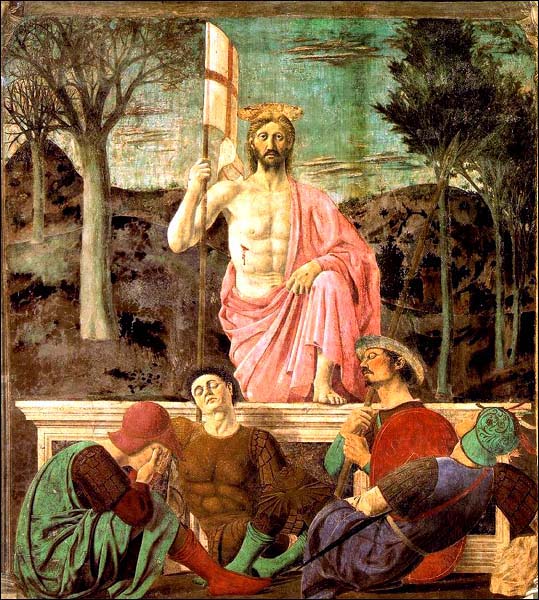
Image: “Resurrection” mural by Piero Della Francesca  1463 – 65