Unknown's avatar

About sandra dipasqua

graphic designer

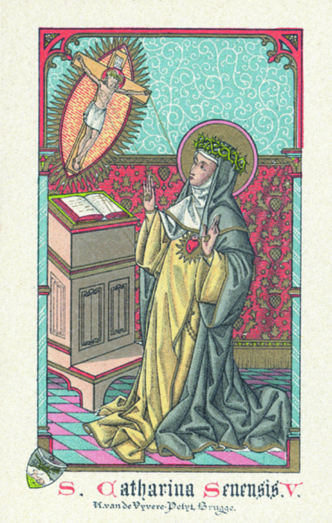
Saint Catherine of Siena  1347–1380. Feast Day: April 29. Patron of: Italy. Fire Protection. Nurses.
Doctor of the Church.

A Dominican tertiary, Catherine was known for her spiritual writings as well as her willingness to care for those with the most repulsive diseases. She is shown with the crown of thorns because she received the stigmata. The open book is for her writings, many of which she dictated while in a trance. They are still considered to be great literature and studied to this day.

Novena to Saint Catherine of Siena

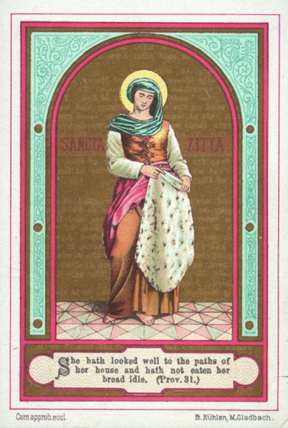
Saint Zita  1218–1278. Feast Day: April 27.
Patron of: Servants.

Those who lose their keys. From Lucca, Italy, Zita was a domestic servant known for her charity and mystical experiences. When she gave her master’s fur coat to a beggar, an angel returned it to her the next day. She is always shown wearing an apron. In this card she holds the returned fur.

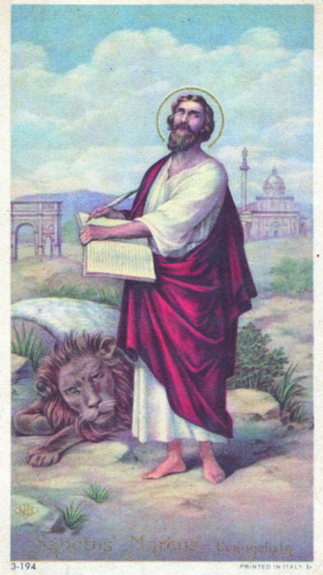
St. Mark

St. Mark, First centuryAssistant to St. Peter, his gospel was written in a.d. 49. He was martyred in Alexandria by being dragged through the streets. In 815 his body was stolen by the Venetians, who interred it in the basilica built in his name. His attribute is the lion, representing the resurrection.

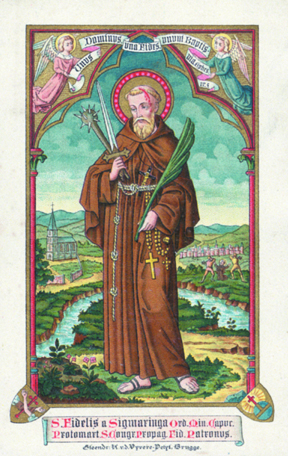
Saint Fidelis of Sigmaringen  1577–1622.
Feast Day: April 24.

A lawyer disgusted with the corruption in the justice system, Fidelis gave away his worldly wealth and became a Franciscan monk. He led a group of Capuchin friars on a mission to the Protestant area of Switzerland and was martyred for his preaching. His card has the shield of the propagation of the Faith, he has a cut in his head, and he holds the sword and whirl bat with which he was martyred in one hand, martyrs’ palms in the other

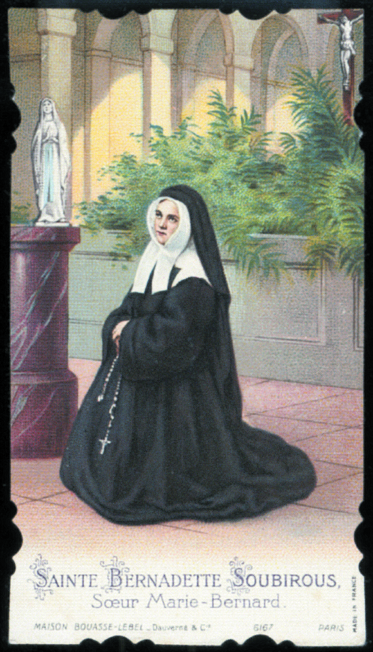
Saint Bernadette Soubirous  1844–1879. Feast Day: April 16.

A poor peasant girl from Lourdes, France, it was her vision of Mary and subsequent communications with her that began the pilgrimage to Lourdes. At Mary’s request, she uncovered a hidden spring of water which was provento have healing powers. Lourdes now attracts over four million pilgrims a year. Bernadette is shown praying with a rosary before a statue of Mary. She wears the habit of the Notre Dame order, the nuns she joined soon after the Marian visitations ended.

Saint Bénézet  1163–1184. Feast Day: April 14.
Patron of: Avignon. Bachelors.

A shepherd watching his mother’s sheep, Bénézet had a vision during an eclipse. A voice told him to build a bridge overa dangerous part of the Rhone River at Avignon. Thinking it impossible, the church and civil officials ridiculed him and refused to help. He lifted a huge stone in place and announced this would be the foundation. The citizens of Avignon were so inspired by this act, they rushed to help him. The bridge was easily constructed. Bénézet died upon its completion and was buried in the bridge. His incorrupt body was removed in 1669 and reinterred in a church. He is shown in shepherd’s robes with the bridge at the bottom of the card.

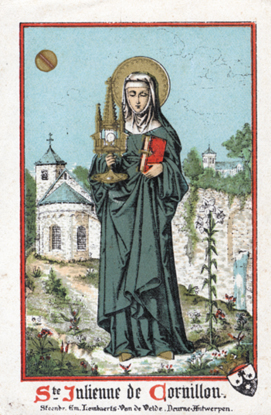
Saint Julienne de Cornillon  1192–1258. Feast Day: April 5.

An Augustinian nun, who with Eve of Liege began the proceeding for the Feast of Corpus Christi. For many years Julienne had a vision of the sun with a black band around it. This symbolized that something was missing from the Church calendar. She is shown with the banded sun, the monstrance holding the body of Christ, her convent in the background, and a closed book of mysterious teaching. A lily is at her side and the Augustinian shield is in the lower corner.


The above saints for April have been taken from the book “Holy Cards” by Barbara Calamari and Sandra DiPasqua. All images are courtesy of Father Eugene Carrella.


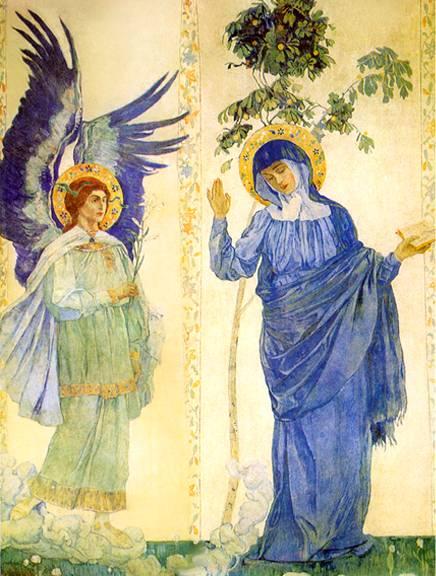
The Annunciation: March 25


Annunciation Novena

I greet you, Ever-blessed Virgin, Mother of God, Throne of Grace, Miracle of Almighty Power! I greet you, Sanctuary of the Most Holy Trinity and Queen of the Universe, Mother of Mercy and Refuge of Sinners!

Most loving Mother, attracted by your beauty and sweetness, and by your tender compassion, I confidently turn to you, miserable as I am, and beg of you to obtain for me of your dear Son, the favor I request in this novena:
( Here mention your request to our dear Mother)

Obtain for me also, Queen of Heaven, the most lively contrition for my many sins and the grace to imitate closely those virtues which you practiced so faithfully, especially humility, purity, and obedience. Above all, I beg you to be my mother and Protectress, to receive me into the number of your devoted children, and to guide me from your high throne of glory.

Do not reject my petitions, mother of mercy! Have pity on me, and do not abandon me during life or at the moment of my death. Amen.

Painting: “The Annunciation” by Mikhail Nesterov  1895

Dining With the Saints

The Feast of San Giuseppe

Feast Day: March 19

Husband of Mary and patron saint of the family, St. Joseph is one of the most revered Saints in the Catholic world. His feast day on March 19th is just about the biggest feast holiday in Italy. Almost every town celebrates by preparing fritelle, sometimes called zeppole (he is also the patron Saint of pastry cooks), and there are myriad versions of these fried puffs, most of them stuffed with a sweet filling that can be ricotta based or a flavored pastry cream. My next door neighbor, whose family is from Sorrento on the Amalfi Coast, makes one that’s loaded with a velvety lemon custard. As excellent as these pastries are, this is not the only food made for this huge feast day.

Altars are decorated with labor intensive, highly decorated breads (some shaped into crowns of thorns and crucifixes). St. Joseph’s day is celebrated at the spring solstice and the offering of bread, the ritual of mixing pounded grain and water, symbolizes the powers of fertility and the riches of the earth.

Pasta with sardines or calamari, baccala in many incarnations, arancini, prosciutto and salumi, seasonal vegetables, such as artichokes, wild asparagus and fennel, appear in many dishes. Each area of Italy offers up the best of its local produce and creations, in some regions up to one hundred dishes are typical outpourings of food centered devotion. Too much is never enough for the adoration of this most beloved Saint and it’s a welcome break coming in the middle of Lent. In Molise there’s a ritual lunch of a relatively modest thirteen courses, most of which are based on fish and pasta. Pasta with anchovies in various incarnations is one of the traditional dishes always served. Here’s a version of this great dish that I’ve always loved.

Bucatini with Anchovies, Tomatoes, and Walnuts

(Serves five as a first course)


Salt

Extra virgin olive oil

1 pound bucatini

3 pints cherry tomatoes, cut in half

2 large garlic clove, very thinly sliced

8 salt packed anchovies, filleted, briefly soaked to remove excess salt, and chopped

Freshly ground black pepper

3/4 cup walnut halves, lightly toasted and roughly chopped

A few large marjoram sprigs, leaves chopped

A large handful of flat leaf parsley, leaves lightly chopped

A chunk of Pecorino Toscano


Set up a large pot of pasta cooking water and bring it to a boil. Add a generous amount of salt and add the bucatini.


In a large skillet, heat 1/4 cup of olive oil over medium-high flame. When very hot add the tomatoes and the garlic and cook quickly, just until the tomatoes start giving off some juice, about 5 minutes. Add the anchovies, seasoning with a little salt and more liberally with black pepper, and sauté a minute longer. Turn off the heat and add the walnuts and the marjoram.


When al dente, drain the bucatini, saving about ½ cup of the cooking water, and transfer it into a warmed serving bowl. Add the bucatini, the parsley, about a tablespoon of grated pecorino, a drizzle of fresh olive oil, and give it a toss, adding a little of the pasta cooking water if needed to loosen the sauce. Bring the chunk of pecorino to the table. Serve hot.


Painting: ‘San Giuseppe’   by Guido Reni 1635

Saint Joseph’s Day Altar from New Orleans, Louisiana

More on Saint Joseph

Novena to Saint Joseph

“Dining With the Saints” is a monthly column by Writer and Chef Erica DeMane. Visit her website at: EricaDeMane.com



Cross versus smudge: which do you prefer?

Over the years as I have photographed Catholics on Ash Wednesday, I have seen my personal preference for a good solid cross confirmed as the people’ choice. Following is a sampling of my Ash Wednesday images.