Unknown's avatar

About sandra dipasqua

graphic designer

2013 in review

The WordPress.com stats helper monkeys prepared a 2013 annual report for this blog.

Here’s an excerpt:

The concert hall at the Sydney Opera House holds 2,700 people. This blog was viewed about 48,000 times in 2013. If it were a concert at Sydney Opera House, it would take about 18 sold-out performances for that many people to see it.

Click here to see the complete report.

Merry Christmas from Novena.com!

A Dining With the Saints Christmas Eve Salad

A Salad to be served after Christmas Eve Dinner, Southern Italian Style

Christmas Eve, according the the Catholic church, is a fast day. Catholics interpret this in many ways. Usually it means eating meagerly and avoiding meat. Southern Italians, always up for a grand food celebration, view this fast day as an opportunity to cook as many types of seafood as they can, often thirteen, symbolizing Jesus and his apostles. If you’re Italian-American, or have eaten Christmas Eve dinner with an Italian-American family, you know what kind of abondanza these feasts can be, with not a speck of meat in sight.

I have favorite Christmas Eve dishes I always make, such as baccala with potatoes and white wine, and spaghetti with clam sauce, but I always include at least one new one each year. Another constant is a variation on the classic Sicilian orange salad. It’s the best palate cleanser after so much fish. If you can find blood oranges, use them, but the salad is just as delicious with regular oranges. This year I’m adding mint, which is customary, but basil also goes really well with oranges, if you prefer.

Merry Christmas to you all.

Orange, Fennel, Black Olive, and Mint Salad

(Serves 4 or 5)

4 oranges, peeled and cut into thin rounds (include 2 blood oranges if you can find them),
2 small fennel bulbs, trimmed and thinly sliced,
½ a red onion, cut into thin slices, a handful of black olives (I like the wrinkled Moroccan type for this salad),
sea salt and freshly ground black pepper, your best extra-virgin olive oil, and a handful of fresh mint leaves

Arrange the orange and fennel slices on a large, pretty serving platter. Scatter on the red onion and the black olives. You can cover and chill this until you’re ready to serve it.

Right before serving, season with sea salt and black pepper. Drizzle with a generous amount of olive oil, and garnish with the mint leaves. Serve right away.

(Erica De Mane is a chef and food writer specializing in the Mediterranean diet. She has a popular blog at http://www.ericademane.com).

Image: A Neapolitan angel from a Christmas creche.

Saint Lucy

Saint Lucy

283 – 304

Feast Day: December 13

Patron of: the blind

Keywords: light, clarity, the blind, eye disease, dysentery, epidemics, cutlers, electricians, glaziers, gondoliers, oculists, peasants, writers, vision

Quote:  “Those whose hearts are pure are the temples of the Holy Spirit.”

Symbols: holding her eyes on a dish, martyrs palms, sword, oxen

Willing to give up the comforts of her privileged life in order to obtain a state of enlightenment, Saint Lucy is one of the early virgin martyrs who challenged the authority of the Roman state. Her very name means ‘light’ and as light is direct and clear, shining in the most filthy of environments, we invoke her for clarity of vision in the spiritual as well as the physical realm.

Born in Syracuse, Sicily to a wealthy family of Greek descent, Lucy’s father died when she was very young.  Following the traditions of their society, Lucy had a large dowry and was affianced in an arranged marriage to a pagan nobleman. Lucy was a Christian and believed that she could best be a conduit of the Holy Spirit by remaining a virgin unfettered by husband and children. At this time Christianity was a great threat to the Roman Empire and the emperor Diocletian vowed to stamp it out wherever it arose. Lucy kept her vow a secret as Christians were considered revolutionaries against the state.  Since her mother suffered from constant bleeding from a uterine hemorrhage, Lucy took her to the tomb of Saint Agatha in Catania, a place where many miracles were reported, for a healing. While spending the night there, Lucy dreamt of Saint Agatha who told her, “You have no need to invoke me, for your faith has already cured your mother. One day you will be known as the patron of your own city.”  Upon awakening and finding her mother completely healed, Lucy confessed to her desire to remain a virgin and distribute her dowry among the poor. Impressed by her faith, her mother acquiesced to her daughter’s wishes.

When her fiancé heard of the broken engagement he went to the governor to denounce Lucy as a Christian. In an attempt to change her mind, she was brought before the authorities. When she asked why was it so important that this man need to marry her, she was told because she had the loveliest eyes. Whereupon Lucy ripped out her eyeballs and told the governor to send them to her former fiancé. The next day her eyesight was miraculously restored and Lucy was once again brought before the authorities. An attempt was made to have her taken to a brothel to be repeatedly raped, but a phalanx of soldiers could not move her. A team of oxen was brought in to no avail. Burning pitch was poured on her head, but she stood fast, predicting the downfall of the emperor. This last declaration proved to be too much and Lucy was fatally stabbed in the throat. True to her prophecy Diocletian the emperor abdicated his throne within the year.

It is said that “the longest of nights and shortest of days belong to Saint Lucy.” Because her feast day, December 13 used to be the winter solstice before the change to the Gregorian calendar, Lucy enjoys great patronage in Scandanavia as the saint who brings the coming of the light. Her relics were moved to Venice where she is celebrated in song by gondoliers. In Sicily she is credited with ending an epidemic of children’s deaths in the 14th century, today she is synonymous with Santa Claus, where children receive gifts on her feast day. When there was a famine in her native land during the 16th century, ships laden with raw wheat turned up on her feast day. The starving inhabitants cooked the wheat whole, and today it is customary to cook with raw wheat on her feast day.

Explanation of symbols:

Eyes on a dish: Lucy ripped out her own eyes and offered them to her fiancée when she was told he loved her for her beautiful eyes. She was not in need of her mortal eyes as she was filled with light.

Palms: Symbol of martyrdom.

Novena to Saint Lucy

Saint Lucy, your beautiful name signifies light. By the light of faith which God bestowed upon you, increase and preserve this light in my soul so that I may avoid evil, be zealous in the performance of good works, and abhor nothing as much as the blindness and darkness of evil and sin. By your intercession with God, obtain for me perfect vision for my bodily eyes and the grace to use them for God’s great honor and glory and the salvation of all men. Saint Lucy, virgin and martyr, hear my prayers and obtain my petitions. (Mention your request here.)

Amen

(Excerpted from the app: “Novena:Praying with the Saints” by Barbara Calamari and Sandra DiPasqua).

Our Lady of Guadalupe

Our Lady of Guadalupe


Feast Day: December 12

Patron of: Motherly Comfort

Quote: “Am I not your mother?”

Keywords: the Americas, compassion, love, forgiveness, mercy, motherly comfort, protection

 Symbols: mandorla (body halo), roses, stars, crescent moon, angel

This image of Mary is the preeminent cultural icon of Mexico and the American Southwest, cherished by Catholics and non-Catholics alike. Unlike other apparitions of Mary, where she sometimes issues warnings to mankind, in her visitation to the Aztec people, she promised hope, love and comfort at a time when their own way of life had been destroyed.   We invoke Our Lady of Guadalupe anytime we need the wisdom and comfort of a motherly force.

In December of 1531, the world of the once great Aztec civilization lay in ruins. The native inhabitants of what would become Mexico City were suffering brutally under the domination of Spanish Colonialists who had first invaded in 1519. Within two short years the forces of Hernan Cortes, with the help of native enemies of the Aztecs had completely overrun and destroyed a dual culture of light and dark, one of gracious cities and blood filled temples. Believing that their superiority and way of life depended on feeding their gods human sacrifices, the Aztecs routinely invaded neighboring tribes, sacrificing tens of thousands of captives a week. Gradually, the images of their own gods, particularly the female ones, took on more monstrous and grotesque features. The Spanish responded  to these sacred sites by wreaking havoc and destruction upon them. Within ten years the remaining Aztec residents were heart-sick, depressed and dying off.

 On December 9, 1531, and Aztec convert to Catholicism called Juan Diego, was on his way to mass. Distracted by the singing of birds on a hillside, he stopped. He then heard the kindly calling of his name in his native Nahuatl language. He approached the noble Aztec woman n the hill and was stunned at the heightened glow of her surroundings. She introduced herself as the perfect maiden Saint Mary, honorable mother of the true God. She asked him to go to the bishop and request a temple be built to her on the hill. She added, “I am the compassionate mother of you and your people, here in this land and of all the people who love me, search for me and confide in me…”  After a long wait, the bishop told Juan Diego that he needed a sign proving that this was a true appearance of Mary. In subsequent days, when Juan Diego again saw the woman on the hill, he begged her to get someone who the bishop would respect more to deliver her request. She kindly replied that he was the perfect one for her message. The next day Juan Diego walked another way into town in order to avoid the woman as his uncle was sick and he did not want to waste any time doing her errands. Nonplussed, she came down from the other side of the hill to meet him. Flustered, he told her he had to tend to his uncle and had no time to wait for the bishop who did not believe him anyway. The woman assured him that his uncle was already well and then told him to gather roses among the rocks.  This being winter he was amazed at how many roses were in full bloom. The woman arranged the roses in his cloak and again sent him off to the bishop. When he was finally granted this audience, it was the bishop’s turn to gasp in amazement. As Juan Diego unwrapped his cloak of roses, there imprinted on his cloak was the exact image of the lady on the hill. The bishop fell to his knees and begged Juan’s forgiveness. Today, tens of millions of pilgrims flock to Mexico City to see this original cloth which is in the cathedral named after this apparition of Mary, Our  Lady of Guadalupe.

The Virgin Mary appears to each visionary as a member of their own culture.  This image of a kindly, loving mother figure so impressed the native people of Mexico, that thousands of them came to be baptized within the first few months of the cloth being put on display.

 Explanation of images:

Mandorla: a body halo which signifies that Mary is wrapped in the grace of God.

Robe of stars: By wwearing the stars she is showing that her God is more powerful than the stars. Blue is the color of royalty and virginity.

Crescent Moon: to Christians, Mary’s virginity. To Indian’s Mary is stronger than the moon god, the god of darkness.

angel:  Carried there by heaven.


 Novena to Our Lady of Guadalupe 

Our Lady of Guadalupe, according to your message in Mexico I venerate you as “the Virgin Mother Of the true God for whom we live, the Creator of all the world, maker of heaven and earth.” In spirit I kneel before your most holy image which you miraculously imprinted upon the cloak of the Indian Juan Diego. And with the faith of the countless numbers of pilgrims who visit your shrine, I beg you for this favor: (mention your request). 

Remember, O Immaculate Virgin, the words you spoke to your devout client, “I am a merciful Mother to you and to all your people who love me and trust in me and invoke my help. I listen to their lamentations and solace all their sorrows and their sufferings.” I beg you to be a merciful Mother to me, because I sincerely love you and trust in you and invoke your help. I entreat you, Our Lady of Guadalupe, to grant my request, if this should be the will of God, in order that I may bear witness to your love, your compassion, your help and protection. Do not forsake me in my needs. Amen.

(Excerpted from the app: “Novena: Praying with the Saints” by Barbara Calamari and Sandra Di Pasqua).


Our Lady of Guadalupe, pray for us.
 

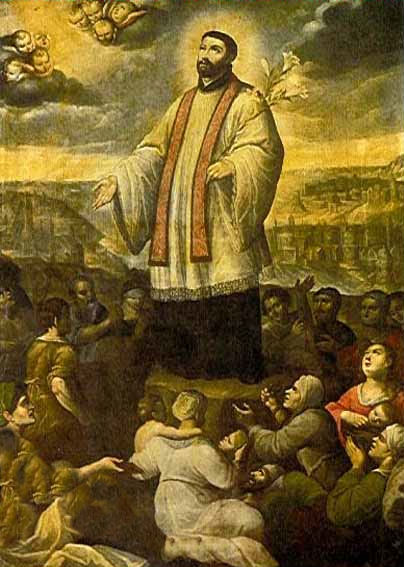
Saint Francis Xavier Miraculous Novena of Grace

Saint Francis Xavier

1506 – 1552

Patron of: Missionaries

Feast Day: December 3

Keywords: foreign missions, grace, hurricanes, missionaries, plague, sailors, tourists

Quote: “It is not the actual physical exertion that counts towards one’s progress, nor the nature of the task, but the spirit of faith with which it is undertaken.”

Symbols: crucifix, lily, flaming heart, torch

Credited with converting hundreds of thousands of people, St. Francis Xavier is considered the most successful missionary since St. Paul. In his own life, he evolved from being a sheltered, wealthy intellectual to becoming a fearless explorer travelling to newly discovered lands, happily living  among the lowest castes of people, improving their lives with love and grace. The novena in his honor, the Miraculous Novena of Grace is said to bring the force of grace into our lives, creating  a more harmonious relationship with the world around us.

Born in the Kingdom of Navarre, the Basque region of Spain, Francis grew up in his family’s castle. Much admired for his intellectual gifts, he was sent to the University of Paris where it was thought that he would become one of its more gifted professors. His life changed drastically when he met an older student named Ignatius Loyola who had a small band of followers. Together with Loyola, St. Francis Xavier formed a new religious order, The Society of Jesus (now known as the Jesuits) with the intention of spreading Christ’s word to the farthest corners of the earth. The King of Portugal sent Francis Xavier on his first mission to Goa in India where his country had a colony. He was concerned about the lack of religious practice available to his people and Francis’s mandate was to form a ministry for his Portuguese subjects. However, the European merchants and traders were more interested in gambling, drinking, slave trading and prostitution than in any religious preachings. When Francis Xavier attempted to meet with the Brahmin or wealthy local people, he was equally rebuffed. He then decided he would work with the lowest of the low, shocking both European and upper caste Indians by openly treating beggars, prostitutes, prisoners and the illegitimate as equals. The many eloquent letters he wrote about his life and work among society’s outcasts are still enlightening reading today. Gifted in languages, Francis Xavier had the ability to easily communicate in the various dialects spoken in the region. He is credited with saving the Paravas, an indigenous people who were pearl divers on the coastal islands from decimation and enslavement by the various Arab and European traders who plagued them.

Excited by his great success, Francis Xavier travelled throughout the Far East and he was the first missionary to travel to Japan. Not always met with the same respect and openness that he offered others, he endured his frustration with good spirits. He died on the island of Chang-Chuen-Shan, never realizing his dream of reaching mainland China. His body was put in quicklime and taken back to Goa, where it lies in a much visited shrine.


Miraculous Novena of Grace to St. Francis Xavier


Most amiable and most loving Saint Francis Xavier, in union with you I reverently adore the Divine Majesty. I rejoice exceedingly on account of the marvelous gifts which God bestowed upon you. I thank God for the special graces he gave you during your life on earth and for the great glory that came to you after your death. I implore you to obtain for me, through your powerful intercession, the greatest of all blessings, that of living and dying in the state of grace. I also beg of you to secure for me the special favor I ask in this novena. In asking this favor, I am fully resigned to the Divine Will. I pray and desire only to obtain that which is most conducive to the greater glory of God and the greater good of my soul. 

Amen.

(Here you may mention the grace, spiritual or temporal that you wish to obtain).

(Recite one Our Father, one Hail Mary, one Glory Be).

 There are two times a year when the Miraculous Novena of Grace is considered especially powerful: from March 4 to March 12 and from November 25 to December 3.

(Excerptef from the App, Novena:Praying With the Saints”).

Pray for the People of the Philippines!

Blessed Virgin Mary.jpg

Immaculate Heart of Mary, one of the Patrons of the Philippines

Please help the people of the Philippines by donating here: http://filipinopastoralministry.com/send-help-yolanda-typhoon-victims/

Join us for a fun and fascinating evening

Image

NovenaTalk

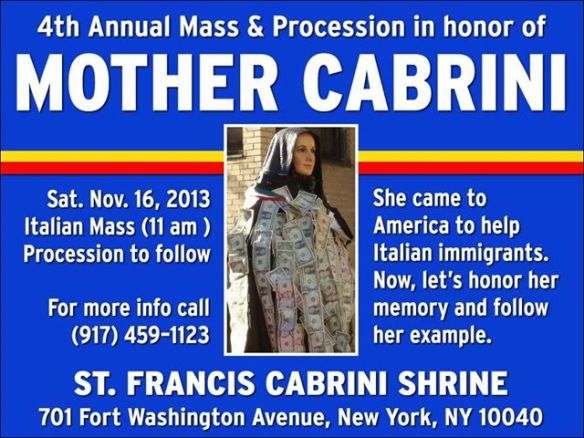
Feast of Mother Cabrini, Patron of Immigrants

1850-1917

Patron: Immigrants

Feast Day: November 13

“We must pray without tiring, for the salvation of mankind does not depend on material success; nor on sciences that cloud the intellect. Neither does it depend on arms and human industries, but on Jesus alone.”

Keywords: immigrants, the poor, orphanages, orphans, displaced persons, the homeless, hospital administration, business, obedience, meditation

Symbols: Sacred Heart of Jesus, Immigrants

The first American citizen to be named a saint, St. Frances Xavier Cabrini never desired to travel to, much less spend her life in her adopted country of the United States of America.  Born Maria Francesca Cabrini in northern Italy, she intended to use her schoolteacher’s degree to work as a missionary in China. Suffering through a smallpox epidemic which killed her parents, she was turned down by two convents she attempted to join.  When she was finally accepted by one, she was sent to a small town to run an orphanage which was eventually closed. Enthralled by the works of Saint Francis Xavier, the Jesuit Missionary, she took his name  and founded an order of nuns, the Missionary Sisters of the Sacred Heart. Many were shocked to see how quickly her new order was approved by the Pope. Instead of granting her wish to continue her namesake’s work in China, Pope Leo XIII told her, “Your China will be the United States.”

At that time 50,000 Italian immigrants lived crammed in a filthy ghetto in New York City. There was no one there to help or intercede for them. Arriving with six other nuns, Mother Cabrini was told to go home by the archbishop of New York. Instead, she moved her nuns into the Italian slums and immediately opened an orphanage. Through her personal tenacity as well as her willingness to live among the poor, Mother Cabrini set an impressive example for those trying to enact social reforms. Gifted with an innate business sense, and due to the great success her order had in caring for the destitute and displaced, Mother Cabrini was able to raise money from all levels of society.  Within a few short years the Missionary Sisters of the Sacred Heart had opened orphanages, schools, hospitals and nurse’s homes throughout the United States, Central America, Argentina, Brazil, France, Spain, England and Italy. She became a United States citizen in 1909.

Though she was a tireless worker and an excellent administrator, Mother Cabrini felt the most important part of her day was the time she spent in mediation. Devoted to the Sacred Heart of Jesus, she felt great strength was to be found in humility, obedience and a quiet atmosphere. In her own case, by following the Pope’s orders at the expense of her personal dreams, she found more success in her mission than she could ever imagine was possible. At the time of her death, she had sixty seven foundations and over thirteen hundred missionaries carrying out her work.

Mother Cabrini is usually depicted in the habit of her order, surrounded by immigrants and school children.

Explanation:

Jesus with the Sacred Heart glowing: Mother Cabrini was especially devoted to meditating on the Sacred Heart of Jesus.

Immigrants: It was her mission to care for the tens of thousands of newly arrived immigrants in the United States.

Novena to Saint Frances Xavier Cabrini

O loving Savior, infinitely generous, seeking only our interest, from your Sacred Heart, came these words of pleading love: “Come to me all you that labor    and are burdened and I will refresh you.” Relying on this promise of your infinite charity, we come to you and in the lowliness of our hearts earnestly beg you to grant us the favor we ask in this novena, (mention your request here) through the intercession of your faithful servant, Saint Frances Xavier Cabrini. Amen.

(Excerpted from the App, “Novena: Praying with the Saints” by Barbara Calamari and Sandra DiPasqua. All images are courtesy of Father Eugene Carrella.)